AI motion sensors range from basic PIR detectors to mmWave presence sensors that can track whether someone remains in a room. My best overall pick is the Aqara Presence Sensor FP400 for its multi-zone spatial automation, while the Aqara FP1E is a simpler mmWave option and the THIRDREALITY Zigbee Motion Sensor 2 Pack suits buyers who want straightforward room coverage. The main tradeoffs are presence detail versus setup complexity, and smart-home integration versus standalone operation. Check which hub and wireless protocol you already use before choosing, since compatibility shapes what automations each sensor can run. Read on for the full comparison and guidance on which type fits your home.

Get privacy and security gear delivered free with Prime
- Fast, free delivery on millions of items
- Prime Video, Amazon Music and more included
- Member-only deals all year
Key Takeaways
- The FP400 offers the most detailed room-level control in this lineup through multi-zone spatial automation, but its Thread and Zigbee support may take more setup than a basic PIR sensor.
- The FP1E and Besisglas use mmWave presence detection, which can detect someone staying still; they suit occupancy automations better than sensors that only react to movement.
- Protocol fit changes the practical value of a sensor: Zigbee picks such as the Aqara P1 and THIRDREALITY models depend on a compatible ecosystem, while Matter Over Thread picks need a suitable Thread network.
- The Eve Motion 3-Pack and Aqara P1 3-Pack focus on multi-room coverage; buying a pack makes sense when you need several detection points, but check each device’s integration needs first.
- The wireless alarm and chime models are standalone-oriented choices; they can serve a simple alerting need, but they do not offer the same smart-home automation approach as the connected sensors.
| Akamatis LITOS v3 mmWave Presence and Light Sensor for Home Assistant |  | Best for Home Assistant Tinkerers | Radar: HLK-LD2401, 24 GHz mmWave | Detection range: Up to 20 ft (6 m) indoors | Ambient light sensor: VEML7700 | VIEW ON AMAZON | See Our Full Breakdown |
| THIRDREALITY Zigbee Motion Sensor 2 Pack |  | Best Value for Zigbee Households | Connectivity: Zigbee | Motion detection range: 20 ft (6 m) | Maximum range: 30 ft | VIEW ON AMAZON | See Our Full Breakdown |
| Meross MS605 Matter Over Thread Presence Sensor |  | Best Outdoor AI Presence Detection | Model: MS605 | Sensors: mmWave, PIR, and light | Connectivity: Matter over Thread | VIEW ON AMAZON | See Our Full Breakdown |
| Eve Motion (Matter) 3-Pack – Smart Motion and Light Sensor |  | Best Multi-Platform Starter Kit | Pack size: 3 sensors | Field of view: 120° | Detection range: Up to 9 m | VIEW ON AMAZON | See Our Full Breakdown |
| meross Presence Sensor MS605, Matter Over Thread, IP67, Battery-Powered |  | Best for Smart Lighting Automation | Model: MS605 | Protocol: Matter over Thread | Sensors: mmWave, PIR, light sensor | VIEW ON AMAZON | See Our Full Breakdown |
| Aqara FP1E Zigbee Presence Sensor with mmWave Radar |  | Best Value Presence Detection | Connectivity: Zigbee 3.0; Matter-over-bridge support | Detection technology: mmWave radar | Field of view: 120°; up to 180° at close range | VIEW ON AMAZON | See Our Full Breakdown |
| Wireless Motion Sensor LED Light – Motion Detector Alarm Chime with 500 FT Range |  | Best No-Hub Entry-Level Alert Kit | Maximum range: 500 feet | Infrared sensor range: 13-16.5 ft | Detection angle: 110 degrees | VIEW ON AMAZON | See Our Full Breakdown |
| Aqara Presence Sensor FP400 – Multi-Zone Spatial Automation, Thread & Zigbee |  | Best Premium / Best for Advanced Automation | Radar technology: 60GHz mmWave | Connectivity: Thread & Zigbee (Matter over Thread) | Detection zones: Multiple custom zones; up to 8 zone occupancy sensors via Thread Border Router | VIEW ON AMAZON | See Our Full Breakdown |
| Besisglas Zigbee Human Presence Sensor with 24 GHz Millimeter-Wave Radar |  | Best Battery-Powered Presence Sensor | Sensor technology: 24 GHz millimeter-wave radar | Maximum range: 7 meters | Power source: 2 AAA alkaline batteries (included) | VIEW ON AMAZON | See Our Full Breakdown |
| Aqara Zigbee 3.0 Motion Sensor P1, 3 Pack | 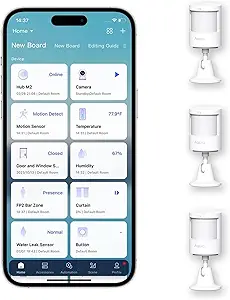 | Best Multi-Room Starter Set | Protocol: Zigbee 3.0 | Quantity: 3 sensors | Battery life: 5 years | VIEW ON AMAZON | See Our Full Breakdown |
| Wireless Motion Sensor Alarm with Remote Control, Indoor PIR Motion Detector |  | Best for Standalone Alerts | Detection technology: PIR infrared | Maximum detection range: 26 ft (8 m) | Modes: Welcome chime, anti-theft siren, no-repeat | VIEW ON AMAZON | See Our Full Breakdown |
| THIRDREALITY Zigbee Motion Sensor, Pet Friendly |  | Best for Alexa Routine Beginners | Connectivity: Zigbee | Hub required: Yes | Motion detection range: Up to 20 ft (6 m) | VIEW ON AMAZON | See Our Full Breakdown |
| Aqara Zigbee 3.0 Motion Sensor P1 (1 Pack) |  | Best for Adjustable Coverage | Protocol: Zigbee 3.0 | Field of view: 170° up to 4 m; 150° up to 7 m | Detection timeout: Configurable from 1 to 200 seconds | VIEW ON AMAZON | See Our Full Breakdown |
| ai motion sensor | Connectivity |
|---|---|
| Akamatis LITOS v3 mmWave Prese | 2.4 GHz Wi-Fi |
| THIRDREALITY Zigbee Motion Sen | Zigbee |
| Meross MS605 Matter Over Threa | Matter over Thread |
| Eve Motion | Thread |
| meross Presence Sensor MS605 | — |
| Aqara FP1E Zigbee Presence Sen | Zigbee 3.0; Matter-over-bridge support |
| Wireless Motion Sensor LED Lig | — |
| Aqara Presence Sensor FP400 | Thread & Zigbee (Matter over Thread) |
| Besisglas Zigbee Human Presenc | — |
| Aqara Zigbee 3.0 Motion Sensor | — |
| Wireless Motion Sensor Alarm w | — |
| THIRDREALITY Zigbee Motion Sen | Zigbee |
| Aqara Zigbee 3.0 Motion Sensor | — |
More Details on Our Top Picks
Akamatis LITOS v3 mmWave Presence and Light Sensor for Home Assistant
This option stands out for buyers who already live inside the Home Assistant ecosystem and want to fine-tune everything themselves. The HLK-LD2401 24 GHz mmWave radar detects both motion and stationary presence up to 20 ft, while the VEML7700 light sensor lets one device drive both occupancy and daylight-based lighting logic — something the THIRDREALITY Zigbee pair simply cannot do, since it only reports basic motion events. Coming pre-flashed with ESPHome on an ESP32-C3 means there is no flashing or soldering, just adoption into your dashboard.
The tradeoff is real, though: this is not a plug-and-play gadget. Compared with the Meross MS605, which works out of the box with Alexa, HomeKit, and SmartThings, the LITOS is useless without a running Home Assistant install, and it is indoor-only.
Pros:- Detects both motion and stationary presence up to 20 ft
- Built-in VEML7700 light sensor enables daylight-aware automations
- External Wi-Fi antenna improves range and connection stability
- Pre-flashed ESPHome removes the usual flashing hassle
Cons:- Requires an existing Home Assistant installation
- Indoor use only, unlike the IP-rated Meross MS605
Best for: Home Assistant users who want full ESPHome-level control over presence and lighting automations
Not ideal for: Alexa- or Google-only households — the sensor does nothing without a Home Assistant server
- Radar:HLK-LD2401, 24 GHz mmWave
- Detection range:Up to 20 ft (6 m) indoors
- Ambient light sensor:VEML7700
- Controller:Seeed XIAO ESP32-C3
- Connectivity:2.4 GHz Wi-Fi
- Firmware:Pre-flashed ESPHome
- Compatibility:Requires Home Assistant
Our verdict“If Home Assistant is the center of your smart home, this is the most hackable presence sensor in the lineup — everyone else should skip it.”
THIRDREALITY Zigbee Motion Sensor 2 Pack
For straightforward motion-triggered lighting, this 2-pack delivers the essentials without mmWave complexity or price. Unlike the AI-driven Meross MS605 or the Akamatis LITOS, these are simple PIR sensors — but that simplicity translates into two years of battery life on cheap AAA cells, no firmware updates, and pairing that takes seconds via automatic discovery. Wide hub support (SmartThings, Hubitat, Homey, Home Assistant, and Echo devices with built-in Zigbee) means they slot into most existing setups without new hardware.
What you give up matters: there is no stationary presence detection, so lights may shut off while you sit still reading. Pet-friendly sensitivity helps with false alarms, but Apple HomeKit and Google Home users need the separately sold MZ1 bridge, which erodes the value argument for those households.
Pros:- Wide compatibility with major Zigbee hubs and Echo devices
- 2-year battery life on standard AAA batteries
- Pet-friendly motion detection reduces false alerts
- Fast, automatic pairing with compatible hubs
Cons:- No stationary presence or mmWave sensing
- HomeKit and Google Home require a separately sold Smart Bridge MZ1
- Indoor use only
Best for: Budget-minded Zigbee users who want reliable, long-battery-life motion triggers for lights and routines
Not ideal for: Anyone who needs stationary presence detection — a sitting person goes invisible to these PIR sensors
- Connectivity:Zigbee
- Motion detection range:20 ft (6 m)
- Maximum range:30 ft
- Battery life:Up to 2 years (typical use)
- Power source:2 AAA batteries per sensor
- Mounting:Wall mount
- Compatibility:Echo (4th Gen/Plus/Studio), Home Assistant, SmartThings, Aeotec, Hubitat, Homey
Our verdict“The cheapest way to add dependable motion automations to a Zigbee home — as long as you don’t need true presence detection.”
Meross MS605 Matter Over Thread Presence Sensor
This MS605 configuration earns its place with an IP67 waterproof rating — the highest in this lineup — paired with genuine AI presence sensing. Stacking mmWave, PIR, and light sensors means it catches both movement and someone sitting perfectly still, closing the exact gap the THIRDREALITY Zigbee sensors leave open. Matter over Thread keeps control local and latency low across HomeKit, Alexa, SmartThings, and Home Assistant, and the foldable, 360° rotatable stand makes aiming it at a driveway or porch far easier than fixed-mount rivals.
Compared with the Eve Motion 3-Pack, which only offers IPX3 splash resistance and no presence intelligence, the MS605 is the clear choice for exposure to weather — but you will need a Thread border router, and Meross recommends a firmware update through its app before direct Alexa control behaves reliably. That update step is an odd friction point on an otherwise polished device.
Pros:- Detects stationary presence using mmWave and adaptive AI
- IP67 rating handles outdoor weather
- Matter over Thread with fully local control
- Customizable detection zones and flexible mount
Cons:- Requires a Matter and Thread-compatible hub
- Firmware update via the Meross app needed for stable Alexa control
Best for: Homeowners who want AI presence detection on a porch, driveway, or garage without weather worries
Not ideal for: Buyers without a Matter/Thread hub — the sensor cannot join third-party platforms without one
- Model:MS605
- Sensors:mmWave, PIR, and light
- Connectivity:Matter over Thread
- Power source:1 CR123A battery (included)
- Battery life:Up to 3 years
- Maximum range:6 m
- Mounting:Wall mount; 90° foldable, 360° rotatable stand
Our verdict“The pick for weather-exposed locations where true AI presence detection still matters, provided you have Thread infrastructure.”
Eve Motion (Matter) 3-Pack – Smart Motion and Light Sensor
Covering a whole floor on day one is where this 3-pack shines. Each sensor pairs motion and brightness sensing across a generous 120° field of view and 9 m range — the longest detection reach in this batch — and works natively with Apple Home, Alexa, Google Home, and SmartThings through Matter and Thread. Unlike Meross, which funnels some functions through its own app, Eve processes 100% locally with no cloud, registration, or tracking, a meaningful privacy edge for cautious buyers.
Compared with the Akamatis LITOS, the Eve works everywhere rather than locking you into Home Assistant — but like the LITOS, it still demands a Thread border router (Apple TV 4K, HomePod mini, Echo 4th gen, or Nest Hub). The IPX3 rating is fine for covered outdoor spots yet falls well short of the Meross MS605’s IP67, and brightness-refinement automations live only in the iOS Eve app.
Pros:- Cross-platform Matter support for all major ecosystems
- Generous 9 m range with 120° field of view
- Fully local processing with no cloud or tracking
- Indoor/outdoor flexibility with IPX3 water resistance
Cons:- Thread border router or hub required
- Full brightness-based automations limited to the Eve iOS app
- Motion notifications only available on selected platforms
Best for: Multi-platform households outfitting several rooms at once who value local, privacy-first processing
Not ideal for: Households without any Thread border router or compatible hub — these sensors will not function standalone
- Pack size:3 sensors
- Field of view:120°
- Detection range:Up to 9 m
- Connectivity:Thread
- Water resistance:IPX3
- Compatibility:Apple Home, Alexa, Google Home, SmartThings
- Power:Battery (wireless)
- Hub requirement:Thread border router required
Our verdict“The easiest way to blanket a home with trustworthy, privacy-focused motion sensing — if a Thread border router is already in your setup.”
meross Presence Sensor MS605, Matter Over Thread, IP67, Battery-Powered
This listing of the MS605 focuses on its core strength: preventing lights from switching off while you’re still in the room. The adaptive AI blends mmWave and PIR data to recognize a person reading, working, or watching TV — exactly where the THIRDREALITY Zigbee sensors fail — and the light sensor lets automations react to actual brightness conditions. With three customizable detection zones in the Meross app, this model makes more sense for focused indoor spaces like a home office or media room than the similar MS605 configuration, letting you ignore a hallway or doorway and watch only the couch.
Everything runs locally over Matter over Thread, so lights respond instantly even without internet, and the CR123A is rated for three years. The catches are familiar: a Thread hub is mandatory, and a pre-setup firmware update via the Meross app is recommended before Alexa direct control runs smoothly.
Pros:- AI static presence detection keeps lights on when you’re motionless
- Local, offline-friendly Matter over Thread control
- Three customizable detection zones via the Meross app
- 3-year battery life with CR123A included
Cons:- Matter/Thread-compatible hub required for platform integration
- Firmware update needed for stable direct Alexa control
Best for: Smart lighting enthusiasts who keep lights on while stationary — office, media room, and bathroom use cases
Not ideal for: Renters or beginners without a Matter/Thread hub and app setup tolerance
- Model:MS605
- Protocol:Matter over Thread
- Sensors:mmWave, PIR, light sensor
- Power source:1x CR123A battery (included)
- Battery life:Up to 3 years
- Maximum range:6 m
- Detection zones:3 customizable zones
- Mounting:Wall/ceiling/corner with 90° foldable, 360° rotatable stand
Our verdict“The most focused pick for presence-aware lighting that never leaves you in the dark, provided you can handle the hub and setup requirements.”
Aqara FP1E Zigbee Presence Sensor with mmWave Radar
Aqara’s FP1E brings true mmWave presence detection to a budget-friendly price point, and that’s the whole story here. Unlike the Aqara Motion Sensor P1, which relies on passive infrared and can’t tell you someone is still in the room, the FP1E’s radar senses stationary people — reading on a couch, working at a desk — up to 6 meters away with a 120° field of view. Its AI-driven interference reduction filters out small pets and adapts sensitivity to your space, which cheaper radar sensors like the Besisglas 24 GHz unit don’t attempt at this level of polish. The tradeoffs are real, though: you must supply your own 5V/1A power adapter (there’s no battery option), an Aqara hub is required, and tinkerers should know Zigbee2MQTT and third-party USB dongles aren’t officially supported.
Pros:- Detects subtle movement and stationary presence where PIR sensors fail
- AI features reduce pet interference and adapt to room conditions
- 200 ms response time enables instant lighting automations
- Flexible ceiling, wall, or corner mounting with included brackets
Cons:- Requires separate Aqara hub and 5V/1A power adapter, adding hidden cost
- Zigbee2MQTT and third-party USB dongles not officially supported
Best for: Smart home hobbyists running HomeKit or Home Assistant who want reliable stationary-presence detection without paying flagship prices
Not ideal for: Buyers who want a standalone, battery-powered sensor — the required hub and wired power make this a poor plug-and-play choice
- Connectivity:Zigbee 3.0; Matter-over-bridge support
- Detection technology:mmWave radar
- Field of view:120°; up to 180° at close range
- Sensing distance:Up to 6 m
- Coverage area:Up to 35 m²
- Response time:200 ms
- Power:5V/1A DC adapter (not included)
- Mounting:Ceiling, wall, or corner
Our verdict“If you need true presence sensing (not just motion) on a budget and already own or will buy an Aqara hub, this is the smartest entry point.”
Wireless Motion Sensor LED Light – Motion Detector Alarm Chime with 500 FT Range
This kit ignores smart home sophistication entirely, and that’s its strength. There’s no hub, no app, no account — the battery-powered sensor talks directly to a plug-in receiver from up to 500 feet away, sounding a chime or a 110 dB siren when motion trips. Compared with every smart option here, like the Aqara FP1E or the Besisglas Zigbee sensor, setup takes minutes instead of an afternoon of hub pairing and automation building. Each receiver handles up to 20 sensors, making it viable for a small shop or classroom doorway monitoring. The downsides follow directly from that simplicity: you get alerts, not data — no occupancy logging, no automations, no AI filtering — and the AAA-powered sensor will need battery swaps. Changing ringtones is reportedly unintuitive, which matters if you plan to reconfigure often.
Pros:- 500 ft range between sensor and receiver covers large properties
- 58 ringtones and 5 volume levels for customization
- Expandable to 20 sensors on a single receiver
- Installs in minutes with included AAA batteries — no hub needed
Cons:- Battery-powered sensor requires periodic replacement
- Ringtone changing procedure is confusing; no smart features or automation support
Best for: Homeowners, small shops, or offices who want an instant audible motion alert with zero smart home infrastructure
Not ideal for: Smart home users — there are no automations, app control, or presence data, only chimes and sirens
- Maximum range:500 feet
- Infrared sensor range:13-16.5 ft
- Detection angle:110 degrees
- Alarm volume:110 dB
- Ringtones:58, with 5 volume levels
- Max sensors per receiver:20
- Power source:2x AAA batteries (included); plug-in receiver
Our verdict“Choose this if you want a dependable, dumb-but-effective alert chime today rather than a presence platform for tomorrow.”
Aqara Presence Sensor FP400 – Multi-Zone Spatial Automation, Thread & Zigbee
The FP400 is the most capable sensor in this lineup, and its 60GHz multi-zone detection is what justifies the premium. Rather than one blanket detection area, it divides a room into custom zones and tracks up to 10 people in real time — so your hallway light, living room scene, and office automation can all trigger from a single device. Its AI background learning sketches room boundaries in under a minute and suppresses false triggers from curtains, something the simpler Aqara FP1E can’t match with its single-zone approach. Dual-protocol Thread and Zigbee support also broadens platform reach beyond what the Zigbee-only Besisglas offers. The fine print matters: you need a recent Aqara hub (M1S, M2, G2H, and G3 owners are out of luck), and full Matter zone features require a Thread Border Router plus up-to-date app versions.
Pros:- Custom multi-zone detection replaces several single-purpose sensors
- AI-assisted setup generates room boundaries and zones in under a minute
- Dual Thread and Zigbee support across Apple Home, Home Assistant, Google Home, Alexa, and SmartThings
- Headcount tracking for up to 10 people enables occupancy-based logic
Cons:- Incompatible with M1S, M2, G2H, and G3 Aqara hubs
- Full Matter zone features require a Thread Border Router and recent app versions
Best for: Advanced smart home builders who want one sensor to drive room-by-room, zone-level automations across multiple platforms
Not ideal for: Owners of older Aqara hubs (M1S, M2, G2H, G3) or anyone wanting battery power — compatibility and wiring constraints rule it out
- Radar technology:60GHz mmWave
- Connectivity:Thread & Zigbee (Matter over Thread)
- Detection zones:Multiple custom zones; up to 8 zone occupancy sensors via Thread Border Router
- Headcount tracking:Up to 10 people
- Field of view:120°
- Max detection range:10×8 m side-mounted; 7×7 m corner; 5-6 m ceiling zone at 3 m height
- Sensitivity levels:3 adjustable levels
- Mounting:Side, corner, or ceiling with magnetic base
Our verdict“If your automations need to know where people are — not just that someone exists — the FP400 is the most capable tool in this roundup.”
Besisglas Zigbee Human Presence Sensor with 24 GHz Millimeter-Wave Radar
Most mmWave presence sensors, including the Aqara FP1E and FP400, need wall power — the Besisglas runs its 24 GHz radar on two AAA batteries rated for up to two years. That single difference changes where you can deploy it: rental shelves, hallways without outlets, detached spaces. It’s also refreshingly hub-agnostic, pairing with Home Assistant, SmartThings, Hubitat, Homey, and even Echo devices with a built-in Zigbee hub, whereas Aqara sensors officially require Aqara’s own hubs. Detection reaches 7 meters and, like any mmWave unit, it catches people sitting still — something a PIR option such as the Aqara P1 simply cannot do. The compromises: no multi-zone intelligence, no AI pet filtering comparable to Aqara’s, a basic wall-mount-only design, and it’s strictly an indoor sensor.
Pros:- Battery-powered with up to 2-year AAA life — no wiring required
- Works across Home Assistant, SmartThings, Hubitat, Homey, and Echo Zigbee hubs
- Detects stationary people up to 7 m away
- Batteries included and ready to deploy out of the box
Cons:- Requires a compatible Zigbee hub
- No multi-zone detection or advanced AI filtering; indoor use only
Best for: Home Assistant or Hubitat users who want cordless mmWave presence detection without being locked into one brand’s hub
Not ideal for: Aqara ecosystem users or anyone wanting zone-level automation and AI filtering — this is a simpler, single-purpose sensor
- Sensor technology:24 GHz millimeter-wave radar
- Maximum range:7 meters
- Power source:2 AAA alkaline batteries (included)
- Battery life:Up to 2 years
- Compatibility:Home Assistant, SmartThings, Aeotec, Homey, Hubitat, Echo devices with built-in Zigbee hub
- Mounting type:Wall mount
- Temperature range:-10°C to 65°C
Our verdict“This is the pick when you need radar-grade presence sensing somewhere an outlet can’t reach and your hub isn’t Aqara’s.”
Aqara Zigbee 3.0 Motion Sensor P1, 3 Pack
The P1 3-pack wins on coverage-per-dollar and longevity rather than raw sensing intelligence. These are PIR motion sensors, not presence sensors — they detect movement, not someone sitting still — so they complement rather than compete with the Aqara FP1E, which handles stationary occupancy. What the P1 offers instead is a 5-year battery life per sensor, a rarity that means you can mount three of them and forget about maintenance for years. The configurable 1–200 second timeout and three sensitivity levels give real tuning control, and the flexible 360° stand makes aiming the 170° field of view simple. Compared with the THIRDREALITY Zigbee Motion Sensor 2 Pack, the P1’s broader ecosystem reach — HomeKit, Alexa, IFTTT, Home Assistant — and longer battery life are the differentiators. Just know the hub lock-in: Aqara hubs only, and no light-sensitivity function under HomeKit or Alexa.
Pros:- Exceptional 5-year battery life, even in low temperatures
- Adjustable 1-200 second timeout and 3 sensitivity levels
- Wide 170° field of view with flexible 360° aiming stand
- Works with HomeKit, Alexa, IFTTT, and Home Assistant
Cons:- Requires an Aqara Zigbee 3.0 hub; incompatible with other Zigbee hubs and Zigbee2MQTT
- No light sensitivity function in HomeKit and Alexa
Best for: Households outfitting multiple rooms with low-maintenance motion-triggered lighting and alerts in one purchase
Not ideal for: Anyone needing true presence detection for stationary occupants — PIR technology can’t see a person who isn’t moving
- Protocol:Zigbee 3.0
- Quantity:3 sensors
- Battery life:5 years
- Detection timeout:1-200 seconds (configurable)
- Field of view:170° up to 4 m; 150° up to 7 m
- Sensitivity levels:High, medium, low
- Compatibility:Aqara Home, HomeKit, Alexa, IFTTT, Home Assistant
Our verdict“For whole-home motion automation on a set-and-forget basis, this trio delivers the best coverage and battery economics in the roundup.”
Wireless Motion Sensor Alarm with Remote Control, Indoor PIR Motion Detector
The M120 suits buyers who want a motion-triggered warning without building a smart-home setup. Its PIR detection reaches up to 26 feet, and the stated pet and airflow filtering aims to reduce nuisance alerts. Choose among a welcome chime, anti-theft siren, and no-repeat mode, then adjust the volume or switch modes with the included remote. That makes it more self-contained than the THIRDREALITY Zigbee Motion Sensor, which needs a compatible hub to trigger Alexa routines and other automations. The tradeoff is that the M120 is an indoor alarm rather than a connected sensor: the supplied details describe no smart-home integrations, and its mounting is limited to a pole mount. Battery or USB power gives placement flexibility, though it remains an indoor-only option.
Pros:- Three modes cover entry chimes, siren alerts, and no-repeat operation
- Remote control allows arming, disarming, and mode changes
- Battery or USB 5V power offers placement flexibility
- Pet and airflow filtering is intended to reduce false alerts
Cons:- Indoor use only
- Pole-mount mounting type limits placement options
- Product details do not specify smart-home app or hub integrations
Best for: People who want a quick-to-install indoor chime or siren with remote arming and no hub requirement
Not ideal for: Smart-home users who need app alerts, connected automations, or wall and corner mounting options
- Detection technology:PIR infrared
- Maximum detection range:26 ft (8 m)
- Modes:Welcome chime, anti-theft siren, no-repeat
- Power:Battery or USB 5V
- Volume:4 adjustable levels
- Mounting type:Pole mount
- Dimensions:4.33 × 2.36 × 2.83 in
Our verdict“Choose the M120 for straightforward indoor chimes or siren alerts with remote control and no hub setup.”
THIRDREALITY Zigbee Motion Sensor, Pet Friendly
For someone starting with motion-triggered smart-home actions, this sensor offers a relatively simple bridge from detection to Alexa routines, notifications, and smart-light control. It detects motion up to 20 feet away and uses two AAA batteries, with typical life stated at up to two years. Its main hurdle is the compatible Zigbee hub requirement: an Echo device works only if it has a built-in Zigbee hub. The M120 can sound an alarm without a hub, but it does not offer the same described smart routines; the THIRDREALITY is the better fit when connected actions matter more than a built-in siren. It also supports a wider range of named Zigbee platforms, though Apple HomeKit and Google Home require a separate Smart Bridge MZ1. Buyers should check hub compatibility before choosing it.
Pros:- Supports Alexa routines, notifications, and smart-light control
- Compatible with several named Zigbee platforms, including SmartThings and Home Assistant
- Motion detection reaches up to 20 feet
- Typical battery life is stated at up to two years
Cons:- Requires a compatible Zigbee hub
- Indoor use only
- Apple HomeKit and Google Home need a separately sold Smart Bridge MZ1
Best for: Alexa users with a compatible Zigbee hub who want motion to trigger lights, alerts, or routines
Not ideal for: Buyers without a compatible hub, or those seeking direct Apple HomeKit or Google Home support without an extra bridge
- Connectivity:Zigbee
- Hub required:Yes
- Motion detection range:Up to 20 ft (6 m)
- Power:2 AAA batteries
- Typical battery life:Up to 2 years
- Use:Indoor only
- Additional bridge for Apple HomeKit and Google Home:Smart Bridge MZ1, sold separately
Our verdict“Pick this sensor if you already have a compatible Zigbee hub and want a straightforward way to add motion to Alexa routines.”
Aqara Zigbee 3.0 Motion Sensor P1 (1 Pack)
The P1 gives buyers more control over where and how motion is detected than the fixed-range approach of the THIRDREALITY Zigbee Motion Sensor. Its field of view spans 170° up to 4 meters and 150° up to 7 meters; sensitivity has three levels, and the detection timeout can be set from 1 to 200 seconds. Those adjustments can help tailor lighting or alert automations to a room’s layout and traffic. Aqara also states a five-year battery life, which may reduce battery changes compared with the THIRDREALITY’s stated typical life of up to two years. The tradeoff is ecosystem lock-in: this P1 requires an Aqara Zigbee 3.0 hub and is not compatible with other Zigbee hubs. Some platform features are limited, and third-party USB dongles are not officially supported.
Pros:- Configurable detection timeout from 1 to 200 seconds
- Three sensitivity levels and adjustable coverage angle
- Stated battery life of up to five years
- Supports Aqara Home, HomeKit, Alexa, IFTTT, and Home Assistant
Cons:- Requires an Aqara Zigbee 3.0 hub and does not work with other Zigbee hubs
- No light-sensitivity function in HomeKit and Alexa
- Zigbee2MQTT and third-party USB dongles are not officially supported
Best for: Aqara smart-home users who want to tune detection angle, sensitivity, and reset timing for a specific room
Not ideal for: People who already use a non-Aqara Zigbee hub or need light-sensitivity controls through HomeKit or Alexa
- Protocol:Zigbee 3.0
- Field of view:170° up to 4 m; 150° up to 7 m
- Detection timeout:Configurable from 1 to 200 seconds
- Sensitivity levels:High, medium, low
- Battery life:Up to 5 years
- Stand:Flexible 360°
- Maximum hub distance:10 m
- Dimensions:1.46 × 2.17 × 2.76 in
Our verdict“Choose the Aqara P1 if you have an Aqara hub and want more control over detection coverage and timing than a basic motion sensor provides.”

How We Picked
I ranked these products by how well their detection method serves common automation needs: basic movement, continued room presence, or more precise spatial control. I also weighed smart-home protocol support, expected setup demands, placement flexibility, and whether the product is designed for connected automations or standalone alerts. A sensor with advanced detection can be a poor fit if it requires a hub or network the buyer does not have.
The FP400 leads for spatial control, while the FP1E and LITOS v3 offer presence-focused detection for buyers who value room occupancy. Zigbee PIR options rank well for simpler movement triggers and multi-room coverage, with bundles standing out when several rooms need sensors. Standalone alarms and chimes rank lower for smart-home use because their focus is local alerting rather than connected automation. Product names and stated capabilities guide this comparison; exact ecosystem support and feature availability can depend on the buyer’s hub and setup.
Factors to Consider When Choosing Ai Motion Sensors
Choosing an AI motion sensor starts with deciding what event your automation should detect. A light that turns on when someone enters needs a different sensor from a room that should stay active while someone sits still. These broader factors can help narrow the options before you compare individual models.
Movement Detection or Ongoing Presence?
PIR sensors detect changes in infrared energy, so they are often a natural match for entry-triggered lights and simple motion alerts. A person sitting quietly may stop triggering a PIR sensor, which can switch an automation off too soon. mmWave radar can detect more subtle presence, making it better suited to occupancy routines that should remain active while someone rests or works. That added sensitivity can also create false triggers if the sensor sees motion beyond the intended zone. Think about the event you need to detect before paying for more detailed sensing. For many hallways, a basic movement trigger is enough.
Check the Hub and Wireless Protocol First
Zigbee, Thread, and Matter describe different parts of a smart-home connection, and they do not automatically guarantee that a sensor will work with every hub. Check whether your setup has the required coordinator, Thread border router, or compatible controller before buying. Matter support can simplify connections across participating platforms, but it does not mean every advanced feature appears in every app. A sensor advertised for Home Assistant or a particular ecosystem may rely on specific integrations. Common mistakes include confusing Matter with Thread or assuming a phone alone can connect every device. Confirm the connection path for the automations you want to use.
Plan for Sensor Placement and Detection Zones
Placement can matter as much as sensor type: walls, furniture, doors, and sensor height all affect what a device can detect. Before mounting, decide which room or zone should trigger the automation and which adjacent spaces should stay out of range. Multi-zone sensors can offer finer control, but only if their zones can be configured in the system you use. mmWave units may need adjustment to avoid detecting movement through an open doorway or beyond a wall. Test likely positions temporarily where possible, then tune sensitivity and boundaries. A sensor aimed at the whole room may cause lights or alerts to react in areas you did not intend.
Compare Battery Life, Power, and Upkeep
Battery-powered sensors are easier to place because they do not need a nearby outlet, but batteries add an ongoing maintenance task. The listed product details do not give a directly comparable battery-life figure across all 13 options, so check the manufacturer’s specifications for the chosen model. If a sensor is difficult to reach, battery status reporting and replacement access should influence where you install it. Wired or plug-in devices avoid routine battery changes but can limit placement. Multi-sensor packs multiply the number of devices to maintain. Plan for the whole setup rather than judging upkeep from a single sensor.
Choose Between Automation and Standalone Alerts
Smart-home sensors are built to trigger routines, such as lighting, occupancy states, or notifications through a connected platform. Standalone alarm and chime devices focus on local alerts and can make sense when a simple door or movement warning is the main goal. Do not assume a standalone detector can join a Zigbee, Matter, or Thread automation just because it uses wireless communication. Likewise, a connected sensor may need a hub and configuration before it can act as a useful alert. Decide whether alerts should reach a phone, sound locally, or control other devices. That choice can narrow the category faster than a feature list.
Buy for the Number of Rooms You Need to Cover
Multi-packs are useful when several rooms need similar triggers, as with bedroom, hallway, and utility-room lighting. They may be less convenient if one room needs presence detection while another only needs basic motion. Avoid buying a bundle until you have mapped where each sensor will go and checked that its protocol works in those locations. More sensors also mean more batteries, devices to pair, and settings to manage. A single sensor is a sensible starting point when you are still learning how your automations behave. Expand after confirming that the detection type and placement suit your routine.
Frequently Asked Questions
Will a PIR motion sensor keep lights on while I sit still?
Not reliably in every room. PIR sensors respond to changes in infrared energy, so limited movement can leave a seated person undetected. That may cause a motion-based light routine to switch off even though the room is occupied. A mmWave presence sensor is a better match when still occupancy matters, such as at a desk or while watching television. You can also use a longer timeout, though that may leave lights on after you leave.
Do I need a hub to use a Matter Over Thread presence sensor?
You generally need a compatible Thread network and Matter controller for Matter Over Thread devices to join a smart home. A Thread border router connects the Thread network to the rest of the home setup, while a compatible controller manages Matter devices. Exact requirements vary by platform, so check both the sensor’s support information and your hub’s capabilities. Matter support alone does not mean the sensor connects directly to a phone or Wi-Fi router. Also check whether the features you want are available in your chosen app.
Should I choose mmWave or Zigbee PIR for a bedroom?
Choose based on whether you need still-presence detection. mmWave is suited to keeping an occupancy routine active while someone lies still, but sensitivity and placement may need tuning to prevent unwanted triggers. Zigbee PIR is a simpler choice for detecting entry and movement, such as turning on a light when you walk in. Your existing hub also matters: a compatible Zigbee network may make PIR setup easier, while a presence sensor may require its own integration. If you are unsure, start with the behavior you want the room to have rather than the label on the sensor.
Can I use one sensor to cover several rooms?
Usually, one sensor is best assigned to a defined area. Detection range and boundaries depend on the model, mounting position, walls, and room layout. A sensor that reaches through a doorway may trigger a routine in the wrong room or miss part of the intended space. Multi-zone features can divide coverage where supported, but they still require careful setup and suitable placement. For dependable room-by-room lighting, separate sensors often give clearer control than trying to stretch one sensor across multiple rooms.
Are standalone wireless motion alarms suitable for smart-home routines?
Only if the product explicitly supports your smart-home platform and protocol. Wireless transmission by itself does not mean a detector can join Zigbee, Thread, or Matter automations. Standalone alarms and chimes can be useful when the goal is a local sound or alert, with less emphasis on integration. If you want motion to switch on lights or update an occupancy routine, verify hub compatibility and supported events before choosing. This distinction helps avoid buying an alert device when you need an automation sensor.
Conclusion
For most connected homes, I recommend the Aqara Presence Sensor FP400 as the best overall pick because its multi-zone spatial automation offers the most detailed room control in this lineup. The THIRDREALITY Zigbee Motion Sensor 2 Pack is my best value fit for buyers who need straightforward motion triggers in more than one room and already have compatible Zigbee support. For a premium presence-focused setup, consider the Akamatis LITOS v3 if its Home Assistant orientation matches your system; the Aqara FP1E is a more approachable mmWave alternative. Beginners who only need basic motion detection can start with a single Aqara P1 or THIRDREALITY sensor, provided their hub supports it. For local chimes or alarms without a smart-home-first requirement, the standalone wireless options address a different need. Match the sensor to your hub and the behavior you want before deciding.
Halloween Picks
halloween
As an affiliate, we earn on qualifying purchases.