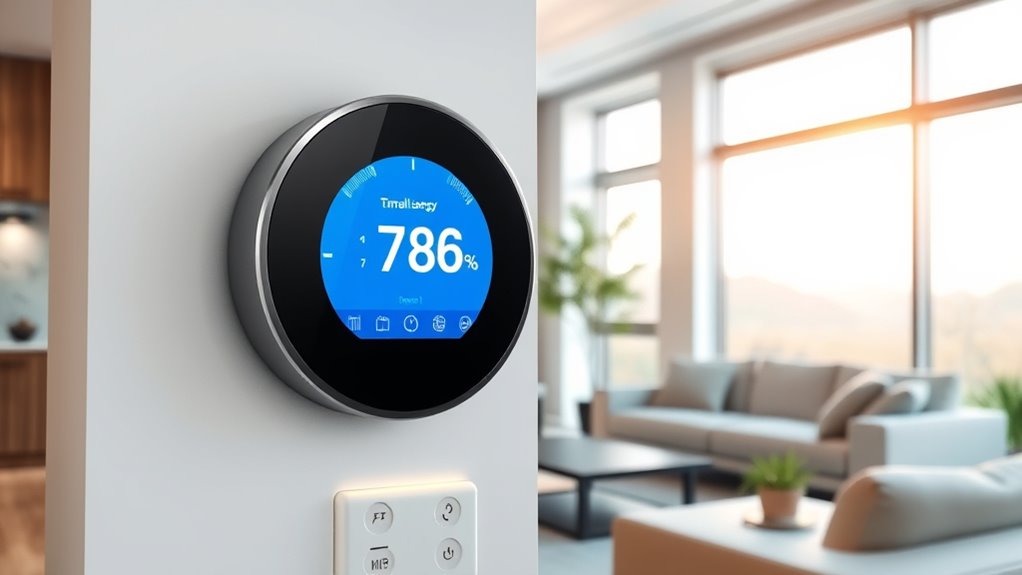

AI thermostats use schedules, occupancy cues, sensors, or adaptive controls to help manage home comfort with less manual adjustment. I’d put the ecobee Smart Thermostat Premium first for its broad smart home features and included SmartSensor, while the Google Nest Learning Thermostat (4th Gen) stands out for adaptive scheduling and the Sensi Lite for straightforward essentials. The main tradeoffs are how much automation you want, whether your heating and cooling system is compatible, and how much you value room-by-room sensing or a polished interface. Some models focus on learning routines, while others offer smart control with simpler setup and fewer extras. Read on for the full comparison and guidance on choosing the right thermostat for your home.

Get privacy and security gear delivered free — and shop member deals
- Fast, free delivery on millions of items
- Access to Prime Big Deal Days deals on October 6–7
- Prime Video, Amazon Music and more included
Key Takeaways
- ecobee Premium leads on breadth: Its SmartSensor and voice assistant support make it the most rounded fit for homes that want more than remote temperature control.
- Nest Learning models favor automation: The 4th Gen is the stronger Nest pick for adaptive control, while the 3rd Gen remains a simpler route into learning schedules.
- Low complexity has value: Amazon Smart Thermostat and Sensi Lite suit buyers who want app-based scheduling without paying attention to an extensive feature set.
- Room comfort depends on sensing: A thermostat in a hallway may not reflect bedroom or living-room conditions; models with separate sensors can address that gap.
- Compatibility sets the shortlist: Wiring, HVAC type, and smart home platform support matter more than AI claims, so check those before comparing automation features.
| ecobee Smart Thermostat Premium with Wi-Fi, Siri and Alexa, and SmartSensor |  | Best for Whole-Home Comfort | Connectivity: Wi-Fi | Voice assistants: Siri and Alexa | Included sensor: SmartSensor | VIEW ON AMAZON | See Our Full Breakdown |
| Google Nest Learning Thermostat Pro Edition (4th Gen, 2024) with Temperature Sensor – Polished Silver |  | Best for Complex HVAC Systems | Generation: 4th Gen (2024) | Color: Polished Silver | Connectivity: Wi-Fi and Bluetooth | VIEW ON AMAZON | See Our Full Breakdown |
| Honeywell Home RTH9600WF Smart Color Thermostat |  | Best for On-Device Controls | Model: RTH9600WF | Connectivity: Wi-Fi | Display: Color touchscreen | VIEW ON AMAZON | See Our Full Breakdown |
| Google Nest Thermostat, Smart Wi-Fi Thermostat, Charcoal |  | Best for Simple Scheduling | Color: Charcoal | Connectivity: Wi-Fi (2.4 GHz and 5 GHz) and Bluetooth Low Energy | Energy certification: ENERGY STAR | VIEW ON AMAZON | See Our Full Breakdown |
| Meross Matter Smart Thermostat for Home, Programmable WiFi Thermostat |  | Best for Matter Smart Homes | Connectivity: Matter and Wi-Fi | Smart home compatibility: Apple Home, Amazon Alexa, Google Home, Home Assistant, and Samsung SmartThings | HVAC support: 24V heat pump, air conditioner, furnace, boiler, dehumidifier, and humidifier | VIEW ON AMAZON | See Our Full Breakdown |
| Sensi Touch 2 Smart Thermostat |  | Best for Guided DIY Installation | Model: ST76 | Connectivity: Wi-Fi and Bluetooth | Smart assistant compatibility: Alexa | VIEW ON AMAZON | See Our Full Breakdown |
| Aqara Smart Thermostat W200 with Apple Adaptive Temperature |  | Best for Multi-Platform Smart Homes | Display: 4-inch full-color touchscreen | HVAC compatibility: Works with about 85% of HVAC systems | Connectivity: Dual-band Wi-Fi, Matter 1.4, Zigbee, and Thread | VIEW ON AMAZON | See Our Full Breakdown |
| Google Nest Learning Thermostat (3rd Gen) – Stainless Steel |  | Best for Learning Your Routine | Model: Learning Thermostat 3rd Gen | Finish: Stainless Steel | Connectivity: Wi-Fi | VIEW ON AMAZON | See Our Full Breakdown |
| Amazon Smart Thermostat |  | Best for Alexa Households | C-wire: Required | Smart-home compatibility: Alexa and Ring | Control methods: Alexa app, schedules, and compatible Alexa devices | VIEW ON AMAZON | See Our Full Breakdown |
| ecobee Smart Thermostat Essential, Wi-Fi Thermostat, Energy Star Certified |  | Best for Cross-Platform Scheduling | Connectivity: Wi-Fi | Display: Color touchscreen | System compatibility: Works with about 85% of systems; supports many 24 VAC HVAC systems | VIEW ON AMAZON | See Our Full Breakdown |
| Google Nest Learning Thermostat (4th Gen) with Nest Temperature Sensor (2nd Gen), Obsidian |  | Best for Room-to-Room Learning | Model: Google Nest Learning Thermostat, 4th generation | Included sensor: Nest Temperature Sensor, 2nd generation | System compatibility: Most 24V heating and cooling systems | VIEW ON AMAZON | See Our Full Breakdown |
| Sensi Lite Smart Wi-Fi Thermostat, ST25 | 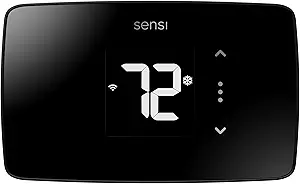 | Best for Straightforward App Control | Model: ST25 | Connectivity: Wi-Fi (2.4 GHz) | Compatible systems: Air conditioner, boiler, furnace, and heat pump | VIEW ON AMAZON | See Our Full Breakdown |
| ecobee Smart Thermostat Enhanced |  | Best for Occupancy-Based Control | Connectivity: Wi-Fi | HVAC compatibility: Compatible with 90% of HVAC systems | Smart home compatibility: Amazon Alexa, Google Assistant, Apple HomeKit, and SmartThings | VIEW ON AMAZON | See Our Full Breakdown |
| Sensi ST55 Wi-Fi Smart Thermostat |  | Best for Traditional Thermostat Replacement | Model: ST55 | Connectivity: Wi-Fi | Voice assistant compatibility: Amazon Alexa | VIEW ON AMAZON | See Our Full Breakdown |
| Honeywell Home T5 Smart Wi-Fi Thermostat |  | Best for Geofenced Weekly Scheduling | Connectivity: Wi-Fi | Scheduling: 7-day flexible scheduling | Temperature control: Geofencing and automatic Home/Away mode | VIEW ON AMAZON | See Our Full Breakdown |
| ai thermostat | Connectivity |
|---|---|
| ecobee Smart Thermostat Premiu | Wi-Fi |
| Google Nest Learning Thermosta | Wi-Fi and Bluetooth |
| Honeywell Home RTH9600WF Smart | Wi-Fi |
| Google Nest Thermostat | Wi-Fi (2.4 GHz and 5 GHz) and Bluetooth Low Energy |
| Meross Matter Smart Thermostat | Matter and Wi-Fi |
| Sensi Touch 2 Smart Thermostat | Wi-Fi and Bluetooth |
| Aqara Smart Thermostat W200 wi | Dual-band Wi-Fi, Matter 1.4, Zigbee, and Thread |
| Google Nest Learning Thermosta | Wi-Fi |
| Amazon Smart Thermostat | — |
| ecobee Smart Thermostat Essent | Wi-Fi |
| Google Nest Learning Thermosta | — |
| Sensi Lite Smart Wi-Fi Thermos | Wi-Fi (2.4 GHz) |
| ecobee Smart Thermostat Enhanc | Wi-Fi |
| Sensi ST55 Wi-Fi Smart Thermos | Wi-Fi |
| Honeywell Home T5 Smart Wi-Fi | Wi-Fi |
More Details on Our Top Picks
ecobee Smart Thermostat Premium with Wi-Fi, Siri and Alexa, and SmartSensor
The ecobee Smart Thermostat Premium is the strongest fit here for households that want room-level comfort as well as schedule automation. Its included SmartSensor can help account for occupancy and temperature in another room, while the built-in air quality monitor adds information the Google Nest Thermostat does not provide. The Power Extender Kit also gives it a practical installation advantage in some homes without a C-wire. That breadth brings more setup and connected features to manage, and Siri control requires an Apple home hub. Some security features also depend on an ecobee subscription. Choose it over the simpler Nest if sensors and air quality matter; skip it if you only need app-based scheduling.
Pros:- Included SmartSensor supports room-level comfort and occupancy-aware adjustments
- Built-in air quality monitoring provides alerts and filter reminders
- Power Extender Kit supports installation in some homes without a C-wire
- Supports Siri and Alexa voice control
Cons:- Siri requires an Apple home hub
- Some security features require an ecobee Smart Security subscription
- Its broader feature set may be unnecessary for homes needing only remote scheduling
Best for: Households with rooms that heat or cool unevenly and buyers who want occupancy sensing, air quality information, and voice features together
Not ideal for: Buyers seeking a simple schedule-and-app thermostat or Siri users without an Apple home hub
- Connectivity:Wi-Fi
- Voice assistants:Siri and Alexa
- Included sensor:SmartSensor
- HVAC compatibility:Compatible with 95% of HVAC systems
- Installation:Power Extender Kit included for homes without a C-wire
- Warranty:3 years
- Certification:ENERGY STAR
Our verdict“Pick the ecobee Premium if room-by-room comfort and air quality features matter more to you than a simpler thermostat setup.”
Google Nest Learning Thermostat Pro Edition (4th Gen, 2024) with Temperature Sensor – Polished Silver
For a home with a heat pump, geothermal equipment, or other involved 24V setup, the Nest Learning Thermostat Pro Edition puts professional installation and adaptive calibration at the center of its appeal. Its included Nest Temperature Sensor adds room-based control, much like the ecobee Premium’s SmartSensor, while the Pro Edition is specifically positioned for certified installer integration. That makes it a better match for buyers who want an HVAC professional to configure the system than for those planning a straightforward DIY replacement. The broad compatibility is useful, but it does not erase the added installation burden. Compared with the standard Google Nest Thermostat, this model targets more complex equipment and a more supported setup.
Pros:- Professional installation focus suits complex HVAC configurations
- Included temperature sensor supports room-based control
- Listed compatibility includes heat pumps, radiant, and geothermal systems
- Adaptive calibration and eco features are designed to support energy efficiency
Cons:- Requires professional installation
- Professional setup adds to the overall purchase burden
- Its specialized installation focus may be unnecessary for simpler systems
Best for: Homeowners with complex 24V, geothermal, heat pump, or radiant systems who plan to use a certified installer
Not ideal for: DIY buyers replacing a basic thermostat who want a self-install option and a simpler setup
- Generation:4th Gen (2024)
- Color:Polished Silver
- Connectivity:Wi-Fi and Bluetooth
- Display:LCD
- Control method:App and voice (Alexa or Google Home)
- Mounting:Wall mount
- Compatibility:24V gas, electric, oil, heat pump, radiant, and geothermal systems
- Battery:1 nonstandard battery required
Our verdict“Choose the Pro Edition when your HVAC system is complex enough to justify installer-led setup and room sensing.”
Honeywell Home RTH9600WF Smart Color Thermostat
The Honeywell Home RTH9600WF suits buyers who want thermostat settings and comfort information visible on the wall, thanks to its customizable color touchscreen. Its smart response technology learns heating and cooling cycle times, which can help a schedule feel less abrupt than a basic timed setting. Compared with the Google Nest Thermostat, Honeywell emphasizes a configurable on-device display rather than presence-based adjustments when you leave. It also supports several voice assistants. The key constraint is wiring: a C-wire is required, and electric baseboard systems are incompatible. That makes it a sensible choice for compatible forced-air or hydronic systems with the right wiring, but a poor fit for buyers uncertain about either.
Pros:- Customizable color touchscreen displays controls and comfort information on the thermostat
- Smart response technology learns heating and cooling cycle times
- Remote control works through an app and supported voice assistants
- ENERGY STAR certified
Cons:- Requires a C-wire and may need an additional power adapter if one is absent
- Not compatible with 120–240V electric baseboard heat
- Lacks the included room sensor provided with the ecobee Premium and Nest Pro Edition
Best for: Homeowners with compatible forced-air, hot-water, steam, or heat-pump systems who want a readable, customizable wall display
Not ideal for: Homes with electric baseboard heat or buyers whose wiring lacks a C-wire and who do not want to add an adapter
- Model:RTH9600WF
- Connectivity:Wi-Fi
- Display:Color touchscreen
- Compatibility:Forced air, hot water, steam, and heat pumps with electric backup
- Incompatibility:Electric baseboard heat (120–240V)
- Power requirement:C-wire required
- Voice assistants:Amazon Alexa, Google Assistant, and Microsoft Cortana
- Certification:ENERGY STAR
Our verdict“Choose this Honeywell if you want a configurable touchscreen and your system has compatible wiring and HVAC equipment.”
Google Nest Thermostat, Smart Wi-Fi Thermostat, Charcoal
The Google Nest Thermostat is a straightforward choice for buyers who mainly want app scheduling, remote temperature changes, and automatic adjustments when the home is empty. It can suggest schedule changes and send HVAC maintenance alerts, giving it more guidance than the basic controls on a conventional thermostat. Compared with the Nest Learning Thermostat Pro Edition, this model is aimed at everyday setup rather than installer-led configuration for complex systems; compared with the ecobee Premium, it has no included room sensor or air quality monitor. Its Google Home app control and broad Wi-Fi support keep the experience centered on Google’s ecosystem. Some systems still need a C-wire or power accessory, and voice control requires a compatible device.
Pros:- Google Home app supports remote temperature control
- Can adjust heating or cooling when occupants leave
- Suggests schedule changes that may help save energy
- Provides HVAC alerts and maintenance reminders
Cons:- Some systems require a C-wire or compatible power accessory
- Voice control needs a compatible smart device
- Does not include room sensing like the ecobee Premium or Nest Pro Edition
Best for: Google Home households that want remote control, schedule suggestions, and away adjustments for a compatible HVAC system
Not ideal for: Buyers who need an included room sensor, built-in air quality monitoring, or compatibility with a system requiring features beyond its supported setup
- Color:Charcoal
- Connectivity:Wi-Fi (2.4 GHz and 5 GHz) and Bluetooth Low Energy
- Energy certification:ENERGY STAR
- App control:Google Home app for Android and iPhone
- Voice assistant compatibility:Google Assistant and Matter-certified voice assistants
- C-wire requirement:Not required in most homes; required for some systems
Our verdict“Pick the Google Nest Thermostat for uncomplicated Google Home scheduling and away adjustments on a compatible system.”
Meross Matter Smart Thermostat for Home, Programmable WiFi Thermostat
The Meross Matter Smart Thermostat stands out for buyers who want one thermostat to work across several smart home platforms, including Apple Home, Alexa, Google Home, Home Assistant, and SmartThings. Matter support and local control make it a more flexible platform fit than the Google Nest Thermostat, whose controls center on Google Home. Its 24/7 scheduling, app monitoring, and system alerts cover the everyday automation needs of a programmable thermostat, while a touch interface keeps basic changes available at the wall. The tradeoff is a narrower equipment boundary: it supports 24V systems but not electric baseboard, millivolt, or two-wire setups. Some wiring configurations also need a C-wire that is not included, so check system wiring before choosing it.
Pros:- Matter compatibility spans Apple Home, Alexa, Google Home, Home Assistant, and SmartThings
- Local control supports use across platforms
- Flexible 24/7 scheduling and energy tracking support routine management
- Offers app, voice, and touch controls
Cons:- Incompatible with 110V/120V/240V electric baseboard heaters, millivolt thermostats, and two-wire systems
- Some wiring configurations require a C-wire that is not included
- Listed HVAC support is limited to 24V systems
Best for: Smart home owners using multiple platforms who have a compatible 24V HVAC system and want Matter-based control
Not ideal for: Homes with high-voltage baseboard heat, millivolt thermostats, two-wire systems, or wiring that needs an unprovided C-wire
- Connectivity:Matter and Wi-Fi
- Smart home compatibility:Apple Home, Amazon Alexa, Google Home, Home Assistant, and Samsung SmartThings
- HVAC support:24V heat pump, air conditioner, furnace, boiler, dehumidifier, and humidifier
- Incompatible systems:110V/120V/240V electric baseboard heaters, millivolt thermostats, and two-wire systems
- Voltage:24V
- Display:LED
- Control methods:App, voice, and touch
- Mounting:Wall mount
- Color and shape:White, square
Our verdict“Choose Meross if you want Matter flexibility across smart home platforms and have compatible 24V wiring.”
Sensi Touch 2 Smart Thermostat
The Sensi Touch 2 suits homeowners who want app-guided setup and useful HVAC reminders without making their thermostat the center of a larger smart-home system. Its Bluetooth-assisted installation can make setup more approachable, while filter alerts and usage reports give owners practical prompts for maintaining their system. It is also ENERGY STAR certified, and Sensi cites potential HVAC energy savings of up to 23%; actual results depend on the home and usage. Compared with the Amazon Smart Thermostat, Sensi adds support for separate room sensors to help address uneven temperatures. The tradeoff is that those sensors are sold separately, and installation requires a C-wire. I’d choose it for straightforward setup and maintenance guidance, but skip it if your wiring lacks a C-wire and you don’t want to add one.
Pros:- Guided app installation with Bluetooth support
- Filter reminders and HVAC usage reports
- Supports Sensi Room Sensors for balancing temperatures across rooms
- ENERGY STAR certified
Cons:- Requires a C-wire
- Room sensors are sold separately
- Claimed energy savings depend on the home and how the thermostat is used
Best for: Homeowners with a C-wire who want guided DIY setup, maintenance reminders, and the option to add room sensors.
Not ideal for: Renters or owners whose HVAC wiring lacks a C-wire, especially if they want room sensing without buying separate accessories.
- Model:ST76
- Connectivity:Wi-Fi and Bluetooth
- Smart assistant compatibility:Alexa
- Room sensor support:Sensi Room Sensors; sold separately
- Certification:ENERGY STAR
- Wiring requirement:C-wire required
Our verdict“Choose the Sensi Touch 2 if you have a C-wire and want guided setup with maintenance tools and optional room sensing.”
Aqara Smart Thermostat W200 with Apple Adaptive Temperature
The Aqara W200 is the most ambitious smart-home hub in this group: alongside thermostat control, it includes a Zigbee hub, Matter controller, and Thread border router. Its 4-inch touchscreen and mmWave presence detection give it more room-control and automation potential than the simpler Amazon Smart Thermostat, which centers on Alexa routines. Matter support also makes the W200 a flexible fit for homes using Apple Home, Google Home, Alexa, or SmartThings. That flexibility comes with setup dependencies: it works with about 85% of HVAC systems, the C-wire adapter is sold separately, and Apple Adaptive Temperature needs compatible Apple devices and a home hub. I’d pick it for a connected home where those standards and automations will be used; its extra hardware is less compelling for someone who only wants basic scheduling.
Pros:- Matter support across Apple Home, Google Home, Alexa, and SmartThings
- Built-in Zigbee hub, Matter controller, and Thread border router
- mmWave presence detection can support automations
- 4-inch color touchscreen
Cons:- C-wire adapter is sold separately
- HVAC compatibility covers about 85% of systems, so buyers need to check their setup
- Some Apple features require compatible devices and a home hub
Best for: Smart-home owners who use multiple ecosystems and want a thermostat with Matter, Thread, Zigbee, and presence-based automation.
Not ideal for: Buyers seeking a simple thermostat for schedules and remote adjustments, or households without compatible hubs and devices for its advanced features.
- Display:4-inch full-color touchscreen
- HVAC compatibility:Works with about 85% of HVAC systems
- Connectivity:Dual-band Wi-Fi, Matter 1.4, Zigbee, and Thread
- Presence detection:mmWave radar
- Smart-home platforms:Apple Home, Google Home, Amazon Alexa, Samsung SmartThings, and Home Assistant
- C-wire adapter:Sold separately
Our verdict“Pick the Aqara W200 if you want broad smart-home integration and will use its presence sensing and built-in connectivity hubs.”
Google Nest Learning Thermostat (3rd Gen) – Stainless Steel
The Google Nest Learning Thermostat (3rd Gen) is aimed at households that would rather let the thermostat adapt to recurring habits than build every setting by hand. It learns temperature preferences and pairs them with Home/Away Assist, which can adjust the system when the home is unoccupied. Energy History and HVAC monitoring add ways to review use and catch potential system issues. Compared with the ecobee Smart Thermostat Essential, Nest puts more emphasis on learning and automatic adjustments, while ecobee highlights schedules and app control. Nest’s learning approach may be less predictable for buyers who want to set and keep a precise schedule, and its remote features depend on working Wi-Fi and internet. Nest Temperature Sensors are also separate, so it is less ready out of the box for room-by-room balancing.
Pros:- Learns temperature preferences and recurring schedules
- Home/Away Assist can adjust settings when residents leave
- HVAC monitoring provides alerts about potential system issues
- Works with Alexa and Google Assistant
Cons:- Remote features require working Wi-Fi and internet
- Nest Temperature Sensors are sold separately
- Energy savings depend on use and weather and are not guaranteed
Best for: Households with recurring daily routines that want automatic schedule learning and Home/Away adjustments.
Not ideal for: People who prefer fixed schedules, need included room sensors, or cannot rely on a stable internet connection for remote features.
- Model:Learning Thermostat 3rd Gen
- Finish:Stainless Steel
- Connectivity:Wi-Fi
- Smart assistant compatibility:Alexa and Google Assistant
- Automation:Home/Away Assist and learned schedules
- Monitoring:Energy History and HVAC monitoring
Our verdict“Choose this Nest if you want automatic learning and away adjustments, and are comfortable letting routines guide temperature changes.”
Amazon Smart Thermostat
The Amazon Smart Thermostat makes the most sense in a home that already relies on Alexa and wants schedules, app control, and compatible-device automations in one familiar setup. Its guided installation through the Alexa app can help DIY owners get through setup, while Honeywell Home thermostat technology and ENERGY STAR certification provide a straightforward foundation. Compared with the Sensi Touch 2, Amazon’s option leans more heavily on the Alexa ecosystem and does not list support for separate room sensors. Presence or temperature-based automatic adjustments also depend on having select Alexa devices, so the thermostat alone does not provide that layer of automation. A C-wire is required, which narrows its fit. I’d choose it for Alexa-first homes that want basic smart control, but not for buyers seeking broad platform support or built-in presence sensing.
Pros:- Control through schedules, the Alexa app, and compatible Alexa devices
- Guided DIY installation in the Alexa app
- ENERGY STAR certified
- Uses Honeywell Home thermostat technology
Cons:- Requires a C-wire
- Presence- or temperature-based automatic adjustments need select Alexa devices
- Smart-home compatibility is centered on Alexa and Ring
Best for: Alexa households with a C-wire that want scheduled temperature control and app-guided installation.
Not ideal for: Homes without a C-wire, buyers outside the Alexa ecosystem, or anyone expecting automatic presence adjustments without compatible Alexa devices.
- C-wire:Required
- Smart-home compatibility:Alexa and Ring
- Control methods:Alexa app, schedules, and compatible Alexa devices
- Installation:DIY guided installation through the Alexa app
- Thermostat technology:Honeywell Home thermostat technology
- Certification:ENERGY STAR
Our verdict“Pick the Amazon Smart Thermostat if Alexa is already your home platform and your HVAC wiring has a C-wire.”
ecobee Smart Thermostat Essential, Wi-Fi Thermostat, Energy Star Certified
The ecobee Smart Thermostat Essential is a flexible choice for households that want a color touchscreen, app control, and scheduling without committing to one assistant. Its compatibility with Apple HomeKit, Google Assistant, and Alexa gives it broader platform reach than the Alexa-focused Amazon Smart Thermostat. ecobee’s eco+ features add humidity detection, schedule assistance, and time-of-use optimization, giving owners several ways to shape operation around their home and utility plan. The tradeoff is that system compatibility needs checking before installation, and homes without a C-wire may need ecobee’s separately sold Power Extender Kit. A SmartSensor is also sold separately, so the Essential is less complete for room-by-room comfort than bundles that include a sensor. I’d choose it for flexible schedules and ecosystem choice, with the understanding that some capabilities require added hardware.
Pros:- Color touchscreen and ecobee app control
- Supports Apple HomeKit, Google Assistant, and Alexa
- eco+ includes humidity detection and schedule assistance
- Tracks energy use and supports time-of-use optimization
Cons:- HVAC compatibility should be checked before purchase
- Power Extender Kit is sold separately for homes without a C-wire
- SmartSensor is sold separately
Best for: Homeowners with compatible 24 VAC HVAC systems who want scheduling and control across Apple, Google, or Alexa homes.
Not ideal for: Buyers who need included room sensors or have uncertain HVAC wiring and do not want to check compatibility or add a power accessory.
- Connectivity:Wi-Fi
- Display:Color touchscreen
- System compatibility:Works with about 85% of systems; supports many 24 VAC HVAC systems
- Smart-home compatibility:Apple HomeKit, Google Assistant, and Alexa
- eco+ features:Indoor humidity detection, schedule assistant, and time-of-use optimization
- C-wire support:Power Extender Kit sold separately for homes without a C-wire
Our verdict“Choose the ecobee Essential if you want flexible scheduling and broad assistant support on a compatible system.”
Google Nest Learning Thermostat (4th Gen) with Nest Temperature Sensor (2nd Gen), Obsidian
Learning plus a second-room sensor gives this Nest an edge for households whose main thermostat misses temperature differences elsewhere in the home. It learns routines and preferences, while the included Nest Temperature Sensor can report conditions in another room. Compared with the ecobee Smart Thermostat Enhanced, which supports separately sold SmartSensors, this bundle includes a sensor from the start. Matter support and compatibility with Google Assistant, Alexa, and Siri also make it a flexible fit for mixed smart-home setups. The tradeoff is that learning is not fully hands-off: some schedule changes need your approval, and HVAC compatibility still depends on your system. I’d choose it for adaptive control with room sensing, while buyers who mainly want straightforward schedules may prefer the Sensi Lite ST25.
Pros:- Learns household temperature preferences and routines
- Includes a second-generation temperature sensor for another room
- Supports Matter, Google Assistant, Alexa, and Siri
- C wire is not required in most homes
Cons:- Some schedule changes require user approval
- Compatibility depends on the home’s specific HVAC system
Best for: Households with rooms that run warmer or cooler than the thermostat area, especially those who want automatic learning and a sensor included.
Not ideal for: Buyers who want a simple fixed schedule or who do not want to review suggested schedule changes; check HVAC compatibility before buying.
- Model:Google Nest Learning Thermostat, 4th generation
- Included sensor:Nest Temperature Sensor, 2nd generation
- System compatibility:Most 24V heating and cooling systems
- C wire:Not required for installation in most homes
- Smart home compatibility:Matter, Google Assistant, Alexa, and Siri
- Display:60% larger display with Dynamic Farsight
- Color:Obsidian
Our verdict“Choose this Nest if you want learning-based control with an included sensor to account for temperatures beyond the thermostat’s room.”
Sensi Lite Smart Wi-Fi Thermostat, ST25
Remote control, scheduling, and geofencing cover the main smart thermostat needs without the Nest’s learning approach or room sensor. The Sensi Lite ST25 makes a sensible pick for buyers who want to change settings from an app and review usage reports, while touch and voice controls keep it usable at the wall. Compared with the Google Nest Learning Thermostat (4th Gen), it offers less adaptive automation, but its feature set is easier to understand if you prefer setting your own schedule. DIY installation is part of its appeal, though power requirements vary: most systems do not need a C wire, but heat pumps and heat/cool-only systems do. It also relies on 2.4 GHz Wi-Fi, so households with only 5 GHz Wi-Fi should check their network setup first.
Pros:- Provides app, touch, and voice control with remote access
- Includes scheduling, geofencing, and usage reports
- Supports battery or C-wire power
- Includes two AAA batteries and a built-in installation level
Cons:- Requires a C wire for heat pumps and heat/cool-only systems
- Wi-Fi connection requires a 2.4 GHz network
Best for: DIY-minded homeowners who want app scheduling, geofencing, and usage reports on compatible 24-volt systems.
Not ideal for: Heat-pump or heat/cool-only system owners without a C wire, and households whose Wi-Fi does not support 2.4 GHz.
- Model:ST25
- Connectivity:Wi-Fi (2.4 GHz)
- Compatible systems:Air conditioner, boiler, furnace, and heat pump
- Power source:Battery or C wire
- C-wire requirement:Required for heat pump and heat/cool-only systems; not required for most other systems
- Controls:App, touch, and voice
- Voice assistants:Amazon Alexa and Google Assistant
- Display:LCD
- Certification:ENERGY STAR
Our verdict“Pick the Sensi Lite if you want core smart scheduling and remote control without paying for learning features or a room sensor.”
ecobee Smart Thermostat Enhanced
Occupancy-aware adjustments make the ecobee Smart Thermostat Enhanced a strong choice for households whose routines vary from day to day. It can adapt heating and cooling to occupancy, schedules, and comfort preferences, with remote changes handled through the app. Compared with the Sensi ST55, which emphasizes manual scheduling and reports, ecobee puts more weight on automatic adjustment. Its included Power Extender Kit can help in homes without a C wire, and broad smart-home support suits buyers who already use Alexa, Google Assistant, Apple HomeKit, or SmartThings. The main catch is that adding room-level sensing means buying SmartSensors separately. Buyers who want a sensor included may find better value in the Google Nest Learning Thermostat (4th Gen) bundle; HVAC compatibility should also be checked before installation.
Pros:- Adjusts heating and cooling using occupancy, schedules, and comfort preferences
- Supports Amazon Alexa, Google Assistant, Apple HomeKit, and SmartThings
- Includes a Power Extender Kit for homes without a C wire
- Comes with a 3-year warranty
Cons:- SmartSensors for room-level monitoring are sold separately
- HVAC compatibility needs confirmation before installation
Best for: Households with changing occupancy patterns that want automatic adjustments and broad smart-home platform support.
Not ideal for: Buyers who want room sensors included or who need a thermostat without checking their HVAC wiring and system compatibility.
- Connectivity:Wi-Fi
- HVAC compatibility:Compatible with 90% of HVAC systems
- Smart home compatibility:Amazon Alexa, Google Assistant, Apple HomeKit, and SmartThings
- Included accessories:Power Extender Kit (PEK) and Trim Kit
- Warranty:3 years
- Additional sensors:Compatible with SmartSensors, sold separately
- Control method:ecobee app
Our verdict“Choose ecobee if occupancy-based adjustments and broad platform support matter more than having a room sensor included.”
Sensi ST55 Wi-Fi Smart Thermostat
The Sensi ST55 is the practical choice when a familiar wall control and installation guidance matter more than occupancy learning. Its traditional thermostat form factor may let some buyers replace an existing unit without covering a differently sized footprint, while the built-in level and app instructions support DIY installation. Scheduling, remote access, usage reports, equipment alerts, and maintenance reminders give it more monitoring than the simpler Sensi Lite ST25. Compared with the Google Nest Learning Thermostat (4th Gen), though, it does not learn routines or include a room sensor; its appeal is control and upkeep information rather than adaptive comfort. A common wire is not needed in most applications, but requirements vary by system, and energy savings are potential outcomes rather than guaranteed results.
Pros:- Traditional form factor may fit an existing thermostat space
- App provides step-by-step DIY installation instructions
- Offers flexible schedules, remote access, and usage reports
- Includes equipment alerts and maintenance reminders
Cons:- Common-wire needs vary by application
- Does not offer the learning and included room sensor features of the Nest 4th Gen
Best for: Homeowners replacing a conventional wall thermostat who want app-guided installation, remote access, and HVAC reminders.
Not ideal for: Buyers seeking automatic learning, room sensing, or broad voice assistant support beyond Alexa.
- Model:ST55
- Connectivity:Wi-Fi
- Voice assistant compatibility:Amazon Alexa
- Certification:ENERGY STAR
- Installation:DIY with built-in level and step-by-step app instructions
- Common wire:Not required in most applications
- Features:Flexible scheduling, remote access, usage reports, equipment alerts, and maintenance reminders
Our verdict“Choose the ST55 if you want a familiar thermostat replacement with useful app guidance and equipment reminders.”
Honeywell Home T5 Smart Wi-Fi Thermostat
Seven-day scheduling and geofencing give the Honeywell Home T5 a clear role for people who want predictable routines with automatic Home/Away changes. A phone’s location can help adjust the setting when household members leave or return, while energy reports offer a way to review HVAC use. Compared with the Sensi ST55, which also provides remote access and reports, the T5 foregrounds location-based control and a flexible weekly schedule. It does not match the Google Nest Learning Thermostat (4th Gen) for learned preferences or included room sensing, so buyers seeking adaptive, room-aware behavior should look elsewhere. The power setup is the main hurdle: a C-wire adapter may be needed, and heating-only oil furnace systems require a C wire. Check the system details before choosing it.
Pros:- Supports flexible seven-day scheduling
- Uses geofencing for automatic Home/Away temperature control
- Offers remote control and monthly energy reports
- ENERGY STAR certified
Cons:- A C-wire power adapter may be required
- Heating-only oil furnace systems require a C wire
Best for: Households with regular weekly routines that want smartphone-based Home/Away temperature changes and energy reports.
Not ideal for: Homes with heating-only oil furnaces and no C wire, or buyers who want learning-based control or included room sensors.
- Connectivity:Wi-Fi
- Scheduling:7-day flexible scheduling
- Temperature control:Geofencing and automatic Home/Away mode
- Certification:ENERGY STAR
- Power requirement:C-wire power adapter may be required
- Compatibility:Works with most heat/cool oil furnace systems
- Heating-only oil furnace requirement:Requires a C wire
Our verdict“Pick the T5 if weekly schedules and location-based Home/Away adjustments suit your household and its wiring supports installation.”
How We Picked
I ranked these thermostats by how well their automation helps with everyday comfort, how useful their controls and apps appear for routine changes, and how much flexibility they offer across smart home setups. I also weighed room sensing, scheduling options, voice assistant support, and the likelihood that a buyer can install the model without extra wiring or accessories. Product names and feature sets were compared as listed; I did not treat marketing language alone as proof of better temperature control.
The top positions go to models that combine meaningful automation with practical control options. The ecobee Premium takes the lead for its mix of SmartSensor support and smart home breadth. Google’s 4th Gen Learning Thermostat follows for buyers who prioritize adaptive scheduling and Nest integration. More basic models rank lower because they can be sensible fits, but offer fewer ways to personalize comfort or coordinate with a broader smart home.
| ai thermostat | Connectivity |
|---|---|
| ecobee Smart Thermostat Premiu | Wi-Fi |
| Google Nest Learning Thermosta | Wi-Fi and Bluetooth |
| Honeywell Home RTH9600WF Smart | Wi-Fi |
| Google Nest Thermostat | Wi-Fi (2.4 GHz and 5 GHz) and Bluetooth Low Energy |
| Meross Matter Smart Thermostat | Matter and Wi-Fi |
| Sensi Touch 2 Smart Thermostat | Wi-Fi and Bluetooth |
| Aqara Smart Thermostat W200 wi | Dual-band Wi-Fi, Matter 1.4, Zigbee, and Thread |
| Google Nest Learning Thermosta | Wi-Fi |
| Amazon Smart Thermostat | — |
| ecobee Smart Thermostat Essent | Wi-Fi |
| Google Nest Learning Thermosta | — |
| Sensi Lite Smart Wi-Fi Thermos | Wi-Fi (2.4 GHz) |
| ecobee Smart Thermostat Enhanc | Wi-Fi |
| Sensi ST55 Wi-Fi Smart Thermos | Wi-Fi |
| Honeywell Home T5 Smart Wi-Fi | Wi-Fi |
Factors to Consider When Choosing Ai Thermostats
Before choosing an AI thermostat, I’d start with the parts of the decision that can rule out a model or change its usefulness in daily life. Automation only helps when the thermostat can control your HVAC system and its sensors reflect the rooms you occupy.
Check HVAC and wiring compatibility first
Write down your heating and cooling system type before shopping, including whether it uses a heat pump, multi-stage equipment, or a separate humidifier. Then compare that information with each thermostat’s compatibility checker and wiring requirements. A missing common wire can affect installation or require an adapter, so do not assume a smart model will work because your current thermostat does. Homes with unusual or older systems may need an HVAC professional to confirm the control wiring. This check can narrow the shortlist faster than comparing apps. It also avoids buying advanced features that your system cannot use.
Decide what “AI” should do in your home
Thermostat automation ranges from learning a repeated schedule to adjusting based on occupancy or sensor readings. Think about whether your week follows a stable routine or changes from day to day. A learning schedule can reduce repetitive programming, but frequent shifts may make a predictable manual schedule easier to manage. Occupancy-based changes may help when rooms are empty, though they depend on reliable presence signals. Look for settings that let you inspect and edit automatic changes. The best automation is the kind you can understand and override without friction.
Match sensors to the rooms that feel wrong
A central thermostat measures conditions where it is mounted, which may not match a sunny upstairs bedroom or a drafty living area. Before buying extra sensors, identify which rooms are uncomfortable and when they are occupied. Some systems can prioritize readings by time or room, while others may offer less flexible sensor behavior. Sensor placement matters too: avoid direct sunlight, vents, and exterior walls that can skew readings. A sensor can improve comfort in a chosen room, but it cannot fix poor airflow or inadequate insulation. Address those issues separately if temperatures vary widely throughout the home.
Choose the smart home platform you already use
Check which voice assistants, hubs, and connectivity standards a thermostat supports, then compare that list with the devices already in your home. Matter support can widen the options for connecting compatible smart home products, but it does not guarantee that every thermostat feature appears in every app. A device may support voice commands while keeping scheduling or sensor controls in its own app. If you use Apple Home, Alexa, or Google Home heavily, verify the specific controls available through that platform. This matters most when family members expect one place to manage home settings. A simpler, well-integrated thermostat can be easier to live with than one offering features scattered across several apps.
Consider installation and ongoing upkeep
Installation comfort varies with wiring access, HVAC complexity, and whether you are willing to shut off power and work at the control panel. Take a clear photo of the existing wiring before removing the old thermostat, and label wires by their terminal markings rather than color alone. Confirm whether the chosen model includes the parts needed for your setup. Also think about upkeep: wireless sensors may use replaceable batteries, and software features can depend on a stable home network. If other household members will use the thermostat, prioritize clear on-device controls and straightforward schedules. Paying for advanced automation makes less sense when basic adjustments are difficult for the people at home.
Pay for features that solve a real comfort problem
Premium models make the most sense when you will use their sensors, broader smart home support, or more detailed controls. If you only need remote access and a basic schedule, a simpler option may cover the routine without adding setup complexity. Compare the full ownership picture, including whether a room sensor or installation accessory is sold separately. Energy use depends on insulation, climate, household habits, and HVAC efficiency, so no thermostat feature guarantees a particular reduction. Prioritize the problem you want to solve, such as uneven room temperatures or changing schedules. That keeps feature comparisons grounded in your home instead of in the longest spec list.
Frequently Asked Questions
Will an AI thermostat work with my heat pump or multi-stage system?
It may, but compatibility varies by model and by the exact controls your system uses. Check the thermostat manufacturer’s compatibility tool with your current wiring labels and HVAC model details before ordering. Heat pumps with auxiliary or emergency heat need particular attention because incorrect setup can affect comfort and operation. Multi-stage systems also require support for the relevant stages to use their equipment as intended. If the wiring or system type is unclear, ask an HVAC technician to identify it first.
Do I need a common wire for a smart thermostat?
Not always, but some thermostats need a C-wire for consistent power, especially when they have connected displays or additional features. Some models can work without one, while others may require a compatible power adapter or a different wiring setup. Do not infer compatibility from the thermostat you have now, since older controls may use batteries. Check the installation guide for the exact model and compare it with your wiring. If you are unsure, a clear photo of the terminals can help a qualified installer assess the setup.
Is a learning thermostat worthwhile if my schedule changes every week?
Learning can still be useful when some parts of your routine repeat, but a highly variable week may limit how well automatic patterns fit. Look for a model that lets you edit schedules and disable or adjust learning behavior. Occupancy cues or room sensors may matter more than schedule learning if your main concern is whether rooms are occupied. A manually programmed schedule can be more predictable for shift work or frequent travel. Choose based on the adjustments you are willing to make, rather than assuming more automation will always mean less effort.
Will adding room sensors fix temperature differences between floors?
Sensors can help a thermostat respond to the temperature in a room you care about, particularly when the central thermostat is in a poor location. They do not change how heat or cool air moves through ducts, and they cannot correct insulation or airflow problems. First note when and where the temperature gap occurs, then see whether the thermostat can use sensor readings at those times. If one floor stays uncomfortable even when the HVAC runs, a duct, balancing, or insulation issue may need attention. Sensors are most useful when the system can already deliver comfortable air but the thermostat is measuring the wrong place.
Can I control one thermostat from Apple Home, Alexa, and Google Home?
Support differs by thermostat, and compatibility with a voice assistant does not always mean every setting is available there. Check the supported platforms for the exact model and confirm which actions they expose, such as changing temperature, viewing sensors, or editing schedules. Matter can improve cross-platform connection for compatible devices, but it does not make every product feature universal. If your household uses more than one platform, prioritize the controls people need most often. Keep the manufacturer’s app available for settings that are not exposed through the home platform.
Conclusion
For the broadest mix of room sensing and connected controls, I recommend the ecobee Smart Thermostat Premium as the best overall choice. Buyers who want adaptive schedules and a Nest-centered setup should look at the Google Nest Learning Thermostat (4th Gen) for the premium pick. For a simpler entry point, the Sensi Lite is my beginner recommendation, while the Amazon Smart Thermostat is the best value fit for households already using Alexa. If uneven room temperatures are the main problem, prioritize a model and sensor setup that can respond to the rooms you use. Start by checking system compatibility, then choose the level of automation your household will actually manage.
Evergreen bestsellers Picks
bestsellers
As an affiliate, we earn on qualifying purchases.