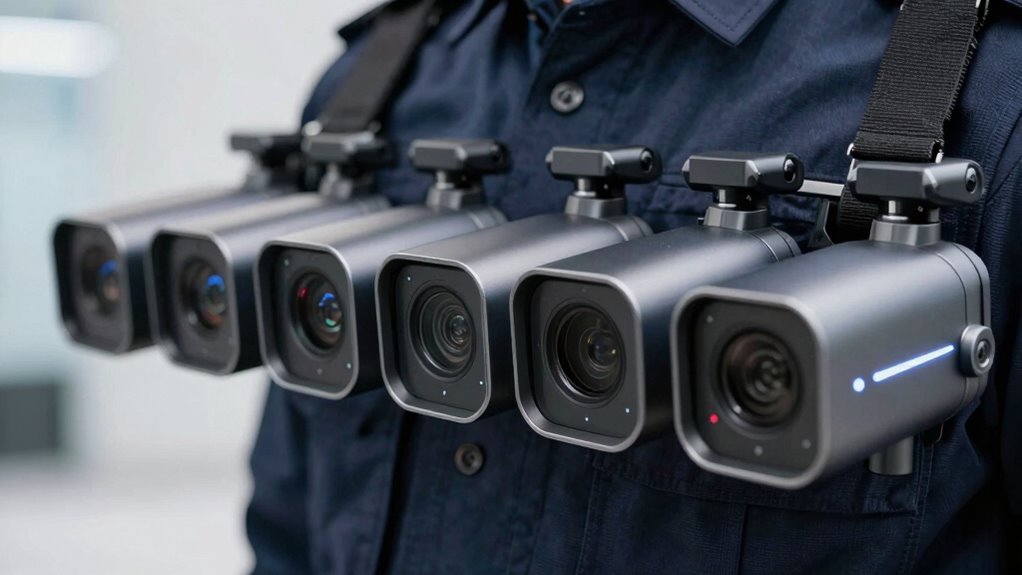
For security work, a body camera needs to capture usable evidence while staying comfortable and recording through the shift. I rank the CAMMHD V8 as the best overall pick for its 4K recording, large storage capacity, dual batteries, and included charging dock. The BOBLOV KJ23Pro is a more restrained 2K option, while the 1080P Wearable Body Camera with 10-hour battery prioritizes runtime and an onboard screen. The main tradeoffs are recording time, image detail, size, and the effort of managing footage; headline resolution alone won’t settle the choice. Read on for the full comparison and advice on matching a camera to your site and shift pattern.

Get privacy and security gear delivered free with Prime
- Fast, free delivery on millions of items
- Prime Video, Amazon Music and more included
- Member-only deals all year
Key Takeaways
- The CAMMHD V8 leads on shift readiness: its two 4400mAh batteries, stated 14-hour work time, 256GB storage, and charging dock make it the most equipped option for long recording periods.
- The BOBLOV KJ23Pro offers a middle ground: 2K recording and 128GB storage provide more listed detail than the 1080p models without the V8’s larger, more complex setup.
- Several compact picks trade capability for simplicity: the AviaryEye A18 Mini, Kaysunlink A18, and Meoilkolnm Mini list 1080p recording and 64GB or 128GB storage, so buyers should compare actual wearability and clip security before choosing.
- Battery claims vary enough to affect deployment: the V8 lists 14 hours and one 1080p model lists 10 hours, while the Z11 lists six hours; buyers working longer shifts should plan for charging or spare power.
- Resolution is not a substitute for an evidence workflow: across this lineup, buyers still need to check file transfer, timestamp settings, secure storage, and how footage will be retained and shared.
| AviaryEye A18 Mini Body Camera with 64GB Card, 1080P HD & Night Vision |  | Best Compact Pick | Video resolution: 1080P HD | Night vision range: Up to 15 feet | Battery life: Up to 5 hours | VIEW ON AMAZON | See Our Full Breakdown |
| CAMMHD V8 256GB 4K Body Camera with Audio and Video Recording, 2160p, Two 4400mAh Batteries, 14h Work Time, H.265 Recorder, Night Vision Police Cam with Charging Dock |  | Best for Long Shifts | Video resolution: 4K (2160P) | Field of view: 170 degrees | Built-in storage: 256GB | VIEW ON AMAZON | See Our Full Breakdown |
| Z11 4K Body Camera with Audio, 128GB, Rotating Lens, 6HR Battery & Night Vision |  | Best for Flexible Mounting | Video resolution: 4K | Storage: 128GB microSD | Battery life: Up to 6 hours at 4K; up to 9 hours at 1080p | VIEW ON AMAZON | See Our Full Breakdown |
| Mini Body Camera with 128GB Storage, Night Vision, and 1080p Recording |  | Best for Simple Clip-On Recording | Video resolution and frame rate: 1080p at 30 fps | Lens field of view: 90 degrees | Storage: 128GB built-in Micro SD | VIEW ON AMAZON | See Our Full Breakdown |
| 1080P Wearable Body Camera with Night Vision, Audio Recording, 10-Hour Battery, 2-Inch Screen, and 128GB Storage |  | Best for On-Device Review | Video resolution: Up to 1080P | Battery life: Up to 10 hours | Screen size: 2 inches | VIEW ON AMAZON | See Our Full Breakdown |
| BOBLOV KJ23Pro 2K Body-Worn Camera with 128GB Memory and Night Vision |  | Best for Long Shifts and Low-Light Patrols | Video resolution: 1440p | Photo resolution: 38 MP | Built-in storage: 128 GB | VIEW ON AMAZON | See Our Full Breakdown |
| Meoilkolnm Mini Wearable Body Camera, 1080p, 128GB, Black |  | Best for Hands-Free Indoor Wear | Video resolution: 1080p | Storage: 128GB memory card included | Battery life: 2 hours | VIEW ON AMAZON | See Our Full Breakdown |
| BOBLOV KJ25 1080p Body Camera with Night Vision |  | Best for Incident-Start Capture | Video resolution: 1080p | Photo resolution: 48 MP | Battery capacity: 3000 mAh | VIEW ON AMAZON | See Our Full Breakdown |
| Kaysunlink A18 Mini Body Camera, 1080p, 64GB Card |  | Best Lightweight Option for Short Rounds | Video resolution: 1080p | Storage: 64GB memory card included | Battery capacity: 1000 mAh | VIEW ON AMAZON | See Our Full Breakdown |
| body cameras for security work | Video resolution | Water resistance | Battery life | Storage |
|---|---|---|---|---|
| AviaryEye A18 Mini Body Camera | 1080P HD | Not water-resistant | Up to 5 hours | — |
| CAMMHD V8 256GB 4K Body Camera | 4K (2160P) | — | — | — |
| Z11 4K Body Camera with Audio | 4K | Not water-resistant | Up to 6 hours at 4K; up to 9 hours at 1080p | 128GB microSD |
| Mini Body Camera with 128GB St | — | Not water-resistant | — | 128GB built-in Micro SD |
| 1080P Wearable Body Camera wit | Up to 1080P | Described as waterproof; protection rating not specified | Up to 10 hours | 128GB |
| BOBLOV KJ23Pro 2K Body-Worn Ca | 1440p | IP66 | — | — |
| Meoilkolnm Mini Wearable Body | 1080p | Not water resistant | 2 hours | 128GB memory card included |
| BOBLOV KJ25 1080p Body Camera | 1080p | Not water resistant | Up to 13 hours | — |
| Kaysunlink A18 Mini Body Camer | 1080p | Not water resistant | About 4–6 hours | 64GB memory card included |
More Details on Our Top Picks
AviaryEye A18 Mini Body Camera with 64GB Card, 1080P HD & Night Vision
For guards who want a camera that adds almost no weight to a uniform, the AviaryEye A18 is the most discreet option in this group. At 0.19 oz, its clip can attach to a collar, helmet, or visor without the bulk of the CAMMHD V8, which is better suited to longer shifts and wider scene coverage. The included 64GB card also makes setup straightforward, while 15-foot infrared night vision can help document nearby activity in dim corridors or at entry points.
The tradeoff is endurance and resilience: its five-hour battery is shorter than the CAMMHD V8’s stated 14 hours, and the A18 is not water-resistant. Its push-button controls keep operation simple but offer fewer settings. I’d choose it for short patrols where a low-profile camera matters more than all-shift recording.
Pros:- Very light 0.19 oz body with an adjustable clip for several mounting positions
- Includes a pre-installed 64GB microSD card for ready-to-use recording
- Infrared night vision reaches up to 15 feet
- Loop recording and motion detection support basic unattended capture
Cons:- Five-hour battery life may not cover a full shift
- Not water-resistant, so rain or wet work conditions pose a risk
- Storage expansion is capped at 128GB and controls are limited to push buttons
Best for: Security staff on short patrols who need a very light, discreet camera with a memory card included.
Not ideal for: Guards covering long shifts or outdoor posts in wet weather; the five-hour battery and lack of water resistance are limiting.
- Video resolution:1080P HD
- Night vision range:Up to 15 feet
- Battery life:Up to 5 hours
- Included storage:64GB microSD card
- Maximum supported storage:128GB
- Weight:0.19 oz
- Video encoding and format:H.264, AVI
- Water resistance:Not water-resistant
Our verdict“Choose the AviaryEye A18 when a barely noticeable camera for shorter security shifts matters more than extended runtime or weather protection.”
CAMMHD V8 256GB 4K Body Camera with Audio and Video Recording, 2160p, Two 4400mAh Batteries, 14h Work Time, H.265 Recorder, Night Vision Police Cam with Charging Dock
The CAMMHD V8 is the strongest fit here for posts where recording time and broad scene coverage matter more than a small, unobtrusive unit. Its stated 14-hour continuous runtime and 256GB built-in storage suit long shifts, while the 170-degree lens captures more of the surrounding area than the 90-degree lens listed for the Mini Body Camera with 128GB Storage. H.265 compression helps manage large 4K files, and its 50-foot infrared range reaches farther than the AviaryEye A18’s 15 feet.
That coverage comes with compromises: the storage is fixed, with no microSD expansion, and the battery-removal window is only three minutes, so it is not a seamless swap during a shift. Its wide view can also include more peripheral detail than a guard needs. I’d favor it for fixed-post or patrol work that benefits from extended recording and a broad field of view.
Pros:- Stated 14-hour continuous recording time for extended shifts
- 170-degree field of view captures a broad area
- 256GB built-in storage with H.265 video compression
- 50-foot infrared night vision and a charging dock
Cons:- Built-in storage cannot be expanded with an external microSD card
- Only a three-minute operating window is specified for battery removal
- A 170-degree view may capture more peripheral area than some security tasks require
Best for: Security teams needing long continuous recording, substantial onboard storage, and wide coverage for extended patrols or fixed posts.
Not ideal for: Staff who need expandable storage or dependable quick battery changes during active shifts.
- Video resolution:4K (2160P)
- Field of view:170 degrees
- Built-in storage:256GB
- Recording time:Up to 14 hours continuous
- Video codec:H.265
- Night vision range:Up to 50 feet
- Charging method:Charging dock with synchronous charging
- Security features:Date stamp, password protection, red/blue warning lights
Our verdict“Pick the CAMMHD V8 for long shifts and broad scene capture, provided fixed storage and its limited battery-change window fit your workflow.”
Z11 4K Body Camera with Audio, 128GB, Rotating Lens, 6HR Battery & Night Vision
The Z11 suits security workers who need to reposition a camera between different tasks. Its compact body and listed mounting options—including a clip, lanyard, and bike mount—make it more adaptable than the fixed shirt-clip approach of the AviaryEye A18. The rotating lens can help aim the recording toward the scene without changing the wearer’s position, and 128GB of microSD storage offers more room than the A18’s included 64GB card. Six infrared LEDs support low-light recording, while the stated runtime varies by resolution.
For guards, the key compromise is that 4K recording is listed at six hours, compared with up to nine hours at 1080p; neither figure matches the CAMMHD V8’s stated 14 hours. The Z11 is also not water-resistant, so it is a weaker choice for exposed outdoor posts. I’d select it when mount flexibility matters more than maximum runtime or weather protection.
Pros:- Compact body with multiple listed mounting options
- Rotating lens helps redirect the view without moving the camera mount
- 128GB microSD storage
- Six infrared LEDs support night recording
Cons:- Listed 4K runtime is six hours, shorter than the CAMMHD V8’s stated 14 hours
- Not water-resistant for rain-exposed security work
- Battery life drops at 4K compared with 1080p recording
Best for: Security staff who switch between body, lanyard, and equipment-mounted recording positions and want 4K capture.
Not ideal for: Outdoor guards working in wet conditions or anyone who needs 4K recording to cover a long shift without interruption.
- Video resolution:4K
- Storage:128GB microSD
- Battery life:Up to 6 hours at 4K; up to 9 hours at 1080p
- Night vision:Six infrared LEDs
- Display:1.3-inch screen
- Mounting options:Clip, lanyard, and bike mount
- Lens:Wide angle, fixed focus, f/2 maximum aperture
- Water resistance:Not water-resistant
Our verdict“Choose the Z11 for flexible mounting and 4K footage when its shorter high-resolution runtime and lack of water resistance are acceptable.”
Mini Body Camera with 128GB Storage, Night Vision, and 1080p Recording
This mini camera is a straightforward option for guards who want 1080p recording, built-in storage, and a clip they can angle toward the work area. Its 360-degree rotating clip gives it a more adjustable attachment than the AviaryEye A18’s standard adjustable clip, and its 128GB storage exceeds the A18’s included 64GB. The 90-degree lens is narrower than the CAMMHD V8’s 170-degree view, which may suit a wearer who wants less peripheral scene in the footage rather than maximum area coverage.
Its limits are clear for shift work: the battery supports about four hours per charge, and the camera is not water-resistant. Recording while charging can extend use near a power source, but it is less practical during a moving patrol. I’d choose it for shorter, predictable assignments where a rotating clip and simple 1080p capture are more useful than 4K or all-shift endurance.
Pros:- 360-degree rotating clip supports flexible positioning on clothing or a strap
- Built-in 128GB storage
- 1080p recording at 30 fps with loop recording
- Can record while charging
Cons:- About four hours of recording per charge is limited for security shifts
- Not water-resistant
- 90-degree field of view is narrower than the CAMMHD V8’s 170-degree lens
Best for: Security staff covering short indoor assignments who want an adjustable clip and onboard storage without needing 4K.
Not ideal for: Full-shift patrols, wet outdoor posts, or workers who need a wide field of view and long untethered recording.
- Video resolution and frame rate:1080p at 30 fps
- Lens field of view:90 degrees
- Storage:128GB built-in Micro SD
- Night vision range:Up to 16.4 feet
- Battery capacity:800mAh
- Recording time:About 4 hours per charge
- Mount:360-degree rotating clip or strap
- Water resistance:Not water-resistant
Our verdict“Pick this mini camera for short indoor duties that benefit from adjustable clip positioning, not for long or rain-exposed shifts.”
1080P Wearable Body Camera with Night Vision, Audio Recording, 10-Hour Battery, 2-Inch Screen, and 128GB Storage
The clearest differentiator here is the 2-inch screen: guards can review footage on the camera itself rather than relying only on a computer or phone connection. Paired with 128GB storage, night vision, and audio recording, that may suit supervisors or staff who need a quick check of captured material between tasks. Its listed 10-hour battery also gives it a longer stated run time than the AviaryEye A18 and the four-hour Mini Body Camera with 128GB Storage, though it falls short of the CAMMHD V8’s 14-hour claim.
The product information does not specify night-vision range, field of view, or the conditions behind its runtime, so I’d be cautious about choosing it for a post that depends on those details. It is described as waterproof, unlike the A18 and Z11, but no rating is provided. I’d shortlist it for workers who value an on-camera screen and confirm the exact weather rating before outdoor deployment.
Pros:- 2-inch screen allows on-device viewing
- Up to 10 hours of stated battery life
- 128GB storage
- Includes night vision, audio recording, and motion detection
Cons:- Night-vision range and field of view are not specified
- Waterproof claim is not accompanied by a stated protection rating
- Battery runtime conditions are not detailed, making shift planning less certain than with the CAMMHD V8
Best for: Security staff or supervisors who want a wearable 1080p camera with a built-in screen for checking footage on site.
Not ideal for: Buyers who need a documented waterproof rating, specified night-vision distance, or verified runtime under their recording settings.
- Video resolution:Up to 1080P
- Battery life:Up to 10 hours
- Screen size:2 inches
- Storage:128GB
- Features:Night vision, audio recording, motion detection
- Connectivity:USB, Bluetooth
- Water resistance:Described as waterproof; protection rating not specified
Our verdict“Choose this model if on-camera playback and a stated 10-hour runtime are priorities, but verify its weather protection and low-light performance before relying on it outdoors.”
BOBLOV KJ23Pro 2K Body-Worn Camera with 128GB Memory and Night Vision
The BOBLOV KJ23Pro is the strongest fit here for security staff who need built-in storage, night vision, and a long recording window in one camera. Its 128GB internal memory avoids the separate-card setup required by the BOBLOV KJ25, while five infrared lights support recording in poorly lit areas. The listed maximum of up to 15 hours applies at 1080p; the camera records up to 1440p, but the supplied details do not give a matching runtime at that resolution. IP66 water resistance also makes it better suited to outdoor shifts than the non-water-resistant KJ25 or Meoilkolnm Mini. The tradeoffs are a fixed zoom and no stated pre- or post-recording feature, so it offers less flexibility for framing and incident capture than some alternatives.
Pros:- Built-in 128GB storage avoids relying on a separately purchased memory card.
- Five infrared lights support recording in low-light conditions.
- IP66 water resistance suits outdoor work better than the non-water-resistant KJ25.
- Up to 15 hours of recording is specified at 1080p, with loop recording to overwrite older files.
Cons:- The 15-hour runtime is specified at 1080p, not 1440p.
- Fixed zoom limits framing adjustments in changing situations.
Best for: Security officers on long patrols who need internal storage, infrared recording, and a camera rated for wet conditions.
Not ideal for: Staff who need adjustable zoom or a confirmed long runtime at 1440p, since the listed 15-hour figure is for 1080p and the zoom is fixed.
- Video resolution:1440p
- Photo resolution:38 MP
- Built-in storage:128 GB
- Maximum recording time:Up to 15 hours at 1080p
- Water resistance:IP66
- Battery capacity:4000 mAh
- Weight:140 g
- Connectivity:USB-C; infrared
Our verdict“Choose the KJ23Pro for outdoor shifts that call for built-in storage and infrared recording, but not if adjustable zoom or a verified 1440p runtime is a priority.”
Meoilkolnm Mini Wearable Body Camera, 1080p, 128GB, Black
The Meoilkolnm Mini prioritizes discreet, flexible mounting over shift-length recording. Its magnetic pendant, safety cord, and 360-degree adjustable clip give staff more ways to position it on clothing than the clip-focused Kaysunlink A18. That can help during short indoor tasks where a hands-free view matters more than extended coverage. The 128GB memory card is included, and the camera records 1080p with a 120-degree viewing angle. Its main limitation for security work is the two-hour battery life: unlike the BOBLOV KJ23Pro’s much longer stated 1080p runtime, this model is better suited to brief assignments or frequent charging. It is also not water resistant, making outdoor patrols in wet weather a poor match.
Pros:- Compact design offers a low-profile option for wearable recording.
- Magnetic pendant, safety cord, and adjustable back clip provide several mounting choices.
- Included 128GB memory card provides substantial recording storage.
- 360-degree clip adjustment helps point the camera from different clothing positions.
Cons:- Two-hour battery life is restrictive for extended security shifts.
- Not water resistant, limiting use in rain or wet environments.
Best for: Indoor security staff who need a small camera with several wearable mounting options for short rounds, reception coverage, or brief tasks.
Not ideal for: Officers covering long shifts or outdoor posts, because the battery is rated for two hours and the camera is not water resistant.
- Video resolution:1080p
- Storage:128GB memory card included
- Battery life:2 hours
- Viewing angle:120 degrees
- Dimensions:64.5 × 28 × 20 mm
- Weight:0.16 kg
- Water resistance:Not water resistant
- Included accessories:Magnetic pendant, safety cord, portable back clip, USB cable
Our verdict“Pick the Meoilkolnm Mini for short indoor assignments where mounting flexibility matters more than battery endurance or weather protection.”
BOBLOV KJ25 1080p Body Camera with Night Vision
The BOBLOV KJ25 stands out for security workers who value pre- and post-recording options: those modes can help capture context around an incident instead of limiting the clip to the moment recording begins or ends. It also offers night vision, a two-inch screen for on-device viewing, and a stated runtime of up to 13 hours. Compared with the KJ23Pro, it trades built-in storage and IP66 water resistance for a larger display and the stated incident-capture modes. A Micro SD card is not included, so buyers need to provide compatible storage themselves, and the KJ25 is not water resistant. That makes it a stronger candidate for controlled indoor posts than wet-weather patrols. Its 1080p video also trails the KJ23Pro’s 1440p resolution.
Pros:- Pre- and post-recording options can preserve context around an incident.
- Night vision supports recording in low-light settings.
- Up to 13 hours of continuous recording is specified.
- Two-inch display allows on-device viewing.
Cons:- Micro SD card is not included, unlike the KJ23Pro’s built-in storage.
- Not water resistant, limiting suitability for wet-weather patrols.
- Records 1080p video rather than the KJ23Pro’s 1440p.
Best for: Indoor security teams who want pre- and post-recording options, night vision, and an onboard screen for reviewing footage.
Not ideal for: Outdoor patrol officers who need water resistance or buyers who want storage ready to use without supplying a Micro SD card.
- Video resolution:1080p
- Photo resolution:48 MP
- Battery capacity:3000 mAh
- Battery life:Up to 13 hours
- Memory card support:64GB–512GB Micro SD; card not included
- Display:2-inch screen, 240 × 320 pixels
- Water resistance:Not water resistant
- Lens:Wide angle, 2.8 mm
Our verdict“Choose the KJ25 for indoor work where incident-buffer features and a screen matter more than built-in storage or weather resistance.”
Kaysunlink A18 Mini Body Camera, 1080p, 64GB Card
At 42 g, the Kaysunlink A18 is the lightest clearly specified option in this group, making it a reasonable choice for staff who want a small camera for shorter rounds. It records 1080p video and audio, includes a 64GB card, and supports both loop and motion recording. Unlike the Meoilkolnm Mini, it can record while charging, which may suit a fixed indoor post with access to power. Its estimated four-to-six-hour battery life is still well below the KJ23Pro’s stated 15 hours at 1080p and the KJ25’s up-to-13-hour figure. The A18 also lacks water resistance, and its 64GB card provides less included storage than the 128GB options. It is a practical compact pick, not the best fit for long or exposed patrols.
Pros:- 42 g weight makes it a lightweight wearable option.
- Includes a 64GB memory card.
- Loop and motion recording offer different ways to manage recording.
- Can record while charging, useful at a powered indoor post.
Cons:- Estimated four-to-six-hour battery life is shorter than the BOBLOV KJ23Pro and KJ25 runtimes.
- Not water resistant, so it is a weak match for wet outdoor work.
- Included 64GB card offers less storage than the 128GB options in this group.
Best for: Security staff seeking a lightweight camera for shorter indoor rounds or a powered post, with included storage and motion-triggered recording.
Not ideal for: Personnel assigned to long shifts or wet-weather patrols, given its four-to-six-hour battery estimate and lack of water resistance.
- Video resolution:1080p
- Storage:64GB memory card included
- Battery capacity:1000 mAh
- Battery life:About 4–6 hours
- Weight:42 g
- Recording modes:Loop and motion recording
- Video format:AVI
- Water resistance:Not water resistant
Our verdict“Choose the Kaysunlink A18 for lightweight, shorter indoor coverage or powered use, but favor the BOBLOV models for longer shifts.”

How We Picked
I ranked these cameras for day-to-day security duties, weighing the features that affect whether a guard can wear, operate, and maintain a camera across a shift. The main criteria were stated recording resolution, battery capacity or claimed runtime, storage, night-vision availability, and practical extras such as a screen, rotating lens, or charging dock. I gave more weight to the CAMMHD V8’s combination of long stated runtime, 256GB capacity, and dock than to resolution alone; the BOBLOV KJ23Pro follows as a more balanced 2K choice.
Compact 1080p models rank lower when their listed details offer fewer advantages for extended or demanding use, though they may suit buyers prioritizing a smaller form. I treated specifications as claims rather than verified performance: the product information does not establish low-light image quality, real-world battery life, durability, secure evidence handling, or compatibility with a department’s procedures. Those gaps matter in security work, so the ranking reflects listed capabilities and likely fit, not a claim that any camera meets a particular legal, workplace, or evidentiary standard.
| body cameras for security work | Water resistance |
|---|---|
| AviaryEye A18 Mini Body Camera | Not water-resistant |
| CAMMHD V8 256GB 4K Body Camera | — |
| Z11 4K Body Camera with Audio | Not water-resistant |
| Mini Body Camera with 128GB St | Not water-resistant |
| 1080P Wearable Body Camera wit | Described as waterproof; protection rating not specified |
| BOBLOV KJ23Pro 2K Body-Worn Ca | IP66 |
| Meoilkolnm Mini Wearable Body | Not water resistant |
| BOBLOV KJ25 1080p Body Camera | Not water resistant |
| Kaysunlink A18 Mini Body Camer | Not water resistant |
Factors to Consider When Choosing Body Cameras For Security Work
Choosing a camera is only part of setting up a dependable recording practice. I’d match the device to the shift, uniform, site conditions, and evidence-handling process before prioritizing a headline specification. These factors help reveal where a camera’s listed features may not translate into a workable security setup.
Match Runtime to the Whole Shift
Start with the time a camera must be ready, not the length of a typical incident. A patrol, break, handoff, and post-shift upload can stretch well beyond active rounds, so a runtime claim that barely covers scheduled hours leaves little margin. Treat manufacturer runtime as a starting point rather than a guarantee, since settings, screen use, temperature, and battery age can affect recording time. For longer shifts, plan how the device will be charged or swapped without leaving a coverage gap. A camera with spare batteries or a dock can help, but only if staff have a clear charging and handover routine. Avoid choosing a small unit solely because it is easy to wear if it cannot cover the periods when recording is expected.
Choose Resolution for the Evidence You Need
Higher resolution can preserve more visual detail, but it can also create larger files and increase demands on storage, transfer, and retention. A 4K label does not guarantee that faces, uniforms, or distant details will be legible in motion or poor lighting. For a fixed post with close interactions, reliable framing and clear audio may matter more than maximum resolution; for broader outdoor patrols, detail at a distance may carry more weight. Check whether the camera records continuously or relies on manual activation, since a missed start can matter more than a resolution upgrade. Ask who will review footage and how quickly it must be found, because cumbersome files can slow an otherwise useful workflow. Match image quality to the actual evidence task rather than buying the largest number on the box.
Check Wearability and Mount Security
A camera that shifts, snags, or feels uncomfortable may be left behind or aimed poorly during a demanding shift. Consider where it will sit on the uniform, whether the lens remains unobstructed when bending or moving, and whether the mount suits the clothing and duties involved. Compact cameras can be easier to wear, but small controls may be harder to operate quickly, especially with gloves. A rotating lens can help with placement, yet it adds a setup step and should be checked after mounting. Test the proposed position during normal movement before relying on it for an incident. Also confirm that the mount is secure enough for the site without interfering with other equipment.
Treat Night Vision as One Part of Low-Light Performance
Night-vision labeling does not tell you how well a camera handles a dim corridor, reflective glass, backlighting, or a moving subject. If security work includes dark areas, review sample footage from the exact model and settings when possible, rather than assuming every night mode produces comparable results. Infrared illumination can help in darkness but may behave differently around reflective surfaces or at a distance. Think about where the camera will be pointed and whether nearby lighting changes during a shift. Audio, stable positioning, and a clear view can still support an incident record when video detail is limited. Make a short site-specific recording check before issuing cameras to a full team.
Plan Storage, Transfer, and Retention Before Buying
More built-in storage can reduce how often staff need to clear a device, but it does not solve the process of protecting, labeling, and retaining recordings. Estimate file volume using the chosen resolution and recording schedule, then decide who can retrieve footage and where it will be stored. A removable card may simplify transfer, but it can also create a loss or access-control concern if handling is informal. Set rules for file names, incident references, access permissions, retention periods, and deletion before cameras enter service. Check whether the device’s transfer method fits the organization’s computers and security policies. For evidence-sensitive work, a clear chain of custody matters at least as much as a large capacity figure.
Confirm Workplace Rules and Operating Controls
Before purchasing, check local law, client requirements, and employer policy on recording, notice, audio capture, and retention. A camera that records audio may be subject to different rules from video-only recording, and expectations can vary by location and setting. Decide when staff should activate recording, how they should explain it when appropriate, and what to do if a device fails. Look for accessible controls that reduce accidental starts, stops, or blocked lenses during an incident. If several guards will share devices, assign responsibility for charging, checking storage, and reporting faults at shift change. A technically capable camera is a poor fit if the team cannot use it consistently within its procedures.
Frequently Asked Questions
Is 4K worth choosing over 1080p for security patrols?
It depends on whether extra image detail is useful for the incidents and distances your team records. The CAMMHD V8 and Z11 list 4K, while several alternatives are 1080p and the BOBLOV KJ23Pro lists 2K. Higher resolution may help preserve detail, but it can consume storage more quickly and does not guarantee clear footage in motion or low light. Check sample recordings and file sizes at the settings you intend to use. If reliable coverage and easy footage handling matter more than fine detail, a lower-resolution camera may fit the job better.
Can any of these cameras reliably cover a full security shift?
The listed claims give a useful starting point but cannot confirm full-shift performance in your conditions. The CAMMHD V8 states up to 14 hours with two batteries, and one 1080p model lists a 10-hour battery; the Z11 lists six hours. Actual runtime can vary with recording settings, screen use, and battery condition. Test a camera through a representative shift, including breaks and handoff, before relying on its stated duration. For shifts longer than the tested runtime, build in a charging or battery-swap plan.
Is night vision enough for recording incidents in dark areas?
No single night-vision label can tell you whether footage will be usable at your site. Distance, movement, reflective surfaces, and changing light all affect what the camera captures. If night patrols are routine, test the camera in the actual corridors, parking areas, or exterior routes where it will be worn. Review both the image and audio, since a dark scene may still be supported by clear sound and a stable camera position. Do not assume models with the same listed feature perform alike without sample footage.
What should I check before using a body camera as incident evidence?
Confirm that your workplace permits the intended recording, including audio, and set rules for when recording starts and stops. Check timestamp settings, file transfer, access controls, retention, and how footage will be linked to an incident report. A large memory card does not by itself protect recordings or establish who handled them. Test a complete workflow from recording to authorized review and archiving before deployment. If the footage may be used in a formal process, follow the employer’s evidence-handling policy and applicable local requirements.
Should I choose a mini camera or one with a screen and charging dock?
Choose based on the work pattern, not size alone. A mini camera may be easier to wear discreetly, but small controls and limited on-device feedback can make setup harder. A screen can help staff check framing, while a dock can simplify charging and handoff for teams; both add steps or bulk that may not suit every uniform. Compare the AviaryEye A18 Mini and other compact options with the CAMMHD V8’s dock and the 1080p model that lists a screen by trying the proposed mounting position and shift routine. A team with shared equipment may benefit more from repeatable charging and checks than from the smallest body.
Conclusion
For the broadest listed feature set, I’d choose the CAMMHD V8 as best overall, particularly for teams that need substantial storage, extended claimed runtime, and a charging dock. The best premium-style pick is also the V8 if its 4K recording and dual-battery setup justify the added operational complexity for your team. For best value in practical capability, the BOBLOV KJ23Pro is the clearest middle-ground choice on the specifications provided, with 2K recording and 128GB storage. The best option for beginners is the 1080P Wearable Body Camera that lists a screen and 10-hour battery, since on-device framing feedback and a straightforward resolution target may make setup easier. For compact, simpler duties, compare the AviaryEye A18 Mini, Kaysunlink A18, and Meoilkolnm Mini by fit, controls, and mounting rather than treating their similar 1080p labels as a decisive difference. Before issuing any model, verify real runtime, footage quality, workplace rules, and the process for securing recordings.