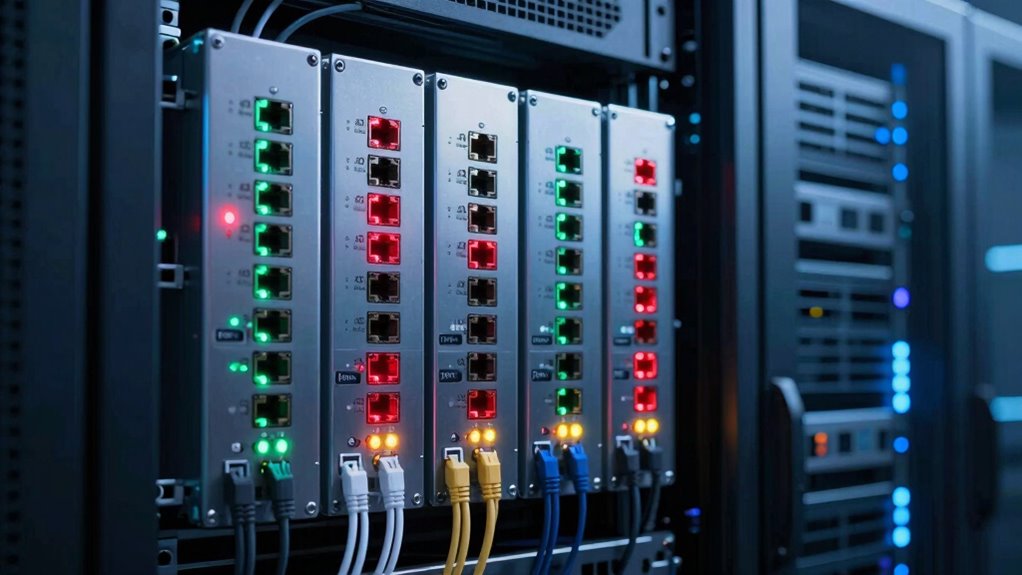

Choosing a managed switch for secure networks involves balancing security features, performance, and ease of management. The Omada ES206X-M2 stands out as the best overall for its robust security protocols and simple setup, ideal for small to medium-sized networks. For those needing PoE+ support, the TP-Link TL-SG1428PE offers extensive port options with power delivery, suited for VoIP and surveillance. The main tradeoffs include balancing advanced security features against ease of use and price. Keep reading for a detailed breakdown of each option to find the best fit for your network needs.

Get privacy and security gear delivered free with Prime
- Fast, free delivery on millions of items
- Prime Video, Amazon Music and more included
- Member-only deals all year
Key Takeaways
- The top picks excel in security features such as VLAN segmentation, access controls, and SNMP monitoring, which are essential for safeguarding networks.
- Port density and PoE support are major considerations; larger networks often require switches with more ports and power options, but these can increase cost and complexity.
- Ease of management varies; some switches offer simple web interfaces, while others require command-line expertise, influencing usability for different skill levels.
- Security and performance are often tied to firmware updates and support; products with regular updates provide better long-term protection.
- Price differences reflect features like stacking, advanced security protocols, and build quality; higher-priced options generally offer more comprehensive security tools.
| Omada ES206X-M2 5-Port 2.5G Managed Switch |  | Best Overall for Small, Secure, and Silent Networks | Ports: 5× 2.5 Gbps RJ45, 1× 10 Gbps SFP+ | Design: Fanless, metal casing, desktop/wall mountable | Management: Cloud management via web or Omada app | VIEW ON AMAZON | See Our Full Breakdown |
| TP-Link TL-SG1428PE 24-Port Gigabit Easy Smart Managed PoE+ Switch |  | Best for Growing Small to Medium Networks with PoE Needs | Number of Ports: 24 PoE+ ports, 2 non-PoE | PoE Power Budget: 250W | SFP Slots: 2 | VIEW ON AMAZON | See Our Full Breakdown |
| NETGEAR 8 Port PoE Gigabit Ethernet Easy Smart Managed Switch (GS308EP) |  | Best Compact PoE Switch for Small Business Environments | Ports: 8 x 1Gbps | Management: Web GUI | VLANs: Up to 64 | VIEW ON AMAZON | See Our Full Breakdown |
| TP-Link TL-SG1016DE 16-Port Gigabit Easy Smart Managed Switch |  | Best for Small to Medium Networks Requiring Advanced Management | Ports: 16 Gigabit | Management: Smart Managed | Features: VLAN, QoS, IGMP, Link Aggregation | VIEW ON AMAZON | See Our Full Breakdown |
| NETGEAR 8-Port Gigabit Ethernet Easy Smart Managed Network Switch (GS308E) |  | Best Budget-Friendly Small Office Switch with Security Features | Ports: 8 x 1Gbps | Management: Web GUI | VLANs: Up to 64 | VIEW ON AMAZON | See Our Full Breakdown |
| TP-Link TL-SG1024DE 24 Port Gigabit Easy Smart Managed Ethernet Switch |  | Best for Small to Medium-Sized Networks Seeking Reliable Management | Number of Ports: 24 | Port Type: Gigabit Ethernet | Management: Smart Managed | VIEW ON AMAZON | See Our Full Breakdown |
| managed switches for secure network | Management | Ports |
|---|---|---|
| Omada ES206X-M2 5-Port 2.5G Ma | Cloud management via web or Omada app | 5× 2.5 Gbps RJ45, 1× 10 Gbps SFP+ |
| TP-Link TL-SG1428PE 24-Port Gi | — | — |
| NETGEAR 8 Port PoE Gigabit Eth | Web GUI | 8 x 1Gbps |
| TP-Link TL-SG1016DE 16-Port Gi | Smart Managed | 16 Gigabit |
| NETGEAR 8-Port Gigabit Etherne | Web GUI | 8 x 1Gbps |
| TP-Link TL-SG1024DE 24 Port Gi | Smart Managed | — |
More Details on Our Top Picks
Omada ES206X-M2 5-Port 2.5G Managed Switch
The Omada ES206X-M2 stands out for its simplicity, durability, and advanced features packed into a compact, fanless design. Compared to larger switches like the TP-Link TL-SG1428PE, it offers a more streamlined, noise-free operation ideal for home offices or small secure environments. While it supports VLAN, IGMP snooping, and automatic loop prevention, its 5-port limit restricts scalability for bigger networks. Its plug-and-play setup makes it accessible for users new to managed switches, but the necessity of Omada cloud management could be a hurdle for those preferring local control. Its metal case ensures durability, yet the lack of a built-in power supply might complicate deployment. Best for small networks needing silent operation, simple management, and reliable hardware.
Pros:- Fanless, silent operation for quiet environments
- Supports advanced features like VLAN and IGMP snooping
- Durable metal construction for long-term use
- Plug-and-play setup simplifies deployment
Cons:- Limited to 5 ports, restricting scalability
- Requires Omada cloud platform, which may be inconvenient for some users
- No included power supply, adding to setup complexity
Best for: Small business or home office users who prioritize silent operation and easy setup.
Not ideal for: Large or expanding networks requiring more ports or local management options.
- Ports:5× 2.5 Gbps RJ45, 1× 10 Gbps SFP+
- Design:Fanless, metal casing, desktop/wall mountable
- Management:Cloud management via web or Omada app
- Features:VLAN, IGMP snooping, automatic loop prevention
Our verdict“This switch is best suited for small, quiet networks with minimal scalability needs and a preference for cloud management.”
TP-Link TL-SG1428PE 24-Port Gigabit Easy Smart Managed PoE+ Switch
The TP-Link TL-SG1428PE offers 24 gigabit ports with PoE+ support, making it ideal for networks that need to power IP cameras, phones, or access points. Its 250W PoE budget and two SFP slots make it flexible for small to medium-sized deployments. Compared with the NETGEAR GS308EP, this switch provides more ports and PoE capabilities, but it requires detailed configuration for PoE auto recovery, which could be a barrier for less experienced users. Its VLAN support enhances security, yet its larger size and power requirements mean it’s better suited to dedicated network closets. The management interface is web-based, making setup straightforward, but advanced features demand some familiarity with networking concepts. This switch is a strong choice for networks needing PoE and VLAN security in a manageable package.
Pros:- Supports high PoE power output for multiple devices
- Flexible with 24 ports and 2 SFP slots
- VLAN support enhances network security
- 3-year warranty provides peace of mind
Cons:- Requires initial configuration for PoE auto recovery
- Larger footprint may not suit tight spaces
- Limited to small/medium networks, not enterprise-scale
Best for: IT managers expanding small to medium networks with PoE device deployment.
Not ideal for: Home users or very small networks that do not require PoE or extensive VLAN features.
- Number of Ports:24 PoE+ ports, 2 non-PoE
- PoE Power Budget:250W
- SFP Slots:2
- PoE Standard:802.3at/af
Our verdict“Ideal for small to medium networks that need PoE, VLAN security, and manageable scalability without complexity.”
NETGEAR 8 Port PoE Gigabit Ethernet Easy Smart Managed Switch (GS308EP)
The NETGEAR GS308EP packs PoE+ support and smart management into a compact, fanless design perfect for small offices or retail setups. While it has only 8 ports, its PoE capacity of 62W and ease of configuration make it suitable for powering devices like IP cameras or VoIP phones. Compared with larger switches like the TP-Link TL-SG1428PE, it sacrifices port count for simplicity and space-saving design. Its energy-efficient, fanless construction ensures silent operation, but the limited PoE budget may not suffice for high-powered devices. Its web GUI simplifies management, although some advanced features are less extensive than bigger enterprise switches. This switch is best for small setups needing PoE and quiet operation in tight spaces.
Pros:- Compact, fanless, silent operation
- Supports PoE+ for powering connected devices
- Easy to configure via web interface
- Durable metal housing for longevity
Cons:- Limited to 8 ports, unsuitable for larger networks
- PoE power budget may be insufficient for high-power devices
- Lacks advanced Layer 3 features
Best for: Small business or retail outlets deploying PoE devices in limited space with simple management needs.
Not ideal for: Large networks or setups requiring high PoE power for multiple high-demand devices.
- Ports:8 x 1Gbps
- Management:Web GUI
- VLANs:Up to 64
- Housing:Fanless metal
Our verdict“Best suited for small setups that need reliable PoE support without occupying much space or requiring complex management.”
TP-Link TL-SG1016DE 16-Port Gigabit Easy Smart Managed Switch
The TP-Link TL-SG1016DE offers a balanced mix of port density and management features, making it suitable for expanding small networks. Its 16 ports support VLAN, QoS, IGMP, and link aggregation, comparable to the TP-Link TL-SG1428PE but without PoE support. Its plug-and-play setup with a web management interface simplifies initial deployment, yet understanding the full feature set requires some networking knowledge. The metal chassis provides durability, but the absence of PoE limits its use case to data-only environments. Compared to simpler unmanaged switches, this model provides more control, but it’s not designed for networks with high PoE power demands. This switch fits small to medium networks needing robust management without PoE.
Pros:- Supports advanced management features including VLAN and QoS
- Durable, metal design with shielded ports
- Easy to set up with plug-and-play and web management
- 3-year warranty for reliability
Cons:- No PoE support, limiting device powering options
- Requires some network knowledge for full use of features
- Limited to small and medium networks, not enterprise-scale
Best for: Small to medium-sized networks requiring advanced VLAN and QoS features but no PoE support.
Not ideal for: Networks that need to power devices via PoE or require plug-and-play simplicity without configuration.
- Ports:16 Gigabit
- Management:Smart Managed
- Features:VLAN, QoS, IGMP, Link Aggregation
- Form Factor:Desktop/Rackmount
Our verdict“Ideal for growing networks that need detailed control and security features without PoE capabilities.”
NETGEAR 8-Port Gigabit Ethernet Easy Smart Managed Network Switch (GS308E)
The NETGEAR GS308E offers a straightforward, silent, and durable option for small offices or home networks, with 8 gigabit ports and VLAN support. While it lacks PoE, its web GUI provides essential management tools such as QoS, IGMP snooping, port mirroring, and storm control, comparable to the NETGEAR GS308EP but without PoE. Its fanless design ensures silent operation, and its simple setup suits users with basic networking skills. However, its port count limits expansion, and it doesn’t support PoE, so powering devices isn’t an option. It’s a good choice where network security and traffic management are priorities, but not for high-demand or PoE-dependent environments. This switch is best for small, secure networks needing basic management and silent operation.
Pros:- Silent operation with fanless, durable metal housing
- Supports VLAN, QoS, and other security features
- Plug-and-play setup with web GUI
- Affordable price point for small networks
Cons:- Limited to 8 ports, restricting scalability
- No PoE support, limiting device powering options
- Basic management features compared to larger enterprise switches
Best for: Home or small office users needing VLAN and QoS without PoE or extensive port requirements.
Not ideal for: Large networks or setups requiring PoE or high port density for many devices.
- Ports:8 x 1Gbps
- Management:Web GUI
- VLANs:Up to 64
- Housing:Fanless metal
Our verdict“Best suited for small networks requiring VLAN and QoS, with a preference for silent, simple operation and no PoE needs.”
TP-Link TL-SG1024DE 24 Port Gigabit Easy Smart Managed Ethernet Switch
The TP-Link TL-SG1024DE stands out for its straightforward deployment, making it a strong choice for small to medium-sized networks that need manageable expansion without the complexity of full enterprise equipment. Compared to the TP-Link TL-SG1428PE, which offers PoE+ capabilities, this model focuses on core switching features like VLAN and QoS, but omits PoE support, which might be a limitation for networks requiring power over Ethernet for cameras or VoIP phones. Its sturdy metal case and shielded ports ensure durability and security, while the plug-and-play setup reduces configuration time. However, its limited placement options—restricted to desktop or rackmount—may be inconvenient for some environments. The inclusion of advanced management tools and a 3-year warranty make it a dependable, low-maintenance option, but the absence of PoE and a more flexible form factor are tradeoffs that could matter in larger or more dynamic installations.
Pros:- Easy plug-and-play setup reduces installation time
- Supports VLAN, QoS, and advanced network management features
- Sturdy metal construction enhances durability
- Includes a 3-year warranty and support coverage
Cons:- Lacks Power over Ethernet (PoE) support, limiting device integration
- Design restricted to desktop or rackmount, reducing flexibility in some environments
Best for: IT managers at small to medium businesses who want reliable, easy-to-manage network switches without PoE needs.
Not ideal for: Organizations requiring PoE support for network devices or those seeking a compact, wall-mountable unit for space-constrained setups.
- Number of Ports:24
- Port Type:Gigabit Ethernet
- Management:Smart Managed
- Form Factor:Desktop/Rackmount
- Material:Sturdy Metal
- Shielded Ports:Yes
- Warranty:3 years
Our verdict“This switch suits small to medium networks prioritizing straightforward management and durability over PoE capabilities or flexible deployment options.”

How We Picked
These switches were selected based on their security capabilities, performance metrics, ease of management, and overall value. We prioritized models that offer robust security features such as VLAN support, access controls, and PoE security, along with reliable build quality. The ranking also considers user reviews and industry reputation, ensuring that each product balances security with usability. Price was a factor, but only when it justified additional security or performance benefits, ensuring that the list caters to a range of budgets without compromising essential security features.| managed switches for secure network | Management |
|---|---|
| Omada ES206X-M2 5-Port 2.5G Ma | Cloud management via web or Omada app |
| TP-Link TL-SG1428PE 24-Port Gi | — |
| NETGEAR 8 Port PoE Gigabit Eth | Web GUI |
| TP-Link TL-SG1016DE 16-Port Gi | Smart Managed |
| NETGEAR 8-Port Gigabit Etherne | Web GUI |
| TP-Link TL-SG1024DE 24 Port Gi | Smart Managed |
Factors to Consider When Choosing Managed Switches For Secure Networks
When selecting a managed switch for a secure network, it’s important to consider several key factors that influence both security and usability. A switch’s security features prevent unauthorized access and protect sensitive data, while performance and management ease ensure smooth operation. Understanding these factors helps avoid common pitfalls like overspending on unnecessary features or choosing a device that’s too complex for your team.Security Features
Look for switches that support features like VLAN segmentation, 802.1X port authentication, and access control lists. These tools help isolate sensitive segments and prevent unauthorized device access. A switch with regular firmware updates and security patches is critical to protect against evolving threats. Avoid switches with limited security options, as they can leave your network vulnerable to breaches.
Port Density and PoE Support
Assess your network size and device needs. Larger networks benefit from switches with more ports, reducing the need for multiple units. Power over Ethernet (PoE+) support is essential if you plan to connect IP cameras, VoIP phones, or wireless access points directly to the switch. However, higher port counts and PoE capabilities often increase the price, so balance your current needs with future expansion plans.
Ease of Management
Some switches offer simple web-based interfaces suitable for less technical users, while others provide CLI options for advanced configurations. Consider your team’s expertise and whether you need features like SNMP monitoring or remote management. Overly complex switches can slow deployment and troubleshooting, so pick a device that matches your management capacity.
Performance and Reliability
Look for switches with gigabit ports at minimum and support for features like link aggregation for increased bandwidth. Reliability over time depends on build quality and firmware stability. Opt for brands with a good track record of updates and support, particularly if your network handles sensitive or critical data. Avoid models with limited throughput or poor hardware reviews.
Cost and Long-Term Value
While price is a decisive factor, consider the total cost of ownership, including support, firmware updates, and security features. Investing in a higher-quality switch can save money long-term by reducing security risks and maintenance needs. Beware of very inexpensive options that lack essential security features or are prone to issues, which could compromise your network integrity.
Frequently Asked Questions
Do managed switches provide better security than unmanaged switches?
Yes. Managed switches offer advanced security features such as VLANs, access controls, and port authentication, which unmanaged switches lack. These tools allow for detailed control over network access and segmentation, reducing the risk of breaches. Unmanaged switches are simpler but provide limited security options, making them unsuitable for networks where security is a priority.
Is PoE support necessary for secure networks?
PoE support is not inherently a security feature but can contribute to a secure network by enabling controlled power delivery to devices like cameras and phones. Properly configured PoE switches can reduce physical access points and simplify device management. However, PoE adds complexity and cost, so only choose it if your network requires powering IP devices directly through the switch.
How often should I update the firmware on my managed switch?
Regular firmware updates are vital to maintain security and compatibility. Manufacturers often release patches for vulnerabilities or bugs, so checking for updates at least quarterly is advisable. Automated update options can streamline this process, reducing the risk of running outdated firmware that exposes your network to threats.
What’s the difference between a smart managed and fully managed switch?
Smart managed switches typically offer a subset of management features, such as VLANs or QoS, with simpler interfaces suitable for less technical users. Fully managed switches provide extensive control, including advanced security, redundancy, and monitoring options, which are essential for larger or more sensitive networks. Choosing depends on your security needs and technical expertise.
Is a higher port count always better for security?
Not necessarily. While more ports can support larger networks and reduce the need for additional switches, they also increase complexity and potential attack points. Focus on your current and near-future needs; a well-managed smaller switch with robust security features can be more effective than a larger, less secure model. Proper segmentation and security policies are more important than port count alone.
Conclusion
For small to medium-sized networks seeking a balance of security and usability, the Omada ES206X-M2 offers strong security features at a reasonable price, making it the best overall. Organizations needing PoE+ for IP devices should consider the TP-Link TL-SG1428PE for its extensive port and power support. Larger enterprises or those with advanced security requirements will benefit from premium options like switches with enhanced firmware and security protocols, such as higher-end NETGEAR models. Beginners or those with limited technical skills should prioritize switches with simple management interfaces, while security-focused networks must opt for devices with comprehensive security features and regular updates.Halloween Picks
halloween
As an affiliate, we earn on qualifying purchases.