For most households, I’d start with the Arlo Video Doorbell 2K (2nd Gen): its wired-or-wireless setup gives it more placement flexibility than wired-only models, while retaining detailed video. The TP-Link Tapo D225 is a strong alternative for shoppers who want a chime included, and the BOIFUN 2K stands out for buyers seeking a no-subscription approach. The main tradeoffs are power source, recording and storage options, field of view, and whether you want a doorbell alone or a broader camera system. I compare all 10 smart doorbells below so you can match those tradeoffs to your home.

Get privacy and security gear delivered free with Prime
- Fast, free delivery on millions of items
- Prime Video, Amazon Music and more included
- Member-only deals all year
Key Takeaways
- The Arlo Video Doorbell 2K (2nd Gen) earns the overall lead for its uncommon wired-or-wireless flexibility paired with 2K video; that adaptability matters more than a small spec advantage when entryway wiring is uncertain.
- The two wired Google Nest Doorbell (3rd Gen) listings offer the same core 2K category appeal in different colors, so buyers should choose by finish and compatibility rather than expecting different performance.
- The Tapo D225 and D210 both bundle a chime, but the D225’s 2K QHD positioning makes it the stronger pick for shoppers prioritizing detail, while the D210 suits buyers who want a simpler wireless Tapo option.
- BOIFUN and Anona emphasize no-subscription use, but their different designs—wide-angle 2K versus 3K dual-camera coverage—address different priorities; buyers should verify how local recording works before choosing either.
- The Blink bundle is the only option here that pairs a doorbell with four outdoor cameras, making it a better fit for whole-property coverage than for someone seeking the most focused doorbell-only setup.
| Arlo Video Doorbell 2K (2nd Gen), Wireless or Wired, 1 Camera |  | Best for Flexible Installation | Resolution: 2K | Field of view: 180 degrees | Power: Rechargeable battery or wired trickle charging | VIEW ON AMAZON | See Our Full Breakdown |
| Ring Battery Doorbell 2K – Retinal 2K Video, Wide-Angle, 6x Zoom, Two-Way Talk, Built-In Battery (Matte Mocha) |  | Best for Zoomed-In Detail | Video resolution: Retinal 2K; resolution may vary with bandwidth | Field of view: 140° horizontal, 140° vertical | Zoom: 6× enhanced zoom | VIEW ON AMAZON | See Our Full Breakdown |
| BOIFUN Wireless Video Doorbell Camera 2K HD with No Subscription, 166° Wide View, Night Vision, Motion Alerts, Two-Way Audio, Battery Powered | 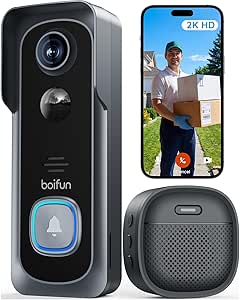 | Best for Subscription-Free Local Storage | Resolution: 2K HD | Field of view: 166° | Night vision: HDR night vision with 940 nm IR | VIEW ON AMAZON | See Our Full Breakdown |
| Google Nest Doorbell (Wired, 3rd Gen) – 2K Video, Live View – Snow |  | Best Wired Pick for Google Home | Video capture resolution: 2K HDR | Field of view: 166° | Night vision: Color | VIEW ON AMAZON | See Our Full Breakdown |
| TP-Link Tapo D225 2K QHD Smart Video Doorbell with Chime |  | Best for Local Storage and Flexible Power | Resolution: 2K QHD | Field of view: 180° head-to-toe | Power options: 10,000 mAh battery or 8–24 V hardwired | VIEW ON AMAZON | See Our Full Breakdown |
| Google Nest Doorbell (Wired, 3rd Gen) with 2K HDR Video, Hazel |  | Best for Google Home | Video resolution: 2K HDR (2000) | Field of view: 166° | Connectivity: Wired, Wi-Fi | VIEW ON AMAZON | See Our Full Breakdown |
| Anona 3K Dual Camera Video Doorbell with No Subscription and Chime |  | Best for Subscription-Free Coverage | Resolution: 3K, 5MP | Camera configuration: Dual 5MP main and secondary cameras | Night vision: Color | VIEW ON AMAZON | See Our Full Breakdown |
| Orbitell 1080p Wireless Video Doorbell Camera |  | Best Basic Wireless Pick | Model: M52 | Video resolution: 1080p | Connectivity: 2.4GHz Wi-Fi; not compatible with 5GHz Wi-Fi | VIEW ON AMAZON | See Our Full Breakdown |
| Tapo D210 2K Wireless Smart Video Doorbell with Chime |  | Best Value for Local Storage | Resolution: 2K | Field of view: 160° diagonal | Wi-Fi: 2.4GHz | VIEW ON AMAZON | See Our Full Breakdown |
| Blink Video Doorbell + Outdoor 4 Wireless Security Cameras System |  | Best for Whole-Entry Coverage | Doorbell resolution: 1440 x 1440p | Outdoor 4 resolution: 1080p HD | Doorbell field of view: 150° | VIEW ON AMAZON | See Our Full Breakdown |
| smart doorbell | Field of view | Night vision | Resolution | Wi-Fi |
|---|---|---|---|---|
| Arlo Video Doorbell 2K | 180 degrees | — | 2K | 2.4 GHz |
| Ring Battery Doorbell 2K | 140° horizontal, 140° vertical | — | — | Wi-Fi 4, 2.4 GHz single band |
| BOIFUN Wireless Video Doorbell | 166° | HDR night vision with 940 nm IR | 2K HD | 2.4 GHz only |
| Google Nest Doorbell | 166° | Color | — | — |
| TP-Link Tapo D225 2K QHD Smart | 180° head-to-toe | Full-color with adjustable spotlight | 2K QHD | 2.4 GHz; does not support 5 GHz |
| Google Nest Doorbell | 166° | Color | — | — |
| Anona 3K Dual Camera Video Doo | — | Color | 3K, 5MP | — |
| Orbitell 1080p Wireless Video | — | Infrared LEDs | — | — |
| Tapo D210 2K Wireless Smart Vi | 160° diagonal | Full color with spotlight | 2K | 2.4GHz |
| Blink Video Doorbell + Outdoor | — | — | — | — |
More Details on Our Top Picks
Arlo Video Doorbell 2K (2nd Gen), Wireless or Wired, 1 Camera
The Arlo Video Doorbell 2K is a strong fit when you want a choice between battery-powered placement and existing-wiring installation. Its 180-degree head-to-toe view can capture more of a visitor and the area near the doorstep than the Ring Battery Doorbell 2K’s 140-degree horizontal view. Person, package, pet, and vehicle detection adds useful sorting to motion alerts, while compatibility with Alexa, Apple Home, Google Home, SmartThings, and IFTTT gives it broader smart-home reach than the Google Nest model, which centers on Google Home.
The tradeoff is that some features, including 60-day video history, require a paid Arlo Secure plan after the included one-month trial. It also uses 2.4 GHz Wi-Fi only. I’d choose it for installation flexibility and platform options, not for subscription-free recorded history.
Pros:- Rechargeable battery or wired trickle charging supports different installation needs
- 180-degree field of view provides head-to-toe coverage
- Detection includes people, packages, pets, and vehicles
- Works with several major smart-home platforms
Cons:- Some features and 60-day video history require a paid plan
- Requires a 2.4 GHz Wi-Fi connection
Best for: Households choosing between battery and wired installation that use more than one major smart-home platform
Not ideal for: Buyers who want long video history without a subscription or whose home Wi-Fi is 5 GHz only
- Resolution:2K
- Field of view:180 degrees
- Power:Rechargeable battery or wired trickle charging
- Weather resistance:IP65
- Wi-Fi:2.4 GHz
- Audio:Two-way audio
- Smart-home compatibility:Alexa, Apple Home, Google Home, Samsung SmartThings, IFTTT
- Included subscription trial:1 month
Our verdict“Choose the Arlo if flexible power options and broad smart-home compatibility matter more than avoiding subscription costs for recorded history.”
Ring Battery Doorbell 2K – Retinal 2K Video, Wide-Angle, 6x Zoom, Two-Way Talk, Built-In Battery (Matte Mocha)
The Ring Battery Doorbell 2K suits buyers who want to inspect details in a visitor or delivery image from the app. Its 6× enhanced zoom gives it a distinct advantage over the TP-Link Tapo D225, whose listed strengths are its 180-degree view, local storage, and flexible power rather than zoom. Ring also offers 140-degree horizontal and vertical coverage, two-way talk, and a built-in battery that recharges by USB-C, with an advertised tool-free installation time of about 10 minutes.
That convenience comes with limits: it connects on 2.4 GHz Wi-Fi only, and full AI features depend on a paid Ring Protect subscription. Some advanced video-analysis features are unavailable in certain states, and the charging cable is not included. Compared with the Arlo, Ring’s clearest differentiator is zoom, not broader smart-home compatibility.
Pros:- 6× enhanced zoom helps inspect details in captured video
- 140-degree horizontal and vertical field of view includes head-to-toe coverage
- Built-in battery recharges via USB-C
- Designed for tool-free installation with Alexa integration
Cons:- Full AI features require a paid Ring Protect subscription
- Uses 2.4 GHz single-band Wi-Fi
- USB-C charging cable is not included and some video-analysis features vary by state
Best for: Alexa households that want a battery-powered doorbell with zoom for checking faces or delivery details
Not ideal for: Buyers who need 5 GHz Wi-Fi, broad smart-home platform support, or full AI features without a subscription
- Video resolution:Retinal 2K; resolution may vary with bandwidth
- Field of view:140° horizontal, 140° vertical
- Zoom:6× enhanced zoom
- Power:Built-in lithium-ion battery, USB-C recharge
- Wi-Fi:Wi-Fi 4, 2.4 GHz single band
- Audio:Two-way talk
- Dimensions:2.11 × 5.78 × 1.41 inches
- Operating temperature:-4°F to 120°F (-20°C to 48.5°C)
- Warranty:One-year limited warranty
Our verdict“Pick Ring if zoomed-in inspection and straightforward battery installation matter more than subscription-free AI features or wider platform support.”
BOIFUN Wireless Video Doorbell Camera 2K HD with No Subscription, 166° Wide View, Night Vision, Motion Alerts, Two-Way Audio, Battery Powered
The BOIFUN is the straightforward pick for buyers who want 2K video and local recording without paying for a subscription to use its core features. It supports microSD cards up to 128GB, unlike the Arlo, whose 60-day video history requires a paid plan. Its 166-degree view is wide enough for useful doorstep coverage, and 940 nm infrared night vision provides discreet illumination after dark. Two-way audio and an anti-theft alarm round out the basics.
The compromises show up in connectivity and storage setup. BOIFUN only supports 2.4 GHz Wi-Fi, and the microSD card is sold separately; Tapo D225 also offers local storage but accepts cards up to 512GB and adds battery-or-wired power. BOIFUN’s stated battery life of up to 60 days is based on laboratory conditions, so frequent motion activity or local conditions may shorten it.
Pros:- Core features do not require a subscription
- Supports local recording to a microSD card up to 128GB
- 166-degree field of view and 2K HD video
- 940 nm infrared night vision and built-in anti-theft alarm
Cons:- Only supports 2.4 GHz Wi-Fi
- MicroSD card is not included
- Up-to-60-day battery-life figure is based on laboratory conditions
Best for: Renters and budget-conscious households who want local video storage and core doorbell functions without a subscription
Not ideal for: Homes with only 5 GHz Wi-Fi or buyers who want larger-capacity storage and flexible wired power
- Resolution:2K HD
- Field of view:166°
- Night vision:HDR night vision with 940 nm IR
- Wi-Fi:2.4 GHz only
- Battery life:Up to 60 days under laboratory conditions
- Local storage:MicroSD cards up to 128GB
- Audio:Two-way audio
- App:BoifunCam
Our verdict“Choose BOIFUN for subscription-free basics and local storage, but choose Tapo D225 if you need more storage capacity or wired-power flexibility.”
Google Nest Doorbell (Wired, 3rd Gen) – 2K Video, Live View – Snow
For a Google-centered home with existing doorbell wiring, the Nest stands out for continuous wired power and 2K HDR footage. That means no battery charging routine, while its 166-degree view and color night vision help show more of the entry in low light than BOIFUN’s infrared-only description suggests. Gemini AI alerts and searchable video history add a more intelligent review experience when paired with Google Home Premium.
This is a narrower fit than the Arlo: Nest is designed around Google Assistant and Google Home, while Arlo supports several other platforms and can run on a rechargeable battery. The Nest also requires existing wiring and a screw-in mount, so it is not the flexible choice for renters or unwired entrances. Advanced AI features depend on a paid subscription, which limits its appeal if you want local, subscription-free storage like the Tapo D225.
Pros:- 2K HDR video with a 166-degree field of view
- Color night vision helps retain scene detail in low light
- Wired power avoids battery recharging
- Gemini alerts and searchable video history are available with Google Home Premium
Cons:- Installation requires existing doorbell wiring and screw-in mounting
- Advanced AI features require a paid Google Home Premium subscription
- Compatibility is centered on Google Assistant and Google Home
Best for: Google Home households with existing doorbell wiring that want continuous power, color night vision, and searchable video
Not ideal for: Renters, homes without doorbell wiring, or buyers seeking broad platform support and subscription-free advanced history
- Video capture resolution:2K HDR
- Field of view:166°
- Night vision:Color
- Power source:Corded electric
- Connectivity:Wi-Fi
- Mount type:Screw-in doorbell mount
- Dimensions:5.16 × 1.65 × 1.14 inches
- Weight:4.96 ounces
- Compatibility:Google Assistant, Google Home
Our verdict“Choose the Nest if you already have doorbell wiring and want a Google-focused, continuously powered doorbell with color night vision.”
TP-Link Tapo D225 2K QHD Smart Video Doorbell with Chime
The Tapo D225 makes a practical case for buyers who want a wide view without tying core detection and recording to a paid plan. Its 180-degree head-to-toe view, 2K QHD video, and person, package, and vehicle alerts cover the everyday doorstep checks, while a microSD card can store footage locally. Compared with BOIFUN, it supports cards up to 512GB rather than 128GB and adds a hardwired option alongside its rechargeable battery.
The 10,000 mAh battery is listed for up to eight months, though actual runtime will depend on use; hardwiring can instead provide continuous recording. Full-color night vision uses an adjustable spotlight, which can make visitors easier to see but is less discreet than BOIFUN’s infrared illumination. It also requires 2.4 GHz Wi-Fi, not 5 GHz. Alexa and Google Assistant support is useful, but the Arlo offers broader platform compatibility.
Pros:- 180-degree head-to-toe field of view with 2K QHD video
- Battery or 8–24 V hardwired power supports different installations
- Person, package, and vehicle detection is included
- Local microSD storage supports cards up to 512GB
Cons:- Does not support 5 GHz Wi-Fi
- MicroSD card is not included
- Adjustable spotlight may be less discreet than infrared night vision
Best for: Households seeking local video storage, broad doorstep coverage, and the choice of battery or hardwired power
Not ideal for: Homes with only 5 GHz Wi-Fi or buyers who prefer discreet infrared night vision without a spotlight
- Resolution:2K QHD
- Field of view:180° head-to-toe
- Power options:10,000 mAh battery or 8–24 V hardwired
- Battery life:Up to 8 months
- Wi-Fi:2.4 GHz; does not support 5 GHz
- Local storage:MicroSD card up to 512GB; card not included
- Night vision:Full-color with adjustable spotlight
- Detection:Person, package, and vehicle
- Smart-home compatibility:Alexa and Google Assistant
Our verdict“Pick Tapo D225 if you want local recording, wide coverage, and flexible power without relying on a cloud subscription for its listed detection features.”
Google Nest Doorbell (Wired, 3rd Gen) with 2K HDR Video, Hazel
The Nest Doorbell (Wired, 3rd Gen) is the strongest fit here for households already organized around Google Home. Its 2K HDR video, color night vision, and 166° field of view combine useful detail with a broad view of the entry, while wired power removes battery charging from the routine. Compared with the battery-powered Tapo D210, the Nest trades installation flexibility for a constant power supply; compared with the Anona 3K Dual Camera, it has a narrower coverage approach but a more direct fit for Google’s ecosystem. Two-way audio and intelligent alerts cover everyday doorstep needs. The tradeoff is that some Gemini features require a Google Home Premium subscription, and the wired setup may not suit homes without compatible doorbell wiring.
Pros:- 2K HDR video with color night vision provides detailed daytime and nighttime views.
- 166° field of view covers a broad area around the doorway.
- Wired power avoids routine battery charging or replacement.
- Integrates with Google Home and Gemini features.
Cons:- Wired installation limits placement and may require existing compatible wiring.
- Some Gemini features require a Google Home Premium subscription.
Best for: Google Home households with existing doorbell wiring that want a wide, detailed view without managing a rechargeable battery.
Not ideal for: Renters or homeowners without compatible wiring, and buyers who want every Gemini feature without a subscription.
- Video resolution:2K HDR (2000)
- Field of view:166°
- Connectivity:Wired, Wi-Fi
- Night vision:Color
- Audio:Two-way
- Power:Corded electric
- Dimensions:5.16 x 1.65 x 1.14 inches
- Color:Hazel
Our verdict“Choose the Nest if you have doorbell wiring and want detailed, wide-angle monitoring closely integrated with Google Home.”
Anona 3K Dual Camera Video Doorbell with No Subscription and Chime
The Anona 3K Dual Camera suits buyers who want broad doorstep coverage and AI alerts without paying for a subscription to use those detection features. Its dual 5MP cameras give it a different coverage strategy from the single-camera Google Nest Doorbell, while people, pet, and package detection can help separate useful activity from passing motion. It also offers color night vision, two-way audio with a voice changer, and a choice of battery or wired installation. That flexibility makes it more adaptable than the wired-only Nest, but the setup may take more effort, and local recording requires a separately purchased microSD card. Storage tops out at 512GB, so buyers planning extensive recording should weigh that limit before choosing it.
Pros:- Dual 5MP cameras provide a broader monitoring approach than a single-camera doorbell.
- AI detection for people, pets, and packages does not require a subscription.
- Can run on a rechargeable battery or wired power.
- IP65 weather resistance and color night vision suit outdoor use.
Cons:- MicroSD card for local recording is not included.
- Setup may be more involved than simpler single-camera doorbells.
- MicroSD storage is limited to 512GB.
Best for: Homeowners who want dual-camera coverage, AI alerts without a subscription, and the option to choose battery or wired installation.
Not ideal for: Buyers who want a simple setup or included local storage, or who need more than 512GB of microSD capacity.
- Resolution:3K, 5MP
- Camera configuration:Dual 5MP main and secondary cameras
- Night vision:Color
- Power options:5200mAh rechargeable battery or wired
- Battery life:Up to 100 days
- Local storage:MicroSD up to 512GB; card not included
- Weather resistance:IP65
- Voice assistant compatibility:Alexa, Google Assistant
Our verdict“Pick the Anona if subscription-free AI detection and dual-camera coverage matter more than a simple setup or included storage.”
Orbitell 1080p Wireless Video Doorbell Camera
The Orbitell M52 is the straightforward choice for buyers who want core doorbell functions—motion alerts, two-way audio, and night vision—without prioritizing high-resolution footage. Its 1080p video is a step down from the Tapo D210’s 2K and the Anona’s 3K dual-camera setup, so it is better suited to checking who is at the door than capturing the most detail. AI person identification can filter out vehicles and animals, and the IP65 rating supports outdoor installation. The main network constraint is its 2.4GHz-only Wi-Fi, which rules out a 5GHz-only setup. Storage is another tradeoff: it uses encrypted cloud storage, and pre-capture recording requires a subscription.
Pros:- AI person identification can distinguish people from vehicles and animals.
- Two-way audio and real-time motion alerts support quick responses.
- Four infrared LEDs provide night vision.
- IP65 weather resistance supports outdoor installation.
Cons:- 1080p resolution provides less detail than the 2K Tapo D210 or 3K Anona.
- Works only with 2.4GHz Wi-Fi, not 5GHz.
- Pre-capture recording requires a cloud subscription.
Best for: Buyers with a 2.4GHz Wi-Fi network who want basic wireless alerts and two-way talk rather than high-resolution footage.
Not ideal for: Households using only 5GHz Wi-Fi or buyers who want pre-capture recording without a cloud subscription.
- Model:M52
- Video resolution:1080p
- Connectivity:2.4GHz Wi-Fi; not compatible with 5GHz Wi-Fi
- Audio:Two-way
- Night vision:Infrared LEDs
- Storage:Encrypted cloud storage
- Weather resistance:IP65
- Installation:Wireless
Our verdict“Choose the Orbitell for basic wireless monitoring on a 2.4GHz network, but skip it if resolution or subscription-free pre-capture matters.”
Tapo D210 2K Wireless Smart Video Doorbell with Chime
The Tapo D210 balances useful video detail with flexible battery installation and the option to save footage locally. Its 2K resolution, 160° diagonal view, and color night vision with a spotlight make it a more detail-focused choice than the 1080p Orbitell M52. Unlike the wired Google Nest Doorbell, it can be placed without relying on existing doorbell wiring, and a microSD card supports local storage without a cloud subscription. Person detection and activity zones help reduce irrelevant alerts, though the card is sold separately and cloud video history requires Tapo Care. Battery life also depends on activity and environmental conditions, so frequent motion can mean more charging than a wired model.
Pros:- 2K video and a 160° diagonal field of view provide detailed, broad coverage.
- Person detection and activity zones help tailor motion alerts.
- MicroSD local storage is available without a cloud subscription.
- Rechargeable battery allows placement without doorbell wiring.
Cons:- MicroSD card is sold separately.
- Cloud video history requires a Tapo Care subscription.
- Battery life varies with usage and environmental conditions.
Best for: Renters and homeowners seeking a wireless 2K doorbell with customizable alerts and a local-storage option.
Not ideal for: Buyers who want a card included, cloud video history without a subscription, or freedom from battery upkeep.
- Resolution:2K
- Field of view:160° diagonal
- Wi-Fi:2.4GHz
- Battery:6400mAh rechargeable
- Storage:MicroSD up to 512GB or Tapo Care cloud storage
- Night vision:Full color with spotlight
- Compatibility:Alexa and Google Assistant
- Included accessory:15° horizontal angled wedge
Our verdict“Choose the Tapo D210 if you want wireless 2K monitoring with activity controls and the option to keep recordings on a separately purchased card.”
Blink Video Doorbell + Outdoor 4 Wireless Security Cameras System
The Blink Video Doorbell + Outdoor 4 system is the pick for buyers who need more than a single camera at the front door: it pairs a doorbell with Outdoor 4 cameras for monitoring other parts of the property. The doorbell records at 1440 x 1440p, while the Outdoor 4 units capture 1080p HD, making the bundle’s broader camera coverage its main distinction from the single-device Tapo D210. Blink lists battery life of up to two years, which can reduce maintenance, though actual use and conditions can affect that figure. The system uses AA lithium batteries rather than a rechargeable doorbell battery, and cloud storage and advanced features require a subscription. It is a better fit for a wider security setup than for buyers seeking the sharpest doorbell footage alone.
Pros:- Includes a doorbell and Outdoor 4 cameras for coverage beyond the entrance.
- Doorbell video resolution is 1440 x 1440p, with 1080p HD from the Outdoor 4 cameras.
- Battery life is listed as up to two years.
- Two-way audio and motion detection are available through the Blink app.
Cons:- Cloud storage and advanced features require a subscription.
- Devices use AA lithium batteries that eventually need replacement.
- Requires a high-speed internet connection.
Best for: Households that want a doorbell plus separate outdoor cameras to cover additional approaches to the home.
Not ideal for: Buyers who only need a doorbell, want local storage without a subscription, or prefer a rechargeable battery system.
- Doorbell resolution:1440 x 1440p
- Outdoor 4 resolution:1080p HD
- Doorbell field of view:150°
- Outdoor 4 field of view:143° diagonal
- Connectivity:2.4GHz Wi-Fi 802.11b/g/n
- Power:Doorbell: 3 AA lithium batteries; Outdoor 4: 2 AA lithium batteries each
- Battery life:Up to two years
- Included batteries:5 AA Energizer lithium batteries
Our verdict“Choose the Blink bundle if you want multiple camera viewpoints and long battery life, rather than a standalone doorbell with subscription-free storage.”
How We Picked
I ranked these smart doorbells by how well their stated features answer common entryway needs: useful video detail, practical coverage, flexible installation, and a clear path to alerts and two-way communication. I also weighed the ownership experience implied by the product details, including included chimes, subscription-free positioning, battery versus wired power, and whether a bundle adds useful coverage or unnecessary equipment. A high resolution alone did not determine placement; ease of fitting the device to a home and the tradeoffs buyers must accept mattered just as much.
The Arlo Video Doorbell 2K (2nd Gen) ranks first because wired-or-wireless operation gives it broader fit than the wired-only Nest choices while keeping 2K detail. Tapo’s chime-equipped models and the no-subscription BOIFUN and Anona options rank well for specific needs, while the Nest models appeal to buyers who already favor a wired installation. The Orbitell 1080p model sits lower because its listed resolution is more modest, and the Blink package is ranked as a specialized system rather than a pure doorbell pick. Similar products retain separate entries where color, power, or system scope changes the decision.
| smart doorbell | Audio | Night vision |
|---|---|---|
| Arlo Video Doorbell 2K | Two-way audio | — |
| Ring Battery Doorbell 2K | Two-way talk | — |
| BOIFUN Wireless Video Doorbell | Two-way audio | HDR night vision with 940 nm IR |
| Google Nest Doorbell | — | Color |
| TP-Link Tapo D225 2K QHD Smart | — | Full-color with adjustable spotlight |
| Google Nest Doorbell | Two-way | Color |
| Anona 3K Dual Camera Video Doo | — | Color |
| Orbitell 1080p Wireless Video | Two-way | Infrared LEDs |
| Tapo D210 2K Wireless Smart Vi | — | Full color with spotlight |
| Blink Video Doorbell + Outdoor | — | — |
Factors to Consider When Choosing Smart Doorbells
Before picking a model, I’d match the doorbell to the constraints of the actual entryway rather than shopping by resolution alone. These choices differ most on power and installation, recording expectations, and whether a doorbell should work as a standalone device or part of a wider setup.
Choose Wired or Battery Power Around Your Entryway
Wired models can avoid routine battery recharging, but they depend on compatible existing wiring and a suitable installation point. Battery models are easier to place where wiring is absent, though charging becomes part of ongoing ownership and can interrupt coverage while the unit is away from the door. A model such as Arlo’s, listed for wired or wireless use, offers more flexibility than the wired-only Nest options. Before buying, check your existing chime and transformer requirements against the manufacturer’s installation guidance; a familiar-looking doorbell circuit is not a guarantee of compatibility. Renters should also check whether mounting changes are allowed. Choose the power type that fits your home and maintenance tolerance, not just the one that sounds easier on paper.
Treat Resolution as One Part of Recognizable Video
2K and 3K labels describe image resolution, but they do not tell the whole story about whether a visitor or package will be easy to identify. Field of view, camera angle, lighting, and distance from the door all affect what appears in the frame. A wide view can capture more of a porch but may make a distant face appear smaller; zoom can help inspect detail but does not replace good framing. Think about where people stand when they ring and where deliveries are usually left. If the entryway is shaded or faces bright daylight, check the model’s stated HDR or night-vision features as well as its resolution. A well-positioned camera with a useful angle may serve you better than a higher number on the box.
Read Subscription and Recording Claims Carefully
“No subscription” can be a meaningful advantage, but it does not automatically explain how clips are stored, how long they remain available, or whether remote access has limits. Check whether the model uses local storage, what hardware is required, and whether notifications and live view work without a plan. Cloud recording may make clips easier to access away from home, while local storage can reduce recurring service dependence but may require more setup. Confirm what happens to recordings if the doorbell loses power or the network goes down. Compare the included capabilities with the features you would actually use before paying for a plan or choosing a model based on a subscription claim alone.
Decide Whether a Chime Is Part of the Setup
An included chime, as listed with the Tapo D225, Tapo D210, and Anona dual-camera model, can make a new doorbell more practical if you do not want to rely only on phone alerts. Still, check whether the chime is a plug-in accessory, how it connects, and whether it can be heard from the rooms where you spend time. Homes with existing mechanical or digital chimes should verify compatibility rather than assume a new smart doorbell will work with them. Phone notifications can arrive late or be muted, so an audible indoor alert may matter to people who work away from their phones. On the other hand, a chime adds another device to place and configure. Choose based on how you want to hear the door, not simply because an accessory is in the box.
Compare Standalone Doorbells With Multi-Camera Bundles
A standalone doorbell is usually the cleaner choice when the front entry is your main concern. The Blink package includes four outdoor security cameras, which could suit a household trying to cover several areas with one system purchase, but it also brings more devices to mount, configure, and maintain. Think through camera placement, power access, network coverage, and whether you want alerts from multiple zones before choosing a bundle. Extra cameras only add value when they cover blind spots you genuinely care about. If you need just a visitor view and package monitoring, a doorbell-focused model may be simpler. For broader property coverage, compare the complete system requirements rather than judging the bundle by camera count alone.
Frequently Asked Questions
Should I choose the wired Nest Doorbell or a battery-capable model?
Choose the wired Nest if your entryway has compatible wiring and you prefer not to manage battery charging. A battery-capable option such as the Arlo is a better fit when wiring is unavailable, uncertain, or limits placement. Wired installation can still require checking transformer and chime compatibility, so verify those details before purchasing. Also decide whether you are comfortable with installation work or need a simpler mounting route. The right choice depends on your home’s wiring and maintenance preferences, not video resolution alone.
Does a no-subscription doorbell mean I can keep recordings without extra equipment?
Not necessarily: a no-subscription claim does not by itself specify where clips are stored or what hardware storage requires. Before choosing BOIFUN or Anona on that basis, check the current product details for local storage method, recording retention, remote access, and any feature limits. Also distinguish live viewing and motion alerts from saved event clips; they may not have the same requirements. If you want to review events after they happen, recording access should be a deciding factor. Confirming the storage path first can prevent a mismatch between “no plan” and the recording experience you expect.
Is 3K video worth choosing over 2K for a doorbell?
Higher resolution can preserve more detail, but it is most useful when the camera angle and distance make that detail visible. A 3K dual-camera design such as Anona’s may appeal if its coverage arrangement fits your entry, while a 2K model can be enough for a typical porch. Check the actual view area and placement before treating resolution as the deciding factor. Network quality and recording settings can also shape the viewing experience. If the camera will be mounted far from where visitors stand, better framing may help more than a resolution bump.
Do I need an included chime if my phone receives alerts?
A chime is useful if you want to hear the doorbell indoors without keeping your phone close or relying on its notification sound. It can also help other household members who do not share the app. If phone alerts are enough for your routine, an added chime may be unnecessary hardware. Check whether the model can work with your existing chime and whether the included one needs an outlet or separate setup. The Tapo and Anona listings include chimes, but the best fit depends on how you want alerts delivered around your home.
Should I buy the Blink doorbell bundle if I only need to watch my front door?
Probably not unless the additional cameras cover areas you already want to monitor. The Blink package pairs its doorbell with four outdoor cameras, which makes it more relevant for buyers planning broader property coverage than for a front-door-only setup. A larger system can mean more installation, power planning, notifications, and device management. If your main concern is seeing visitors or deliveries, a standalone doorbell keeps the setup more focused. Before choosing the bundle, map where each camera would go and confirm that the system’s requirements fit your home.
Conclusion
For the best overall, I recommend the Arlo Video Doorbell 2K (2nd Gen) because its wired-or-wireless setup fits more entryways than a wired-only model. For best value-minded fit, the Tapo D210 is a practical starting point if you want a wireless 2K doorbell with a chime; choose the D225 instead when its 2K QHD positioning better matches your detail priorities. The best premium-style pick for shoppers focused on a wired 2K setup is the Google Nest Doorbell (Wired, 3rd Gen), with Snow and Hazel providing color choices rather than different core roles. For beginners, I’d favor a chime-equipped Tapo model to make alerts easier to hear at home. If you want a specific need addressed, pick BOIFUN or Anona for subscription-free positioning after confirming recording details, and choose Blink when you want a multi-camera system rather than a doorbell alone.
Halloween Picks
halloween
As an affiliate, we earn on qualifying purchases.