
This checklist is for people who want to add practical privacy and security tools to their mobile-device setup. It covers accessories for limiting screen visibility, controlling USB connections, blocking wireless signals, protecting stored data, securing account sign-ins, and covering a webcam. Choose based on your routine: the right tool depends on which exposure you want to address.

Get privacy and security gear delivered free with Prime
- Fast, free delivery on millions of items
- Prime Video, Amazon Music and more included
- Member-only deals all year
The sections follow those use cases, with one named pick in each slot. Each section explains why the category may matter, what to check before buying, and who the listed product may suit. Compatibility and fit deserve special attention: devices, ports, cameras, and accessories vary, so confirm the product details against your own equipment.
Use the checklist as a set of prompts, not a requirement to buy every item. Start with the risk or inconvenience you actually face, then review the fit notes and look-for points before choosing. Verify the exact model and the product’s stated capabilities, especially where a device or service must support a particular connection or security method.
Privacy screen protector
A privacy screen accessory can be useful when you want to reduce casual viewing of your display in shared spaces. The listed pick, Phone Distraction Blocker for iPhone and Android – Screen Time Lock, is presented as a screen-time lock, so check the product description carefully to understand what it does and whether it is a physical screen protector, a software-based control, or another type of accessory. The name alone does not establish its mechanism or device compatibility.
A common buying mistake is assuming that a product labeled for iPhone and Android fits every model or provides the same result on every screen. Check your exact phone model, display dimensions, case clearance, and any stated operating-system requirements. If the product is a physical privacy filter, confirm its viewing-angle behavior and touch compatibility; if it relies on software or a lock feature, confirm setup steps and supported devices. Avoid relying on broad platform wording when model-level details are available.
Consider how you use your phone: a screen accessory can affect visibility or interaction, so review the product’s instructions before making it part of daily use. Match the function to your need—screen privacy and screen-time control are different goals, even when a product name suggests both.
What to look for:
- Exact phone model and screen dimensions supported
- Whether the item is a physical filter or a screen-time control
- Case clearance and installation requirements
- Touchscreen and display compatibility details
- What the product actually blocks or limits
Phone Distraction Blocker for iPhone and Android – Screen Time Lock

Brick is a physical phone blocker that uses a magnetic, anti‑slip silicone device to create a small friction step before you can access distracting apps. You set up blocked apps in the companion app, tap your phone to the Brick to lock it, and track focus time with built‑in timers.
Pros:
- Physical blocker adds a tangible pause to break mindless scrolling
- Customizable modes for work, school, and family time
- Focus‑time tracking shows how much time is regained
- No batteries or charging needed
Cons:
- Requires the Brick device to be nearby each time you want to unlock
- Limited compatibility to iOS 18+ and Android 12+
- May not block all system notifications depending on app settings
Best for: Phone users comparing screen privacy or screen-time controls
Not ideal for: Shoppers who need a confirmed fit without model details
Bottom line: Confirm the product’s function and exact device fit before deciding whether this pick meets your screen privacy needs.
USB data blocker
A USB data blocker is intended for situations where you want to charge a device through a USB connection while limiting data transfer. The named pick is the OFFGRID USB-C Data Blocker Charge-Only Adapter. It may suit a travel kit or shared charging setup, but the product name does not establish which power standards, devices, or cables it supports. Review the manufacturer’s specifications before relying on it.
A frequent mistake is treating every USB-C connection as interchangeable. Check connector and charging support for the phone, cable, and power source you plan to use. Confirm whether the adapter supports the required power delivery behavior and whether its use changes charging speed or functionality. Also verify the intended direction of connection and any limits described by the maker. A charge-only adapter is not a substitute for checking the source itself or the cable’s condition.
Think about where you expect to use it and how often you will need data access from that connection. Keep the data tradeoff in mind: an adapter designed to block data may prevent the connected device from communicating with a computer or other equipment through that path. Check dimensions and port access if you use a case or a tightly arranged travel charger, and keep the adapter identifiable so it is not mistaken for an ordinary connector.
What to look for:
- USB-C compatibility with your phone and cable
- Charging standards and power support stated by the maker
- Clear charge-only behavior and connection direction
- Fit alongside your case or charging setup
- Whether you need data access through the same connection
OFFGRID USB-C Data Blocker Charge-Only Adapter

This compact USB-C adapter allows charging while blocking data transfer, helping protect devices at public charging stations. It has a lightweight metal exterior and is compatible with USB-C phones, laptops, and tablets.
Pros:
- Blocks data transfer while allowing charging
- Compact and lightweight for travel
- Metal exterior
- Compatible with a range of USB-C devices
Cons:
- Single port
- No charging speed or power rating is specified
Best for: People who want a charge-only adapter in their USB-C kit
Not ideal for: Users who need USB data access while connected
Bottom line: Check charging support across your phone, cable, and power source before adding this adapter to your setup.
Faraday phone pouch
A signal-blocking pouch can be relevant when you want to isolate a phone from wireless connections while it is inside the pouch. The listed product is the SLNT Faraday Phone Sleeve – Signal Blocking Pouch (Black, Medium). Its stated purpose makes fit and handling central: a pouch only works for your routine if the phone fits comfortably and you can use it as intended when it is put away.
A common mistake is assuming the word “Faraday” guarantees a particular level of signal blocking in every situation. Read the product’s stated scope and any instructions for closing, storing, or testing the pouch. Check whether the “Medium” size fits your phone with its case, and account for any additional items you plan to place inside. Confirm whether the pouch is designed for a phone alone or has other constraints, rather than inferring performance from the product name.
Consider the tradeoff before relying on a signal-blocking sleeve: a phone inside may not remain reachable through the connections the pouch is intended to block. Plan for access and emergencies, and make sure you know how to retrieve the device quickly. Inspect the closure and materials described by the maker, since consistent use depends on following the product instructions and keeping the pouch in usable condition.
What to look for:
- Dimensions that fit your phone and case
- The product’s stated signal-blocking scope
- Instructions for closure and correct use
- Capacity for any items you plan to store with the phone
- How quickly you can access the phone when needed
SLNT Faraday Phone Sleeve – Signal Blocking Pouch (Black, Medium)
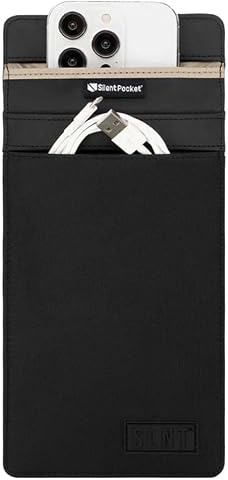
The SLNT Faraday Phone Sleeve features advanced signal-blocking technology to protect devices from cellular, WiFi, Bluetooth, GPS, RFID, NFC, EMF, and satellite signals. Made from durable weatherproof nylon or sleek leather, it offers versatile, discreet protection with dual pockets for organization, suitable for various device sizes.
Pros:
- Effectively blocks multiple signals to protect privacy
- Available in durable weatherproof nylon or sleek leather
- Multiple sizes accommodate various devices
- Compact and lightweight for everyday carry
Cons:
- May be more expensive than basic sleeves
- Requires proper closure to ensure signal blocking
- Limited color options
Best for: Phone users who want a dedicated signal-blocking sleeve
Not ideal for: People who need their phone reachable while it is stored
Bottom line: Verify the pouch’s fit and stated use, and plan around the phone being less reachable inside it.
Encrypted USB drive
Portable storage can help keep files separate from a phone or computer’s built-in storage, while an encrypted drive is intended to add a security step for stored data. The listed pick is the iStorage diskAshur2 1TB Portable Hard Drive. Confirm the product’s exact security features and supported connections in its specifications; the name alone does not describe setup, access, or compatibility.
One common mistake is buying storage based only on capacity or assuming encryption removes the need for careful handling. Check how access is controlled, how the drive is initialized, and what happens if credentials are forgotten, using the manufacturer’s documentation. Confirm that your computer or other intended device supports the required interface and any supplied software or setup process. The product is named as a portable hard drive, so check its size, power needs, and portability against how you plan to carry and connect it.
Think through which files belong on portable storage and how you will maintain a separate backup. Encryption is not a backup, and a single drive can be lost or damaged. Review the maker’s guidance for safe removal, password handling, and recovery before storing important material. If you need to move files directly from a phone, verify that your phone supports the drive’s connection method and any required adapters.
What to look for:
- Exact encryption and access-control features documented
- Supported connection types for intended devices
- Setup, credential recovery, and reset instructions
- Drive dimensions and power requirements
- A separate backup plan for important files
iStorage diskAshur2 1TB Portable Hard Drive

The iStorage diskAshur2 is a secure, portable 1TB hard drive featuring hardware-based AES-XTS 256-bit encryption and PIN authentication. It is designed for rugged use with IP56 dust and water resistance, making it ideal for protecting personal or business data on the go.
Pros:
- Hardware-based encryption requires no software installation
- Rugged design with IP56 dust and water resistance
- Broad compatibility across multiple operating systems and devices
- Helps ensure compliance with data regulations like GDPR and HIPAA
Cons:
- Requires manual PIN entry for every connection
- Transfer speeds are limited by mechanical HDD technology compared to SSDs
Best for: People who need portable storage with documented encryption
Not ideal for: Users without a compatible device or backup plan
Bottom line: Confirm supported connections and access procedures, then keep a separate backup of important files.
Hardware security key
A hardware security key can provide a physical way to authenticate to compatible accounts and services. The listed pick is the Yubico YubiKey Bio C FIDO Edition USB-C Security Key. Before choosing it, confirm that the services you use support the key’s authentication method and that your devices have a suitable USB-C connection or supported adapter.
A common buying mistake is assuming that one key works with every account, device, and sign-in flow. Check service compatibility first, including whether the account accepts FIDO security keys and whether any biometric feature is supported in the specific environment. Review the maker’s setup instructions and understand how to register the key with each account. Also plan a recovery method, such as another supported key or account recovery option, so losing the only key does not lock you out.
Consider where you will carry the key and how you will connect it to your phone or computer. Match USB-C access to your devices, including cases or ports that may make insertion awkward. Check whether the services you rely on allow more than one key to be registered, and follow their own account security guidance. A hardware key is most useful when you have confirmed the accounts and sign-in processes where you intend to use it.
What to look for:
- Support for FIDO security keys on your services
- USB-C compatibility with your phone and computer
- Biometric feature requirements for your setup
- Instructions for registering and recovering account access
- Ability to register a backup key where supported
Yubico YubiKey Bio C FIDO Edition USB-C Security Key

This USB-C security key supports FIDO2 passkeys and FIDO U2F for passwordless and second-factor authentication, using fingerprint verification with a PIN fallback. It works with Windows, macOS, ChromeOS, and Linux, and is durable, water-resistant, and battery-free.
Pros:
- Fingerprint authentication with a PIN fallback
- Supports FIDO2 passkeys and FIDO U2F
- Compatible with major desktop operating systems
- Battery-free and resistant to water, tampering, and crushing
Cons:
- Does not support OTP, TOTP, or Smart Card (PIV)
- Some advanced features require a YubiKey 5 Series
Best for: Users whose accounts and devices support FIDO security keys
Not ideal for: People who rely on services without key support
Bottom line: Verify service support and register a recovery option before making this your sign-in key.
Webcam privacy cover
A webcam cover gives you a physical way to close off a camera when it is not in use. The listed pick is Webcam Privacy Cover Slide Shutter for Logitech C920, C920x, C930e, an, but the product name appears incomplete. Treat the listed camera models as a starting point only and check the full product listing for the complete compatibility information before choosing it.
A frequent mistake is buying a cover based on camera family or appearance without checking the exact model and lens area. Confirm the full supported model list, the cover’s dimensions, and how it attaches. Check that the shutter can move freely without obstructing the lens, microphone, indicator light, or nearby controls. If the camera has a curved or textured housing, verify that the attachment method is intended for that surface and that the cover will stay in place.
Think about how often you use the webcam and whether the cover will be easy to slide open and closed during calls. Check clearance and operation with any mount, monitor, or camera accessory you already use. Follow the maker’s installation guidance and confirm that the shutter does not interfere with the camera’s normal positioning. Since the product name ends at “an,” do not infer the remaining models or fit claims; use the full listing and your camera’s model label to make the match.
What to look for:
- Complete product listing and supported camera models
- Exact camera model match, including suffixes
- Cover dimensions and attachment method
- Clearance for lens, indicator, microphone, and controls
- Shutter movement with your mount or setup
Webcam Privacy Cover Slide Shutter for Logitech C920, C920x, C930e, and C922 Pro

A sliding privacy shutter that fits Logitech C920, C920x, C930e, and C922 Pro Stream webcams, as well as other popular models. The cover slides closed to block the camera lens and protect your privacy when not in use.
Pros:
- Compatible with a wide range of Logitech webcam models
- Simple sliding design for quick privacy control
- Cost-effective alternative to OEM covers
Cons:
- Third-party product not endorsed by Logitech
Best for: Owners of a listed compatible webcam seeking a sliding cover
Not ideal for: Anyone whose exact camera fit is unclear
Bottom line: Get the complete compatibility list and match it to your camera model before installing a cover.
If you are building this checklist gradually, start with the item that addresses your most frequent exposure or inconvenience, then move to the next most relevant use case. Prioritize fit and compatibility before adding accessories: confirm device models, ports, account support, and product instructions so each choice has a clear role in your setup.
You do not need to use every category to make thoughtful choices. Review what you already own, identify the gap that matters to you, and use the look-for points to compare suitable options. A small, well-matched kit is easier to understand and use consistently. Revisit compatibility when you change phones, computers, accounts, or cameras.