
TL;DR
Mistral is positioning itself as Europe’s sovereignty-focused AI builder, emphasizing control, open weights, and enterprise-focused models. While this appeals to regulated industries, critics argue it’s falling behind in reasoning and scale compared to global giants.
Imagine a company that says, ‘We’re not just building smarter AI, we’re building AI you control.’ That’s Mistral in a nutshell. It’s a Paris-based firm riding the wave of European concerns about digital sovereignty and data control.
But here’s the twist: beneath the sovereignty story lies a tough question. Is Mistral genuinely innovating, or is it just patching a patchwork of smaller, regional advantages? The recent summit spotlighted this debate, revealing a company trying to carve out its own path—one that’s less about leading in raw power and more about control and compliance.
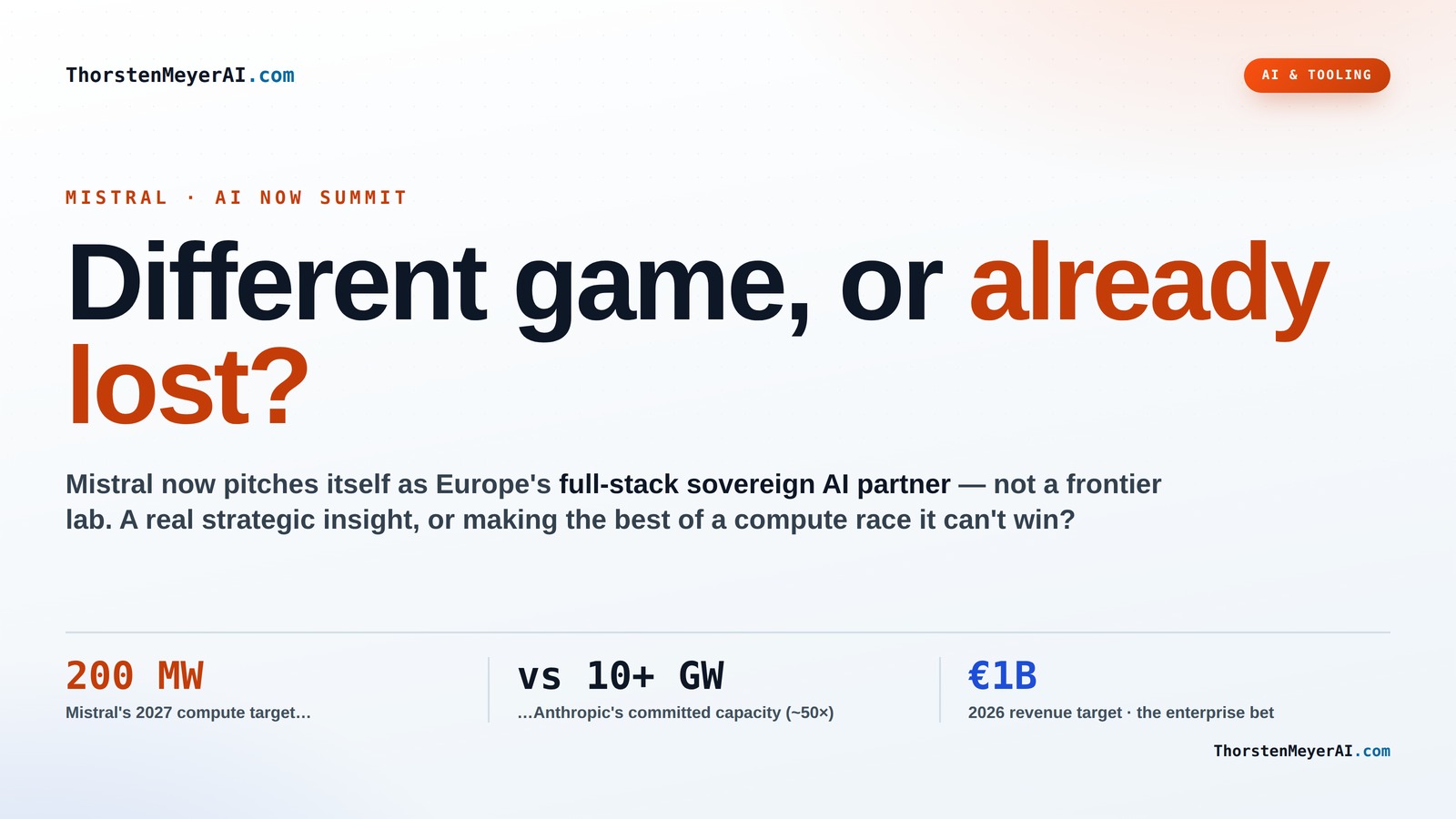
Different game, or already lost?
Mistral now pitches itself as Europe’s full-stack AI provider — compute, models, platform, consultancy — not a frontier-model lab. Is that a real strategic insight, or making the best of a race it can’t win? Both readings fit the same facts.
From model lab to full-stack provider
The clearest signal from the summit wasn’t a model — it was a posture. Heavy on enterprise logos and partnerships (ASML, BNP Paribas, Alexa+), light on new-model announcements. That absence is exactly what skeptics seized on.
Compute
40MW Paris DC + Sweden build · 200MW target by 2027
Models
Open & custom · efficient · you own and run them
Platform
Forge for custom models · Vibe for Work agent
Consultancy
Sales teams, integrators, EU provenance & support
The AI Productivity Platform Blueprint: Create a Scalable Productivity App from Scratch, Attract Thousands of Users, and Turn Artificial Intelligence Into … Business Blueprint Series Book 15)
As an affiliate, we earn on qualifying purchases.
As an affiliate, we earn on qualifying purchases.
Small & focused, or large & general?
Mistral bets on specialized small models. The claim isn’t that they win a reasoning leaderboard — they don’t. It’s that on the metrics that matter in production agent systems, a purpose-built small model wins. Flip the metric to see the case reverse.
Small specialized vs large general — by what you measure
In token-heavy agentic apps making hundreds of calls, speed/energy/cost compound. Toggle the metric.
As an affiliate, we earn on qualifying purchases.
Narrow models doing real work
Each is one model doing one thing efficiently — the tangible version of the strategy. Strong on their own terms; the open question is whether the bundle beats a free Chinese open-weight download.
On-prem KYC compliance
Mistral models run inside the bank’s walls for know-your-customer checks. Sensitive financial data never leaves. (BNP was Mistral’s first customer, 2023.)
Voxtral multilingual voice
A focused voice model powering Alexa+ across Europe — speed and efficiency over raw size.
Robostral industrial robotics
Plus a “physics AI” push (via the Emmi acquisition) into aerospace, automotive & semiconductor design and simulation.
Document AI / OCR at scale
Large-scale text extraction — the unglamorous, high-volume enterprise work small models excel at.

Claude Code for Beginners: Master Skills, MCP, and Custom Agents to Automate Tasks
As an affiliate, we earn on qualifying purchases.
As an affiliate, we earn on qualifying purchases.
The strategy is downstream of the compute gap
Once you see the raw numbers, “why is Mistral behind?” answers itself — and the specialized-small-model strategy starts looking partly like a smart adaptation to a binding constraint, not a pure philosophical choice.
Compute & capital · Mistral vs a frontier leader, this same week
Not a knock — it’s the constraint that forces the efficiency-first, sovereignty-wedge strategy. Adapting intelligently to your position is what good strategy is.

The AI Data Center Race: No-Constraints Thinking for the Age of Compute
As an affiliate, we earn on qualifying purchases.
As an affiliate, we earn on qualifying purchases.
“I want them to win, but I’m worried”
That ambivalence is the most accurate read of where Mistral sits. The enterprise pivot gets read two opposite ways — and both deserve airing.
On-prem, real sales teams, the Koyeb deployment acquisition, EU provenance — exactly what regulated enterprises want, and stickier than consumer mindshare. Targeting €1B revenue in 2026 with 1,000 staff, up from 15 people and one customer in 2023. US closed-API labs structurally can’t match the sovereignty axis.
“Software consultancy with a data center,” not a foundation-model moat. Enterprise B2B is where European startups go when they can’t win consumer or world-scale SaaS. Why pay Mistral on-prem when you could run Qwen free? One paying Le Chat Pro user said the quality gap with frontier labs is now hard to ignore.
Key Takeaways
- Mistral’s sovereignty-first approach appeals strongly to European regulated industries concerned about data control and independence.
- Open-weight models like Mistral 7B enable self-hosting, customization, and compliance, creating a trust advantage over closed API models.
- While strategic in its regional focus, critics argue Mistral falls behind in reasoning and large-scale capabilities compared to global frontier models.
- Control and regulatory compliance can be a durable moat for Mistral, but only if they can maintain technical competitiveness in reasoning and scale.
- Enterprises buying Mistral prioritize sovereignty, flexibility, and data residency over raw model leaderboard performance.
What Does Sovereign AI Really Mean? It’s About Control, Not Just Tech
Sovereign AI is about owning your data, models, and infrastructure. It’s control in a world obsessed with data privacy and regulation. Think of a bank running AI in its own servers, not on a cloud managed by a US giant. That’s sovereign AI.
For example, BNP Paribas uses Mistral models on-prem to process sensitive customer info, ensuring compliance with strict European data laws. This setup isn’t just about privacy; it’s about reducing dependency and risk, especially in highly regulated sectors.
In practice, sovereignty means customizing, inspecting, and updating models without external interference. It’s a strategic shield against geopolitics and regulatory crackdowns—a key reason for Mistral’s appeal in Europe.

How Mistral’s Strategy Stands Out from OpenAI and Anthropic
Mistral isn’t just another AI lab. It’s positioning as a full-stack provider—covering compute, models, and deployment—especially for clients who want self-hosted solutions. Unlike OpenAI, which offers API access, Mistral emphasizes owning the entire stack.
They've built a 40MW data center near Paris and plan to hit 200MW by 2027, aiming for European independence in compute resources. Their models, like the open-weight Mistral 7B, are designed for self-hosting and customization—appealing to regulated sectors wary of vendor lock-in.
This approach isn’t just about tech; it’s about strategic independence. It’s a different game—one focused on control and sovereignty rather than just raw AI power.

Open Weights and Self-Hosting: The Power of Transparency
Open weights are Mistral’s secret weapon. They released models like Mistral 7B and Mixtral, which users can download, fine-tune, and run locally. This transparency appeals to organizations that need to inspect and modify their AI models—especially in regulated industries.
Imagine a European bank customizing a model to meet strict compliance rules—no external API needed. They can keep sensitive data inside their own servers, avoiding dependency on US cloud giants.
This open approach also fosters trust, giving users the confidence to deploy AI in sensitive environments. It’s a clear differentiator in a landscape dominated by closed, API-only services.
Is Sovereignty a Long-Term Moat or Just a Regional Preference?
Sovereignty sounds powerful, but is it enough to keep Mistral ahead? The debate hinges on whether control and compliance outweigh raw model performance. For many European businesses, sovereignty is a must-have. But globally, giants like OpenAI and Anthropic push forward on reasoning and scale.
Consider the example of a government agency that needs to run AI in-house due to legal constraints. For them, sovereignty isn’t optional—it’s a non-negotiable. But for a startup wanting cutting-edge reasoning, the big models still dominate.
So, sovereignty can be a regional advantage, but it might not be enough to win the broader AI race—at least not on raw capability.

Critics Say Mistral Is Falling Behind on Reasoning and Scale
The critics argue Mistral’s models, including the popular 7B, aren’t keeping pace with the latest giants on reasoning and medium-context understanding. On Hacker News, many say Mistral is falling far behind in benchmarks that measure complex reasoning and multi-turn conversations. For more insights, see reading Mistral's sovereignty bet.
For instance, while Mistral’s models excel in specific tasks, they lag behind GPT-4 or Claude in nuanced understanding and reasoning. This gap is critical because enterprise applications often demand high levels of accuracy, contextual understanding, and multi-turn reasoning. If Mistral’s models can’t meet these needs, their suitability for high-stakes deployments diminishes, limiting their competitive edge in the broader AI ecosystem.
It’s a tradeoff: focus on control and quick, efficient models versus chasing the biggest, most capable models. The question is whether Mistral can bridge this gap or if it’s already lost the front-line fight.

What Enterprises Are Really Buying When They Choose Mistral
When companies buy Mistral, they aren’t just after cutting-edge reasoning—they’re after control, compliance, and flexibility. They want models they can host themselves, tweak, and keep inside their own walls. Think of a European pharma firm deploying Mistral models on-prem to analyze sensitive patient data without external risks.
For regulated industries, the appeal is clear: reduce dependency on US cloud giants, meet strict data laws, and retain control. Mistral’s enterprise focus is about building trust and reducing regulatory headaches, not just winning in benchmark leaderboards.
So, the core value isn’t just the model—it’s the entire package of sovereignty, support, and customization.
Frequently Asked Questions
What does 'sovereign AI' really mean?
Sovereign AI means owning and controlling your models, data, and infrastructure—not relying on external cloud services. It’s about deploying AI on your terms, especially in regulated industries that need privacy and compliance.
Is Mistral open source or just open weights?
Mistral offers open weights like Mistral 7B and Mixtral, which users can download, fine-tune, and self-host. This openness is a core part of their strategy, fostering transparency and control.
Why would a company choose Mistral over OpenAI or Anthropic?
Many companies pick Mistral for its focus on sovereignty, control, and compliance. They want models they can run internally, customize, and keep within European data laws—something API-only services can’t reliably provide.
Does sovereignty matter more than benchmark performance?
For many regulated European companies, yes. Sovereignty ensures control, compliance, and reduced dependency, which can outweigh the benefits of slightly better reasoning in less controlled environments.
Can Mistral compete with larger labs on reasoning and scale?
It’s a tough challenge. Critics say Mistral’s models lag behind GPT-4 and others on complex reasoning. Whether they can innovate fast enough to catch up remains an open question.
Conclusion
Mistral’s bet on sovereignty and full-stack control may carve out a vital niche, especially in Europe. But as AI advances rapidly—pushing bigger models and deeper reasoning—the question remains: can sovereignty alone sustain a competitive edge?
For now, Mistral’s focus on control and transparency keeps it relevant. But the AI race favors scale and reasoning—those who master both will lead. Your move, Mistral.




![Self-Distillation Enables Continual Learning [pdf]](https://aiespionage.net/wp-content/uploads/2026/05/self-distillation-enables-continual-learning-pdf-featured-560x300.jpg)