
TL;DR
A July 1, 2026 ISR Briefing argues that Wide-Area Motion Imagery can record and rewind movement across city-sized areas, making AI and layered radar support central to its use. The report says the technology’s reach is matched by limits in weather, data handling, airspace access and civil-liberties oversight.
Thorsten Meyer AI published a July 1, 2026 ISR Briefing arguing that Wide-Area Motion Imagery can track and archive movement across city-sized areas, a capability that carries clear intelligence value but also unresolved questions over privacy, oversight and control.
The briefing says a conventional drone camera is limited to a narrow field of view, while WAMI sensors combine many cameras into a single composite image covering several square kilometers. According to the source material, analysts can use archived imagery to move backward from an event and follow a vehicle or person to an earlier location.
The report describes WAMI as a system built around capture, stabilization, AI-based detection, tracking and archiving. It cites DARPA’s ARGUS-IS as a widely discussed example, using 368 five-megapixel cameras to produce about a 1.8-gigapixel image, with reported resolution near 13 centimeters per pixel from 17,500 feet.
The article says the technology is constrained by weather, smoke, darkness, data volume and the need for overhead access. It argues that AI processing near the sensor is required because the imagery stream is too large for humans to watch live or for full raw feeds to be moved easily.
The eye over the city: how Wide-Area Motion Imagery works — and where it goes blind
A normal drone sees through a soda straw. WAMI watches an entire city at once, tracks every mover, and records it all for forensic rewind. Immense reach — with hard limits that make radar and AI its necessary partners.
- City-scale motion, fine detail
- Forensic rewind
- Cloud / smoke / dark degrade it
- Needs a platform loitering overhead
sensing
+ AI
- Sees through cloud & total dark
- Tasked over denied airspace
- Persistent, wide-area from orbit
- Sovereign · on-prem · air-gap
The same archive that traces a bomber to a safe house can trace anyone home — retroactively, without prior suspicion. Baltimore’s secret 2016 deployment led to a 2021 federal ruling that persistent aerial tracking violated the Fourth Amendment. The security value is real; so is the mass-surveillance risk. Who owns the sensor, the archive, and the AI is the accountability question.
WAMI’s power is the archive and the AI reading it; its weakness is weather, airspace, and oversight. The mature posture isn’t optical-vs-radar or capability-vs-liberty — it’s layered sensing (optical WAMI + all-weather SAR), AI-enabled exploitation, and sovereign, auditable control of the whole chain. WAMI shows what a persistent eye can do with clear skies and owned airspace; for the cloud, the night, and the denied area, the radar layer is where the resilient coverage lives.
City Tracking Meets Legal Pressure
The briefing’s central point is that WAMI’s power lies in its archive. Used after an attack, shooting or border incident, the recording can help analysts reconstruct routes and contacts. Used without limits, the same archive could allow retroactive tracking of ordinary people who were not suspected of wrongdoing.
That distinction matters because persistent aerial surveillance has already faced legal challenge. The source material points to Baltimore’s secret 2016 deployment and a 2021 federal appeals ruling that found persistent aerial tracking violated the Fourth Amendment.
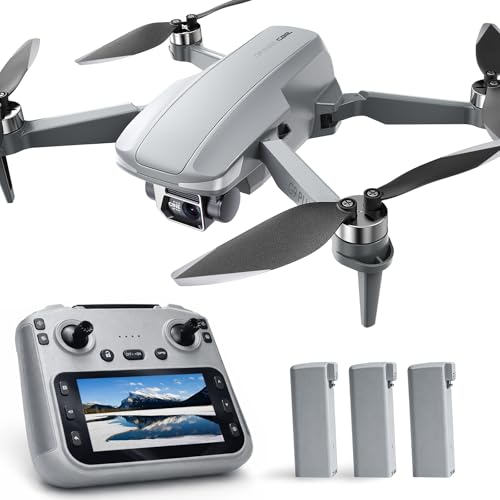
GPS Drone with EIS 4K Camera for Adults , RC Drones with 4.5 inch HD Screen on Controller, Auto Return, 3 Batteries for 90 min Flight Time, 3280 FT Long Control Range Transmission, Circle Fly and Follow Me Mode, Foldable Quadcopter for Beginner Gifts Toy, Under 249g
- HD Display Remote Controller: 4.5-inch high-definition live video feed
- Includes 32GB SD Card: For instant photo and video storage
- GPS Assisted Flight: Stable flights up to 3280 FT away
As an affiliate, we earn on qualifying purchases.
As an affiliate, we earn on qualifying purchases.
From Narrow Video To City Frames
The briefing places WAMI within the wider field of intelligence, surveillance and reconnaissance. BAE Systems is cited as describing WAMI as an airborne optical system that fuses sensors, cameras and processors to detect and track moving objects across a broad area.
RUSI analysts are cited as saying WAMI offers far broader coverage than ordinary full-motion video and adds a forensic capability other wide-area sensors do not provide in the same way. The briefing also says radar systems such as synthetic aperture radar can fill gaps when optical systems are limited by clouds, darkness or denied airspace.
“A normal drone sees through a soda straw. WAMI watches an entire city at once.”
— Thorsten Meyer AI ISR Briefing

DJI Avata 2 Fly Smart Combo (Single Battery), FPV Drone with Camera 4K, Immersive Experience, One-Push Acrobatics, Built-in Propeller Guard, 155° FOV, Camera Drone with Goggles N3 and RC Motion 3
- Immersive Flying Experience: Goggles provide cockpit-like visuals
- Intuitive Motion Control: Control drone with natural hand gestures
- Easy Acrobatics: Perform flips, rolls, and drifts effortlessly
As an affiliate, we earn on qualifying purchases.
As an affiliate, we earn on qualifying purchases.
Oversight Details Remain Open
The briefing does not resolve who should control sensor ownership, data retention, AI review or audit access. It also does not provide a single operating standard for how long archived imagery should be kept or when investigators may search it.
Technical limits also remain case-dependent. The report says cloud, smoke, darkness and airspace restrictions can reduce WAMI’s value, but performance will vary by sensor, altitude, weather, platform and mission rules.
As an affiliate, we earn on qualifying purchases.
Radar And Audit Rules Advance
The briefing points to a layered model in which optical WAMI is paired with all-weather radar sensing and AI-supported analysis. It says resilient coverage will depend on systems that can operate when aircraft cannot safely loiter or when optical imagery is degraded.
The policy question now is whether governments and vendors can define clear audit trails, retention limits and search rules before wider use. The next phase is likely to focus as much on governance and accountability as on sensor performance.

The Drone Age: How Drone Technology Will Change War and Peace
As an affiliate, we earn on qualifying purchases.
As an affiliate, we earn on qualifying purchases.
Key Questions
What is Wide-Area Motion Imagery?
Wide-Area Motion Imagery is an airborne imaging method that combines many cameras into a broad view, allowing analysts to track movement across city-sized areas rather than one small scene.
Why is AI needed for WAMI?
The briefing says AI is required because WAMI produces too much imagery for human teams to watch live. AI systems help detect, track and sort large numbers of movers across the frame.
What makes WAMI controversial?
The same archive that can help reconstruct an attack route can also support retroactive tracking of people who were not under prior suspicion. That creates privacy and constitutional concerns.
Can WAMI work in all weather?
No. The briefing says optical WAMI can be degraded by clouds, smoke, darkness and airspace limits. Radar systems may help cover some of those gaps.
What is the main unresolved issue?
The unresolved issue is accountability: who controls the sensor, who can search the archive, how AI outputs are audited, and how long movement records are retained.
Source: Thorsten Meyer AI