
Deepfakes started in the early 2010s with experiments in digital manipulation and machine learning. Researchers used neural networks, especially GANs, to create realistic fake videos, initially for entertainment and artistic projects. As technology became more accessible, anyone could produce convincing content quickly, leading to a rise in misinformation, privacy concerns, and societal debates. If you keep exploring, you’ll discover how this powerful innovation continues shaping our digital world and its challenges.
Key Takeaways
- Deepfakes originated from early efforts in machine learning and digital manipulation, with GANs emerging in the mid-2010s.
- Initially, the technology was used by researchers and tech-savvy enthusiasts, sharing open-source tools and tutorials.
- High-profile celebrity deepfake videos in 2017 drew public attention and highlighted risks of misinformation and privacy violations.
- As accessibility grew, anyone could produce convincing fake videos quickly, fueling a surge in malicious and entertainment content.
- The rise of deepfakes prompted ongoing discussions on ethical, societal, and technological challenges and the need for regulation.
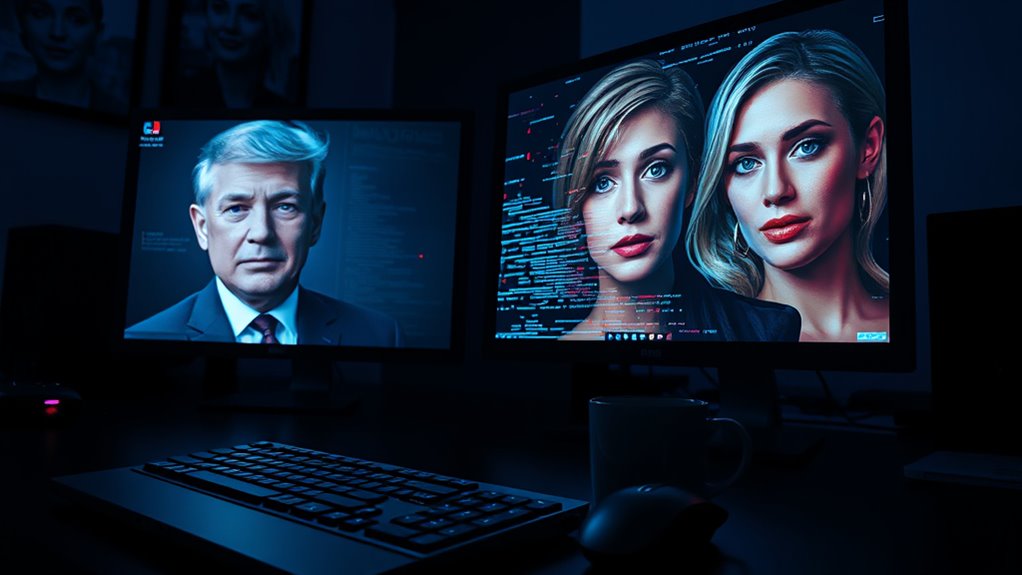
Deepfakes have rapidly transformed from a niche digital novelty into a powerful tool with far-reaching implications. You might have first heard about them through viral videos or social media posts, but their roots go back to the early days of machine learning and digital manipulation. It all started with the desire to create realistic computer-generated images and videos, leveraging advancements in artificial intelligence. In the mid-2010s, researchers and hobbyists began experimenting with generative adversarial networks, or GANs, a breakthrough technology that allows computers to generate highly convincing images and videos. GANs operate by pitting two neural networks against each other—one generating fake content, the other trying to detect it—consequently improving the realism with each iteration. This process quickly became the backbone of deepfake creation, enabling users to swap faces, alter expressions, or produce entirely synthetic videos that look remarkably authentic.
Initially, deepfake technology was accessible mainly to researchers and tech-savvy enthusiasts, who used open-source tools and code shared freely online. You could find tutorials and communities dedicated to creating and sharing deepfake videos, often for entertainment, satire, or artistic expression. However, as the technology improved, so did its potential for misuse. What started as amusing or impressive demonstrations soon raised serious concerns about misinformation, privacy violations, and malicious impersonation. Around 2017, the term “deepfake” gained widespread attention, thanks in part to a few high-profile videos featuring celebrities with altered faces or voices. These videos showcased the impressive potential of the technology but also highlighted its darker applications.
The rapid evolution of deepfake tools meant that anyone with a basic understanding of AI could produce convincing fake videos in a matter of hours, if not minutes. This democratization of the technology fueled an explosion of content—some harmless, others dangerous. You might have seen fake celebrity videos, political figures appearing to say things they never did, or fake news spread quickly across social media. These developments marked a turning point, revealing how deepfakes could influence public opinion, manipulate elections, or damage reputations. The early history of deepfakes is therefore a story of innovation meeting caution, where the same tools that create entertainment can also be weaponized. It’s a short, sharp reminder that technological progress always comes with ethical and societal responsibilities. Moreover, ongoing research into color fidelity and accuracy continues to improve the realism and potential uses of deepfake technology.
Deepfake and Image Forgery Detection: Cybersecurity, Multimedia Forensics, Image Manipulation (De Gruyter STEM)

As an affiliate, we earn on qualifying purchases.
As an affiliate, we earn on qualifying purchases.
Frequently Asked Questions
How Do Deepfakes Impact Political Stability?
Deepfakes can destabilize politics by spreading misinformation and eroding trust in leaders and institutions. You might find it harder to distinguish real from fake content, which fuels confusion and suspicion. As you encounter manipulated videos or audio, your confidence in political messages diminishes, increasing polarization and unrest. These technologies threaten democratic processes by manipulating public opinion and undermining factual discourse, making political stability more fragile.
What Are the Legal Consequences of Creating Deepfakes?
Creating deepfakes can lead to serious legal consequences, including criminal charges like fraud or defamation. In 2020, courts in the U.S. convicted individuals for manipulating videos to spread false information. You could face hefty fines, imprisonment, or lawsuits if your deepfake harms someone’s reputation or violates privacy laws. Laws are rapidly evolving to combat malicious use, so understanding these legal risks helps you avoid severe penalties.
Can Deepfakes Be Detected Reliably?
Detecting deepfakes reliably is challenging but improving. You can use specialized software that analyzes inconsistencies in facial movements or artifacts left by editing. However, deepfake creators constantly refine their techniques, making detection harder. Staying informed about new detection tools and techniques helps you spot fakes more effectively. While no method is foolproof, combining multiple approaches increases your chances of identifying deepfakes accurately.
How Do Deepfakes Influence Public Trust?
Imagine a clear stream suddenly muddied by a false reflection—that’s how deepfakes shake your trust. They make you question what’s real, turning familiar faces into masks and honest words into illusions. As these images weave into the fabric of your daily life, your confidence in media and information weakens, fostering doubt and suspicion. You become more cautious, unsure what to believe, as trust erodes in the face of convincing deception.
What Are Future Trends in Deepfake Technology?
You’ll see deepfake technology becoming more realistic and accessible, making it harder to distinguish real from fake content. AI algorithms will improve, enabling seamless video and audio manipulations that could influence politics, entertainment, and social media. You might also encounter tools that help detect deepfakes more effectively. However, as these trends evolve, you’ll need to stay vigilant and critical of the media you consume to avoid misinformation.
Conclusion
So, here you are, witnessing the rise of deepfakes—an incredible feat of technology that’s blurring truth and fiction. Ironically, just as we marvel at its potential, it also invites us to question what’s real anymore. You thought you’d always be able to tell the difference? Think again. In this brave new world, the line between genuine and fake isn’t just blurred; it’s disappearing altogether. Welcome to the age where seeing isn’t always believing.