
TL;DR

Get privacy and security gear delivered free with Prime
- Fast, free delivery on millions of items
- Prime Video, Amazon Music and more included
- Member-only deals all year
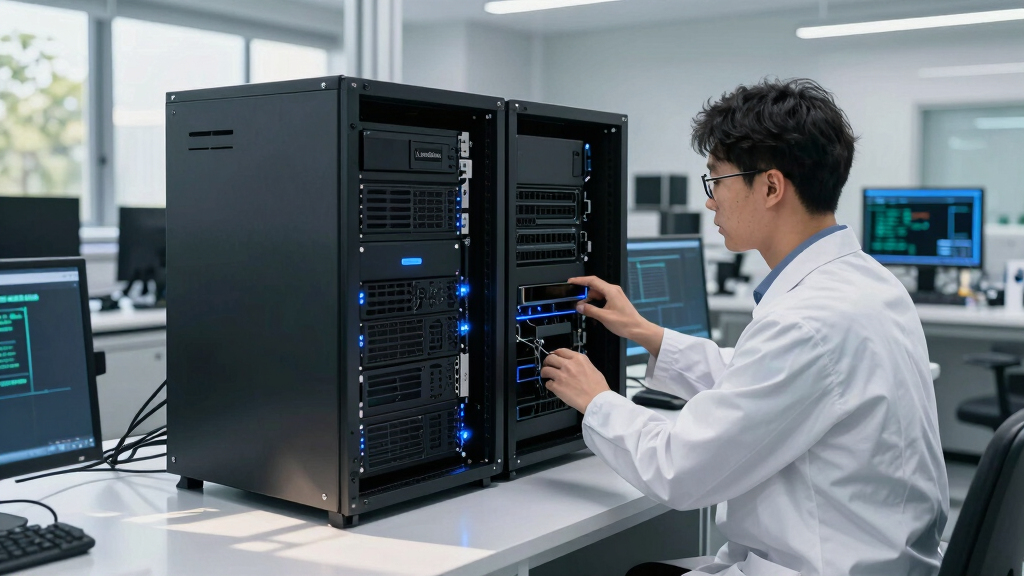
China has launched the LineShine supercomputer, a 1.54-exaflop CPU-only system with Arm processors, bypassing US-imposed GPU bans. It highlights a strategic shift towards CPU-centric AI and HPC solutions.
China has launched the LineShine supercomputer, a 1.54-exaflop machine built entirely with Arm-based CPUs, bypassing US restrictions on GPU exports. This development marks a significant shift in China’s supercomputing approach, emphasizing CPU-only architectures for AI and HPC workloads.
The supercomputer, developed by China’s National Supercomputing Center, comprises 20,480 nodes, each with two LX2 processors, totaling 40,960 CPUs and over 2.4 million cores. Each LX2 processor contains two compute chiplets with 304 cores, integrating advanced vector and matrix units (SVE and SME) to accelerate AI training and scientific computations.
The system delivers 1.54 exaflops of BF16 training performance, peaking at 2.16 exaflops during specific AI workloads. It employs a unique memory subsystem combining 32 GB of on-package HBM with 4 TB/s bandwidth and 256 GB of DDR5 memory, enabling large-scale data handling. The supercomputer is interconnected via the LingQi high-speed network at 1.6 Tb/s per node.
Compared to GPU-based supercomputers, LineShine’s CPU-centric design avoids costly data transfers and complex programming models associated with heterogeneous architectures. It also aligns more closely with traditional HPC workflows, integrating seamlessly with existing infrastructures.
Why It Matters
This development signifies a strategic pivot for China in supercomputing, reducing dependence on US-made GPUs and platforms like Nvidia’s CUDA. It demonstrates China’s ability to innovate within export restrictions, potentially altering global supercomputing and AI deployment strategies. The move may influence international technology policies and competition in high-performance computing.
high performance CPU supercomputer
As an affiliate, we earn on qualifying purchases.
As an affiliate, we earn on qualifying purchases.
Background
In recent years, US export bans have limited China’s access to high-end GPUs, prompting a shift towards CPU-only supercomputers that leverage advanced Arm processors. China’s previous deployments have relied heavily on CPU architectures, but the scale and performance of LineShine mark a new milestone. The machine’s performance exceeds previous Chinese supercomputers and highlights a focus on AI workloads optimized for dense matrix and vector operations.
While US-based supercomputers often combine CPUs and GPUs for maximum performance, China’s approach emphasizes CPU-centric designs with high-bandwidth memory subsystems, aiming to address AI training and scientific computing without reliance on foreign accelerators.
“The LineShine supercomputer exemplifies China’s strategic shift towards CPU-only architectures for AI and HPC, bypassing US GPU restrictions and showcasing innovative use of Arm processors.”
— Anton Shilov, Tom’s Hardware
“LineShine demonstrates our capability to develop high-performance, CPU-centric supercomputers that meet the demands of modern AI and scientific workloads.”
— Chinese National Supercomputing Center spokesperson
What Remains Unclear
It remains unclear how the performance of LineShine compares in real-world applications to GPU-based systems, as peak theoretical metrics may not directly translate to operational efficiency. Additionally, the long-term impact on China’s technological independence and global competition is still developing.
What’s Next
Next steps include detailed performance evaluations, integration into scientific and AI research projects, and potential scaling or replication of this architecture. Monitoring how other nations respond to China’s CPU-centric supercomputing approach will also be important.
Key Questions
Why did China develop a CPU-only supercomputer?
Due to US export restrictions on high-end GPUs, China focused on leveraging its domestic Arm-based CPUs to maintain and advance its supercomputing capabilities.
How does LineShine’s performance compare to GPU-based supercomputers?
LineShine delivers 1.54 exaflops of BF16 performance, but its peak theoretical performance in FP64 is around 2.47 exaflops. Its real-world efficiency relative to GPU systems remains to be fully assessed.
What are the advantages of a CPU-only supercomputer?
CPU-only systems avoid costly data transfers, simplify programming models, and integrate more naturally with traditional HPC workflows, especially for AI training involving irregular control flow and large datasets.
Will this architecture influence global supercomputing strategies?
Potentially, as it demonstrates an alternative approach to high-performance computing that reduces reliance on foreign accelerators, possibly inspiring other nations to pursue similar CPU-centric designs.
Halloween Picks
halloween
As an affiliate, we earn on qualifying purchases.