Indoor security drone can mean a small camera drone for checking rooms, capturing a quick view from above, or practicing monitored flights—not a self-patrolling security system. Among these five, I’d start with the DJI Neo for approachable 4K capture and full-coverage propeller guards, or the DJI Avata when wider, more immersive footage matters more than simple setup. For a lower-complexity starter, the Vrcyu CZ26 includes beginner controls and two batteries.

Get privacy and security gear delivered free with Prime
- Fast, free delivery on millions of items
- Prime Video, Amazon Music and more included
- Member-only deals all year
The tradeoff is that no model here is described as an autonomous indoor patrol drone: each needs a person to control it, and indoor flight still brings collision, privacy, and battery limits. Image quality, camera adjustment, controller setup, and flight stability separate the picks. I rank them for practical indoor monitoring potential, while giving weight to guarded propellers, ease of control, useful camera coverage, and how much extra equipment the buyer needs.
Key Takeaways
- DJI Neo is my most balanced pick for indoor video: stabilized 4K and full-coverage propeller guards pair with several control options, though the standard combo includes one battery.
- DJI Avata offers the widest listed field of view at 155° and 4K stabilization, but goggles and a remote controller are sold separately and its obstacle sensing is limited.
- Vrcyu CZ26 is the most approachable starter kit here, with altitude hold, one-touch controls, guards, a case, and two batteries; its stated maximum range is 262 feet.
- AxrumRC KY106 gives beginners a built-in 4.3-inch controller screen, so monitoring the camera feed does not require a smartphone; footage is limited to 720p.
- AxrumRC 720p Mini adds optical-flow positioning and a manually adjustable camera, but its entry-level resolution and manual camera adjustment make it less suited to detailed documentation.
| DJI Neo Mini Drone with 4K UHD Camera |  | Best Overall for Approachable 4K Indoor Monitoring | Video resolution: 4K UHD, stabilized | Still image resolution: 12 MP | Weight: 135 g | VIEW LATEST PRICE | See Our Full Breakdown |
| DJI Avata First-Person View Drone |  | Best for Wide-Angle, Immersive Footage | Video resolution: 4K stabilized | Field of view: 155° | Sensor: 1/1.7-inch | VIEW LATEST PRICE | See Our Full Breakdown |
| Vrcyu CZ26 Mini Drone with HD FPV Camera, 90° Tilt Lens, and Two Batteries |  | Best Beginner Kit | Camera: HD FPV, CMOS sensor | Camera adjustment: Electric 90° tilt lens | Total flight time: Up to 25 minutes across two batteries | VIEW LATEST PRICE | See Our Full Breakdown |
| AxrumRC KY106 Mini Drone with Camera and 4.3-Inch Screen Remote |  | Best for Smartphone-Free Monitoring | Video resolution: 720p MP4 | Controller display: Built-in 4.3-inch screen | Flight positioning: Optical flow and altitude hold | VIEW LATEST PRICE | See Our Full Breakdown |
| AxrumRC Mini RC Drone with 720p Camera |  | Best Compact Practice Drone | Camera resolution: 720p | Still image resolution: 0.9 MP | Camera adjustment: Manual 90-degree adjustment | VIEW LATEST PRICE | See Our Full Breakdown |
| indoor security drone | Weight | Video resolution |
|---|---|---|
| DJI Neo Mini Drone with 4K UHD | 135 g | 4K UHD, stabilized |
| DJI Avata First-Person View Dr | 0.41 kg | 4K stabilized |
| Vrcyu CZ26 Mini Drone with HD | 4.48 ounces | — |
| AxrumRC KY106 Mini Drone with | 2.08 ounces | 720p MP4 |
| AxrumRC Mini RC Drone with 720 | 84.1 g | — |
More Details on Our Top Picks
DJI Neo Mini Drone with 4K UHD Camera
The DJI Neo earns my top position because it balances useful indoor imaging with a comparatively approachable control setup. Its stabilized 4K video gives footage more detail than either 720p AxrumRC model, while the included full-coverage propeller guards are a sensible match for operating around indoor obstacles. At 135 g, it is also lighter than the Avata, which weighs 0.41 kg according to the supplied specs.
Control flexibility is its strongest distinction. Neo supports app, voice, or remote-controller operation, plus palm takeoff and landing. That can make short, supervised checks simpler than setting up the Avata’s FPV-oriented system. Its subject tracking and eight QuickShots modes are useful capture tools, though they should not be mistaken for autonomous security patrol features. The product details do not identify a dedicated patrol mode or continuous monitoring function.
Compared with the Vrcyu CZ26, Neo is the stronger choice when image detail and stabilization matter more than receiving two batteries and a carrying case in the box. Compared with Avata, it is lighter and includes full-coverage guards, but Avata’s 155° field of view is substantially wider than Neo’s unspecified field of view. I would choose Avata for an experienced pilot prioritizing immersive, wide-angle footage and Neo for a broader range of supervised indoor uses.
The compromises are meaningful. The standard combo includes one battery, so extended room-by-room checks may require a pause to recharge or an additional battery. The DJI Fly app must be downloaded from DJI’s official website, which adds a setup step for app control. I also would not interpret the stated 10 km maximum range as an indoor operating target: walls and room layout make long-range claims a poor measure of performance inside a home. For controlled, short flights, Neo is the most balanced pick in this group; for unattended surveillance, I would choose a fixed security camera instead.
Pros:- Stabilized 4K UHD video and 12 MP stills provide more detail than the two 720p models.
- Full-coverage propeller guards are well suited to cautious indoor flying.
- App, voice, and remote-controller options let buyers choose a preferred control method.
- Palm takeoff and landing, subject tracking, and QuickShots simplify short capture sessions.
Cons:- The standard combo includes only one battery.
- The DJI Fly app must be downloaded from DJI’s official website.
- Listed features do not establish autonomous security patrol or unattended monitoring.
Best for: Buyers who want a guarded, lightweight drone for supervised indoor checks and value stabilized 4K footage with several control options.
Not ideal for: People seeking continuous or autonomous patrols, a multi-battery kit, or a drone that can operate without app setup or hands-on piloting.
- Video resolution:4K UHD, stabilized
- Still image resolution:12 MP
- Weight:135 g
- Battery:1435 mAh; one battery included in standard combo
- Control options:App, voice, or remote controller
- Propeller protection:Full-coverage guards
- Capture features:Subject tracking and eight QuickShots modes
Our verdict“I recommend the DJI Neo as the best overall supervised indoor camera drone here, provided you accept a single included battery and do not expect autonomous surveillance.”
DJI Avata First-Person View Drone
If a wide field of view is the priority, the DJI Avata stands apart from the other picks. Its listed 155° field of view, 1/1.7-inch sensor, and stabilized 4K capture give it the strongest stated combination for seeing a broad area and recording detailed footage. Built-in propeller guards add a layer of protection for agile flying, although guards do not make close indoor flight risk-free.
Avata’s role is more specialized than Neo’s. It suits a buyer who already understands FPV flying or is prepared to purchase and learn the separate goggles and controller. Those accessories are not included, making setup less straightforward than the Neo’s palm takeoff and multiple control choices or the CZ26’s one-touch controls. The Avata’s compact form and stated 18-minute flight time are useful, but the product details do not establish that it can patrol rooms independently.
For indoor coverage, its wide lens can show more of a room in one shot than the 720p AxrumRC cameras, and it offers a more immersive perspective than the Neo’s listed feature set specifies. Yet its obstacle sensing is limited to downward sensing in certain flight modes. That matters more indoors than the impressive 10 km transmission-range figure: furniture, walls, people, and pets are close obstacles, and the supplied specs do not describe comprehensive collision avoidance.
The camera’s 155° view is also tied to specific aspect ratios and resolutions, so buyers should check that the desired framing works for their intended recording format. I place Avata second rather than first because its image potential is excellent, but its separate equipment, specialized FPV orientation, and limited sensing make it a less convenient general-purpose indoor choice than Neo. It is the better fit for skilled pilots who value immersive wide-angle footage; beginners wanting a simple room-check tool should look at the Vrcyu CZ26 or DJI Neo instead.
Pros:- 155° field of view can capture a broad perspective in a single pass.
- 1/1.7-inch sensor and stabilized 4K video lead the lineup on stated imaging hardware.
- Built-in propeller guards help protect the aircraft during minor bumps.
- Up to 18 minutes of flight time is longer than the stated total for the CZ26.
Cons:- Goggles and remote controllers are sold separately.
- Obstacle sensing is limited to downward sensing in specific flight modes.
- The 155° view is restricted to particular aspect ratios and resolutions.
Best for: Experienced or FPV-curious pilots who want a very wide view, stabilized 4K footage, and guarded agility for carefully supervised flights.
Not ideal for: First-time pilots, buyers who want a ready-to-fly controller-and-display kit, or anyone relying on obstacle avoidance for tight indoor navigation.
- Video resolution:4K stabilized
- Field of view:155°
- Sensor:1/1.7-inch
- Flight time:Up to 18 minutes
- Weight:0.41 kg
- Transmission range:Up to 10 km stated
- Included protection:Built-in propeller guards
- Obstacle sensing:Downward sensing in specific flight modes
Our verdict“I’d choose Avata for wide, immersive footage and an experienced pilot, but its separate controls and limited sensing keep it behind Neo as an all-around indoor pick.”
Vrcyu CZ26 Mini Drone with HD FPV Camera, 90° Tilt Lens, and Two Batteries
The Vrcyu CZ26 is my beginner pick because its controls and included accessories make the first supervised flights less complicated. Altitude hold, headless mode, and one-touch takeoff and landing reduce the number of controls a new pilot has to manage at once. The kit also includes propeller guards, a carrying case, spare props, a phone holder, and two batteries, so it arrives better equipped for practice than Avata, which needs separately purchased goggles and a controller.
Its camera is an HD FPV model with an electrically adjustable 90° tilt lens. Being able to change the angle remotely gives it more framing flexibility than the AxrumRC 720p drone, whose camera must be repositioned manually. The listed total flight time is up to 25 minutes across two batteries, a helpful provision for learning, although it is not a single 25-minute uninterrupted flight. Its maximum stated range is 262 feet, far shorter than the headline transmission ranges listed for the DJI models.
For indoor security-style checks, the CZ26 is best understood as a learning and casual-viewing tool rather than a high-detail recorder. The supplied description calls its camera HD but does not give a specific resolution, so I would not assume footage will match the Neo or Avata’s 4K output. Its beginner functions help with basic handling; they do not establish automatic room patrols, reliable obstacle avoidance, or continuous recording. Compared with the DJI Neo, it sacrifices stated 4K stabilization and subject tracking for a more complete starter bundle.
The tradeoff is sensible for a first drone: an accessible feature set and useful kit, but modest stated range and limited total flight time. Buyers who need to inspect fine details or preserve clearer documentation should move up to the Neo. Buyers who want a screen integrated into the controller may prefer the AxrumRC KY106, though that model is limited to 720p as well. I’d choose the CZ26 for a new pilot who values setup aids and included accessories over premium image quality.
Pros:- Altitude hold, headless mode, and one-touch takeoff and landing help beginners manage basic flights.
- Remote 90° camera tilt makes framing easier to change than on the manually adjusted AxrumRC 720p model.
- Two batteries provide up to 25 minutes of combined stated flight time.
- Includes propeller guards, a carrying case, spare props, and a phone holder.
Cons:- Maximum stated range is 262 feet.
- The up-to-25-minute figure applies to both batteries combined.
- The supplied description does not specify a numerical camera resolution.
Best for: First-time drone owners who want guarded practice, basic flight aids, an adjustable camera angle, and two batteries in the kit.
Not ideal for: Buyers who need clearly specified 4K footage, long indoor operating range, or security patrol features beyond person-controlled flight.
- Camera:HD FPV, CMOS sensor
- Camera adjustment:Electric 90° tilt lens
- Total flight time:Up to 25 minutes across two batteries
- Maximum range:262 feet
- Flight aids:Altitude hold, headless mode, one-touch takeoff and landing
- Weight:4.48 ounces
- Included protection:Propeller guards and spare propellers
- Control:Remote control and app
Our verdict“The CZ26 is my best beginner kit for learning supervised indoor flight, but I’d move to the Neo when detailed, stabilized footage matters more.”
AxrumRC KY106 Mini Drone with Camera and 4.3-Inch Screen Remote
The AxrumRC KY106 has one feature that makes it unusually convenient for quick indoor checks: a remote with a built-in 4.3-inch screen. Buyers can monitor the camera view without mounting or connecting a smartphone, which is a clear advantage over the CZ26’s phone-and-app setup. Optical-flow positioning and altitude hold also support steadier hovering for a beginner trying to keep a view on a doorway or corner.
Its simplicity comes with a clear image-quality ceiling. The camera records at 720p, so it cannot match the Neo’s stabilized 4K output or Avata’s 4K sensor combination. That may be fine for a basic live view or casual practice, but less suitable when the goal is to retain detailed footage for later inspection. The supplied specs list Wi-Fi connectivity and MP4 video, while the two included batteries and spare propellers help with repeated practice sessions.
Compared with the Vrcyu CZ26, the KY106 trades a remotely tilting camera and a carrying case for a dedicated viewing screen built into the controller. The CZ26 lists more beginner-oriented controls, including headless mode and one-touch landing, while the KY106’s main usability advantage is not needing a phone. Compared with the AxrumRC 720p Mini, the KY106 also offers a controller screen, while that other model lists a manually adjustable 90-degree camera and optical-flow positioning.
Neither AxrumRC model is a strong choice for detailed indoor documentation, and the KY106’s lightweight plastic construction may be affected by outdoor wind. Indoors, that concern is less central, but the aircraft still needs clear space and a pilot at the controls. The product information does not describe autonomous patrol behavior or collision avoidance. I rank it below CZ26 because its 720p limit and less extensive listed beginner controls make it a narrower pick, but it is the right one for buyers who value phone-free viewing above camera detail.
Pros:- Built-in 4.3-inch controller screen avoids the need to use a smartphone as the display.
- Optical-flow positioning and altitude hold support steadier beginner flights.
- Includes two batteries and spare propellers for repeated practice.
- One-key takeoff and landing help simplify basic operation.
Cons:- 720p video offers less detail than either DJI model’s 4K capture.
- Lightweight plastic construction may be more vulnerable to wind outdoors.
- The supplied information does not specify flight time or maximum range.
Best for: Beginners who want to see the live camera feed on a controller screen without relying on a smartphone.
Not ideal for: Buyers who need detailed recorded footage, high-resolution evidence, or a drone specified for autonomous security monitoring.
- Video resolution:720p MP4
- Controller display:Built-in 4.3-inch screen
- Flight positioning:Optical flow and altitude hold
- Battery:500 mAh lithium polymer
- Included batteries:Two
- Weight:2.08 ounces
- Connectivity:Wi-Fi
- Included spares:Four spare propellers
Our verdict“I’d pick the KY106 for a built-in viewing screen and easy practice, not for footage quality or unattended indoor security.”
AxrumRC Mini RC Drone with 720p Camera
The AxrumRC 720p Mini is a compact practice option for buyers who want basic camera flight without stepping up to DJI’s more capable imaging systems. Its 84.1 g listed weight and small dimensions make it easy to store and carry, while optical-flow positioning and altitude hold help it hold position during simple indoor maneuvers. It also lists obstacle detection, LED lights, one-key takeoff and landing, headless mode, and adjustable speed.
That collection of flight aids makes the AxrumRC more capable as a practice aircraft than its camera resolution suggests. The manually adjustable 90-degree camera can be tilted to change the view, but unlike the CZ26’s electric adjustment, a pilot must reposition it by hand rather than changing the angle remotely during flight. Its 720p camera and 0.9 MP stills are entry-level, so I would not select it when fine visual details or polished recording matter.
Against the AxrumRC KY106, this model gives up the built-in controller screen but adds a listed adjustable camera angle and obstacle detection. The KY106 is more convenient for someone who dislikes phone-based viewing; this one is a better fit for someone who wants a basic camera aircraft with flight aids and can accept setup by hand. The Vrcyu CZ26 remains the stronger beginner bundle because it includes a case, guards, and a remotely tilting camera, as well as a stated combined flight time.
There are important gaps for a security-minded buyer. The product details do not specify camera stabilization, flight time, maximum range, or the scope of obstacle detection, so I would not rely on it for planned room coverage or consistent documentation. Its two batteries are useful for practice, but battery capacity alone does not tell me how long each flight will last. I place it fifth because its compact handling and hover support are appealing, yet the low-resolution camera and manual adjustment are more limiting than the strengths of the higher-ranked options.
Pros:- Lightweight 84.1 g design is easy to carry and store.
- Optical-flow positioning and altitude hold support steadier hovering.
- Manual 90-degree camera adjustment allows a change in viewing angle.
- Includes two batteries, LED lights, and basic flight modes.
Cons:- 720p video and 0.9 MP stills are entry-level for recording visual detail.
- The camera angle must be adjusted manually rather than remotely.
- The supplied specs do not state flight time or maximum range.
Best for: Buyers who want a small, lightweight indoor practice drone with basic hovering aids and a manually adjustable camera.
Not ideal for: Anyone who needs high-detail footage, remote camera-angle changes, a controller display, or clearly specified security-oriented coverage.
- Camera resolution:720p
- Still image resolution:0.9 MP
- Camera adjustment:Manual 90-degree adjustment
- Positioning support:Optical flow and altitude hold
- Weight:84.1 g
- Battery capacity:700 mAh
- Included batteries:Two
- Additional features:Obstacle detection, LED lights, one-key takeoff and landing
Our verdict“The AxrumRC Mini is a useful compact practice choice, but I would select the CZ26 for a more complete starter kit or the Neo for meaningful footage detail.”
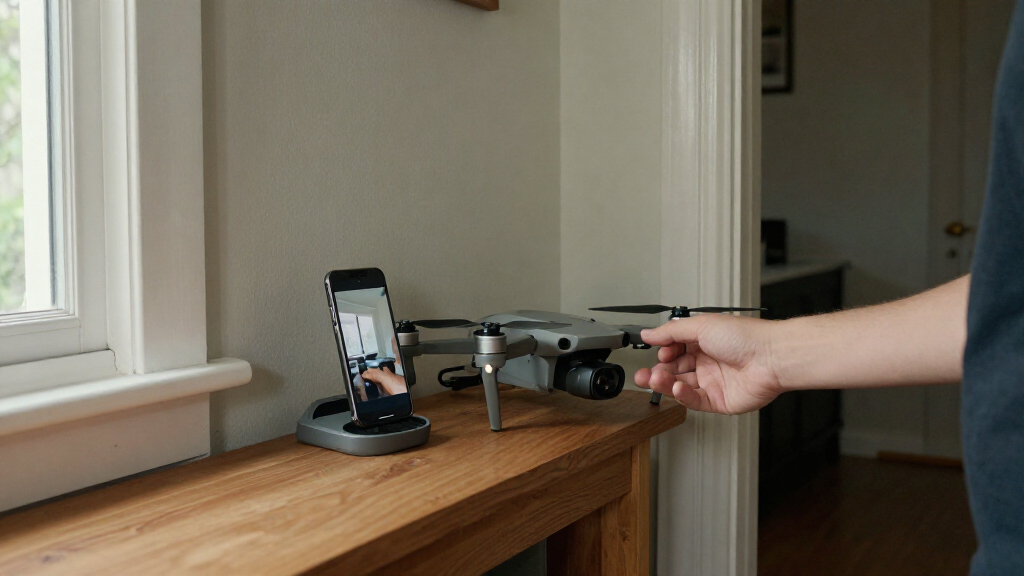
How We Picked
I ranked these products around the real limits of indoor security use. A drone can provide an aerial view, but the supplied information does not describe autonomous patrol routes, unattended operation, or security-alert functions for any of these models. I treat them as remotely piloted camera drones that may help a person inspect an indoor space, not as replacements for fixed cameras or alarms.
My ranking weighs five practical factors: propeller protection for close indoor flying, camera quality and field of view, control simplicity, hover-support features, and the kit’s readiness out of the box. Image resolution matters when footage may need to show small details; flight stability matters when a pilot needs to hold a view; and included controllers or batteries affect how quickly a buyer can get airborne. I also account for significant limitations, such as separate Avata accessories, limited listed range, or a camera that requires manual adjustment.
I do not rank on flight time alone. Longer operation can help during a room check, but these remain battery-powered aircraft that require active piloting and careful clearance around people, pets, furniture, and fragile objects. I give the Neo the lead for its combination of 4K, stabilization, guards, and flexible control; Avata follows for its strong image and broad view, offset by extra equipment and weaker indoor sensing. The smaller starter models suit narrower needs rather than matching those capabilities.
Factors to Consider When Choosing Best Indoor Security Drones
Choosing a drone for indoor security-style viewing starts with a reality check: the five models here are piloted camera drones, not listed autonomous security systems. I’d decide first whether I need better recorded footage, easier flying, or a simpler way to view the live feed. Those goals point to different models, and none removes the need to supervise every flight.
Decide Whether You Need a Drone or a Fixed Camera
A drone can provide a temporary angle from above or help a person inspect a space that is awkward to view from the floor. It can also be put away when not in use. But the supplied product details do not list scheduled routes, unattended patrols, security notifications, or continuous surveillance functions for these five picks. If the main job is watching a room while nobody is home, I would choose a fixed security camera or alarm system rather than rely on a person-controlled aircraft.
These models make more sense when the operator is present and wants a short, controlled look. That distinction affects which features matter: easy takeoff and stable hovering can be more useful than a long transmission range, while guards and careful clearance matter more than acrobatic modes. I would treat the camera feed as a tool for a supervised check, not a substitute for dedicated monitoring equipment.
Match Image Quality to the Detail You Need
The DJI Neo and DJI Avata both capture 4K, giving them an advantage when recording detail matters. Avata also lists a 1/1.7-inch sensor and a very wide 155° view, while Neo pairs 4K with stabilization, subject tracking, and QuickShots. A wide view can cover more of a room in one frame, but framing limits apply to Avata’s 155° setting, and neither resolution nor lens width guarantees that every small detail will be clear.
The Vrcyu’s camera is described as HD FPV without a numerical resolution in the provided specs. The two AxrumRC cameras are explicitly 720p, and the 720p Mini lists 0.9 MP still images. I would use those lower-resolution models for basic live viewing and practice rather than detailed records. Pick the image quality that fits the job instead of paying attention to a resolution label alone: stabilization, camera angle, lighting, and a steady hover all affect what the footage can show.
Give Propeller Guards and Flight Aids Real Weight
Indoor flying places a drone close to walls, furniture, fixtures, people, and pets. Propeller guards can reduce exposure during a minor bump, but they do not make a collision harmless or turn a drone into a safe toy around people. Neo includes full-coverage guards, Avata has built-in guards, and the CZ26 includes guards in its kit. The supplied description for the AxrumRC 720p Mini lists spare props but does not describe included guards; KY106’s listed kit also does not mention guards.
Altitude hold and optical-flow positioning can make hovering easier for a beginner, but they are not the same as complete obstacle avoidance. CZ26 adds headless mode and one-touch controls; both AxrumRC models list altitude hold, and the 720p Mini also lists optical flow and obstacle detection. Avata’s obstacle sensing is limited to downward sensing in certain modes. I would leave ample room around every aircraft and avoid flying near delicate objects rather than treating any flight aid as permission to move through tight spaces.
Choose a Control Setup You Will Actually Use
Control arrangements shape how convenient a short check feels. Neo supports app, voice, or a remote controller and offers palm takeoff and landing. The CZ26 can use its remote or an app and includes a phone holder. The KY106’s built-in 4.3-inch screen is distinctive because it avoids using a phone as the display. AxrumRC’s 720p Mini is specified with a remote control, while Avata requires separate goggles and a controller for its FPV setup.
For a beginner, I’d favor the simplest setup that still provides a comfortable view of the aircraft and camera feed. A phone-based app can be convenient, but it adds a device and setup step. An integrated screen removes that dependence but does not improve the KY106’s 720p recording resolution. Avata can offer a more immersive control experience, but it asks the buyer to accept a more specialized setup and learn it before attempting indoor maneuvers.
Read Flight-Time and Range Claims in Context
The CZ26 lists up to 25 minutes of total flight time across two batteries; that is not one uninterrupted flight. Avata lists up to 18 minutes. The Neo standard combo includes one battery, and the supplied description does not state its flight time. Flight times for the two AxrumRC models are also not provided. I would not infer duration from battery capacity alone, since the available details do not give enough information for a reliable comparison.
Maximum range figures need similar care. Avata lists transmission range up to 10 km, Neo lists a maximum range of 10 km, and CZ26 states 262 feet. Those figures do not describe how a drone will behave through indoor walls, around corners, or in a cluttered building. For indoor use, a short, supervised route with a dependable nearby connection is more relevant than a long-range headline. If you cannot keep the aircraft in sight and control, the flight plan is too ambitious.
Think About Privacy, Safety, and the Limits of Indoor Flight
A flying camera can see into spaces that a fixed camera does not, so I would make a plan for where the camera may point and who can see or store the footage. Tell household members or visitors when a camera-equipped drone is being used, and avoid recording private areas without permission. Keep children and pets out of the flight path, protect fragile items, and stop if the aircraft behaves unpredictably.
These products are small, but their propellers and moving bodies still need space. I would start with a clear, open area, use a low-speed or beginner mode when available, and learn takeoff, hovering, and landing before trying a room inspection. None of the listed features makes a drone collision-proof. If a buyer needs routine, unobtrusive monitoring, a fixed camera is generally the more practical tool; if the buyer needs an occasional aerial view while present, these drones can fill a narrower role.
Frequently Asked Questions
Can these drones patrol a home by themselves?
The supplied information does not describe autonomous patrol routes, unattended operation, or security-alert functions for any of these five products. Features such as subject tracking, altitude hold, one-touch controls, and QuickShots support piloted flights or capture tasks, but they do not establish self-directed security patrol. I would treat each as a camera drone that needs an operator and use a dedicated security camera or alarm for unattended monitoring.
Which pick is easiest for a first-time indoor pilot?
I’d start with the Vrcyu CZ26 if beginner controls and a ready-to-practice kit are the priority: it lists altitude hold, headless mode, one-touch takeoff and landing, propeller guards, and two batteries. The DJI Neo is a stronger choice if you want 4K video and multiple control options, while the KY106 is appealing if you prefer a controller screen instead of a phone. All still require a clear practice area and direct supervision.
Which drone has the best camera for indoor recordings?
The DJI Avata and DJI Neo are the strongest choices on the supplied image specifications because both record stabilized 4K footage. Avata adds a listed 155° field of view and a 1/1.7-inch sensor, while Neo pairs 4K with subject tracking and several control options. The 720p AxrumRC models are better suited to basic viewing or practice, not detailed recordings. I would also check framing and lighting before assuming resolution alone will capture the detail you need.
Do propeller guards make indoor flying safe?
Propeller guards can help protect the drone during a minor bump, but they do not prevent all collisions or remove risk to people, pets, and fragile objects. Neo has full-coverage guards, Avata has built-in guards, and CZ26 includes guards. The available product details do not describe guards for both AxrumRC kits. I’d still fly slowly in an open area, keep people and animals clear, and maintain direct control of the aircraft.
Which model should I choose if I do not want to use a smartphone?
The AxrumRC KY106 is the clearest match because its remote includes a built-in 4.3-inch screen for monitoring the camera feed. That convenience does not change its 720p recording limit, so I would choose Neo instead if recorded image detail matters more. Avata also uses a dedicated FPV setup, but its goggles and controller are sold separately, making it a less straightforward phone-free choice for a beginner.
Conclusion
For the widest range of supervised indoor camera use, I’d choose the DJI Neo: it combines stabilized 4K, full-coverage guards, and flexible controls, with the main compromise being one included battery. Choose the DJI Avata if you are comfortable with FPV equipment and care most about a 155° view; skip it if you want a simple starter setup or broad obstacle sensing. The Vrcyu CZ26 is my pick for a beginner who wants flight aids, guards, and two batteries, while the AxrumRC KY106 suits someone who wants a built-in screen rather than a phone. Choose the AxrumRC 720p Mini for compact practice, not detailed evidence. None of these is a self-running security system, so I would pair an occasional drone inspection with fixed cameras or an alarm when ongoing home monitoring is the goal.