For large properties, my best overall pick is the HXVIEW BU-H900, whose 50× optical zoom is suited to checking distant gates, driveways, and outbuildings. The REOLINK RLC-823S2 is a more balanced PoE choice, while the REOLINK Argus PT Ultra stands out where running network cable is difficult. The main tradeoff is between optical reach and wired reliability on one side, and easier solar or wireless installation on the other. Panoramic coverage can help monitor open areas, but it does not replace the detail gained from zooming in on a distant subject. Read on for the full breakdown and guidance on matching a camera to your site.

Get privacy and security gear delivered free with Prime
- Fast, free delivery on millions of items
- Prime Video, Amazon Music and more included
- Member-only deals all year
Key Takeaways
- Long-distance identification favors optical zoom: The HXVIEW BU-H900’s 50× optical zoom gives it the strongest stated reach in this group; the 16× REOLINK RLC-823S2 and 20× Jennov are more moderate alternatives.
- PoE is the wired-workhorse pattern: Several picks use PoE, which can simplify power and data delivery at a fixed camera location, but large sites still need cable routes and network planning.
- Solar models solve placement problems, not every coverage problem: The REOLINK Argus PT Ultra and aosu solar PTZ avoid a direct network cable, but buyers should plan around charging, connectivity, and exposure at each mounting spot.
- Panoramic coverage and zoom solve different jobs: Hiseeu’s 360° panoramic view emphasizes broad scene awareness, while optical-zoom models prioritize seeing distant details.
- Dual-lens and hybrid zoom offer a different viewing approach: REOLINK TrackMix combines two lenses with 6× hybrid zoom, which can suit monitoring a broad scene and a tracked subject, but it is not a substitute for the HXVIEW’s much higher optical-zoom specification.
| HXVIEW BU-H900 4K Outdoor PTZ Security Camera with 50× Optical Zoom |  | Best for Long-Distance Monitoring | Video resolution: 4K | Optical zoom: 50× autofocus | Pan and tilt: 360° pan; 90° tilt | VIEW ON AMAZON | See Our Full Breakdown |
| REOLINK RLC-823S2 4K Outdoor PoE PTZ Security Camera with 16× Optical Zoom |  | Best for PoE Property Systems | Resolution: 4K UHD, 8 MP | Optical zoom: 16× | Pan and tilt: 360° pan; 90° tilt | VIEW ON AMAZON | See Our Full Breakdown |
| Hiseeu 4K PoE PTZ Security Camera with 360° Panoramic View |  | Best Compact PoE Dome | Resolution: 4K, 8 MP | Pan and tilt: 350° pan; 90° tilt | Power: PoE, corded electric | VIEW ON AMAZON | See Our Full Breakdown |
| Jennov 4K 8MP Outdoor PoE PTZ Security Camera with 20× Optical Zoom |  | Best for Scheduled Patrols | Resolution: 4K, 8 MP | Optical zoom: 20× | Lens: 4.7–94 mm motorized lens | VIEW ON AMAZON | See Our Full Breakdown |
| REOLINK Argus PT Ultra 4K Solar-Powered Wireless Outdoor Security Camera |  | Best for Wire-Free Outbuildings | Resolution: 4K, 8 MP | Pan and tilt: 355° pan; 140° tilt | Connectivity: 2.4 GHz and 5 GHz Wi-Fi | VIEW ON AMAZON | See Our Full Breakdown |
| aosu 3K 5MP Solar-Powered Outdoor PTZ Security Camera with 360° Coverage | 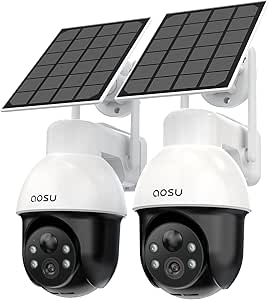 | Best Solar-Powered 360° Coverage | Resolution: 5 MP | Coverage: 360° pan-and-tilt | Zoom: 8× digital | VIEW ON AMAZON | See Our Full Breakdown |
| Anpviz 6MP PoE PTZ Outdoor Security Camera with 5× Optical Zoom |  | Best for Wired Detail and Detection | Resolution: 6MP (3072 × 2048) | Frame rate: Up to 25 fps | Power: Power over Ethernet (PoE) | VIEW ON AMAZON | See Our Full Breakdown |
| REOLINK TrackMix PoE Dual-Lens PTZ Security Camera with 6× Hybrid Zoom |  | Best for Simultaneous Wide and Close Views | Camera type: Dual-lens PTZ security camera | Connectivity: Power over Ethernet (PoE) | Lenses: 2.8 mm wide-angle and 8 mm telephoto | VIEW ON AMAZON | See Our Full Breakdown |
| ptz cameras for large propertie | Weather resistance | Resolution | Pan and tilt | Night vision |
|---|---|---|---|---|
| HXVIEW BU-H900 4K Outdoor PTZ | IP66 | — | 360° pan; 90° tilt | Infrared up to 1,200 ft; color up to 130 ft |
| REOLINK RLC-823S2 4K Outdoor P | IP66 | 4K UHD, 8 MP | 360° pan; 90° tilt | Color and infrared |
| Hiseeu 4K PoE PTZ Security Cam | IP66 | 4K, 8 MP | 350° pan; 90° tilt | — |
| Jennov 4K 8MP Outdoor PoE PTZ | IP66 | 4K, 8 MP | — | Up to 320 feet |
| REOLINK Argus PT Ultra 4K Sola | — | 4K, 8 MP | 355° pan; 140° tilt | 33 feet; color night vision with motion-activated spotlight |
| aosu 3K 5MP Solar-Powered Outd | IP65 waterproof | 5 MP | — | Full-color with spotlight |
| Anpviz 6MP PoE PTZ Outdoor Sec | IP66 | 6MP (3072 × 2048) | 280° pan, 90° tilt | — |
| REOLINK TrackMix PoE Dual-Lens | — | — | — | — |
More Details on Our Top Picks
HXVIEW BU-H900 4K Outdoor PTZ Security Camera with 50× Optical Zoom
For a large property where the camera needs to identify activity far from its mounting point, I rank the HXVIEW BU-H900 ahead of the REOLINK RLC-823S2 for reach: its 50× autofocus optical zoom is substantially stronger than the REOLINK’s 16×. Full 360° pan, 90° tilt, and human tracking let it scan broad grounds and follow a person, while the stated infrared range of up to 1,200 feet favors distant nighttime observation. Its floodlight also adds color night vision at closer range. The tradeoff is infrastructure: this camera needs wired 12 V power, and continuous local recording requires a microSD card that is not included. Choose it for distant gates, driveways, or field edges, not a wire-free installation.
Pros:- 50× autofocus optical zoom helps inspect distant subjects without relying on digital enlargement.
- 360° pan and 90° tilt cover a broad area from one mounting point.
- AI detection and automatic human tracking can follow a person through the camera’s view.
- Supports continuous local recording to a compatible microSD card.
Cons:- Requires a wired 12 V DC power connection, limiting placement options.
- MicroSD card is not included, adding a separate requirement for local recording.
- Its long-range capability may be unnecessary for compact properties or close-in coverage.
Best for: Owners monitoring long driveways, property boundaries, or distant gates who can run wired power and want strong optical reach.
Not ideal for: Buyers seeking a solar or Wi-Fi installation, or those who do not need to zoom in on faraway activity.
- Video resolution:4K
- Optical zoom:50× autofocus
- Pan and tilt:360° pan; 90° tilt
- Night vision:Infrared up to 1,200 ft; color up to 130 ft
- Floodlight:1,500 lumens
- Storage:MicroSD, up to 128 GB
- Power:Corded electric, 12 V DC
- Weather resistance:IP66
Our verdict“Choose the HXVIEW when distant detail matters more than wire-free placement; its 50× zoom gives it more reach than the REOLINK RLC-823S2.”
REOLINK RLC-823S2 4K Outdoor PoE PTZ Security Camera with 16× Optical Zoom
I’d put the REOLINK RLC-823S2 near the top for owners building a wired camera system: PoE carries power and data over one Ethernet cable, which can simplify a long run to a barn, gate, or outbuilding when the network is planned for it. Its 4K image, 16× optical zoom, 360° pan, 90° tilt, and automatic tracking make it a capable broad-area camera. Smart detection covers people, vehicles, and animals, a wider category set than the HXVIEW BU-H900’s stated human tracking. The HXVIEW, however, offers much greater 50× zoom for distant subjects. This REOLINK has no Wi-Fi, so it is a poor fit for sites without Ethernet and compatible PoE equipment; its substantial housing also calls for a considered mounting location.
Pros:- PoE combines power and network connectivity over one Ethernet cable.
- 4K video and 16× optical zoom support detailed views across large outdoor areas.
- 360° pan, 90° tilt, and automatic tracking help follow activity across a wide scene.
- Smart detection identifies people, vehicles, and animals.
Cons:- Does not support Wi-Fi, making it dependent on wired network access.
- Requires compatible PoE equipment for power and connectivity.
- Its 16× optical zoom has less distant reach than the HXVIEW BU-H900’s 50× zoom.
Best for: Property owners with Ethernet runs and a compatible PoE setup who want one camera for vehicle, animal, and person monitoring.
Not ideal for: Buyers who need Wi-Fi installation or cannot provide compatible PoE power and network equipment.
- Resolution:4K UHD, 8 MP
- Optical zoom:16×
- Pan and tilt:360° pan; 90° tilt
- Frame rate:25 fps
- Connectivity:Ethernet PoE; Wi-Fi not supported
- Detection:Person, vehicle, and animal detection; automatic tracking
- Night vision:Color and infrared
- Weather resistance:IP66
- Dimensions:14.6 × 6.9 × 5.5 inches
Our verdict“Pick this REOLINK for a planned PoE installation with varied activity to detect, but choose the HXVIEW BU-H900 when far-distance zoom is the priority.”
Hiseeu 4K PoE PTZ Security Camera with 360° Panoramic View
The Hiseeu 4K PoE PTZ is the compact, dome-style choice in this group: at roughly 5.3 inches across, it is easier to place discreetly than the larger REOLINK RLC-823S2. Its 350° pan and 90° tilt approach full-area coverage, with only a small pan gap compared with cameras offering a full 360°. For a large property, that near-all-around view can help monitor a yard or building perimeter from a fixed mount, while human and vehicle detection, auto-tracking, and two-way audio add useful interaction. It gives up optical zoom figures that are specified on the HXVIEW BU-H900 and Jennov models, so it is less suited to checking distant details. PoE and a compatible NVR are also part of the setup, not optional extras.
Pros:- Compact dome form is easier to fit in a low-profile mounting location than the larger REOLINK RLC-823S2.
- 350° pan and 90° tilt provide near-full coverage from one position.
- Human and vehicle detection with auto-tracking can follow activity.
- Works with ONVIF-compatible PoE NVRs and includes two-way audio.
Cons:- 350° pan leaves a small gap rather than providing true 360° rotation.
- Requires PoE infrastructure or a compatible NVR to operate.
- No optical zoom specification is provided, making it a weaker fit than the HXVIEW BU-H900 for distant inspection.
Best for: Property owners who want a compact dome camera for broad coverage near a house, workshop, or outbuilding and already have PoE infrastructure.
Not ideal for: Buyers needing strong optical zoom for distant gates or fields, or those without a compatible PoE NVR or network setup.
- Resolution:4K, 8 MP
- Pan and tilt:350° pan; 90° tilt
- Power:PoE, corded electric
- Connectivity:Wired Ethernet
- Form factor:Dome
- Mount type:Ceiling mount
- Weather resistance:IP66
- Dimensions:5.28 × 5.3 × 5.3 inches
- Warranty:12 months
Our verdict“Choose the Hiseeu for compact, near-all-around PoE coverage, but favor the HXVIEW BU-H900 if distant subjects need optical zoom.”
Jennov 4K 8MP Outdoor PoE PTZ Security Camera with 20× Optical Zoom
For a property where a camera should revisit known zones, I’d choose the Jennov 4K PTZ for its eight patrol routes and 16 preset positions per route. That makes it more configurable for a sequence of gates, yards, and building approaches than the Hiseeu, whose supplied details emphasize broad pan coverage rather than patrol presets. Its 20× motorized optical zoom sits between the REOLINK RLC-823S2’s 16× and HXVIEW BU-H900’s 50×, balancing detail at distance with a wired PoE setup. H.265+ encoding can reduce bandwidth use, while night vision is specified up to 320 feet. The limits matter: it tracks one subject at a time, needs stable network capacity for 4K streaming, and is compatible with ONVIF PoE NVRs rather than Wi-Fi NVR systems.
Pros:- 20× motorized optical zoom provides more reach than the REOLINK RLC-823S2’s 16× zoom.
- Eight patrol routes with 16 preset positions each suit properties with several recurring areas to check.
- PoE and H.265+ can simplify cabling and reduce video bandwidth use.
- Night vision rated up to 320 feet, two-way audio, and IP66 housing support outdoor monitoring.
Cons:- Tracks only one subject at a time.
- Requires a stable network for 4K streaming.
- Works with ONVIF-compatible PoE NVRs, not Wi-Fi NVR systems.
Best for: Owners of larger sites with several fixed zones to patrol who have wired Ethernet and an ONVIF-compatible PoE NVR.
Not ideal for: Buyers who rely on Wi-Fi NVRs, need multiple subjects tracked at once, or want the HXVIEW BU-H900’s much longer optical zoom.
- Resolution:4K, 8 MP
- Optical zoom:20×
- Lens:4.7–94 mm motorized lens
- Power and connectivity:Power over Ethernet; wired Ethernet
- Video encoding:H.265+
- Night vision:Up to 320 feet
- Patrol routes:Up to 8 routes with 16 preset positions each
- Tracking:Human detection and auto-tracking; one subject at a time
- Weather resistance:IP66
Our verdict“Choose the Jennov for scheduled patrols across multiple preset zones, but look to the HXVIEW BU-H900 for substantially greater zoom reach.”
REOLINK Argus PT Ultra 4K Solar-Powered Wireless Outdoor Security Camera
The REOLINK Argus PT Ultra fills a different role from the wired PTZ cameras here: its solar-powered, Wi-Fi design can suit a shed, detached garage, or remote corner where running Ethernet and power is inconvenient. It records 4K video, pans 355°, tilts 140°, and detects people, vehicles, and pets. Compared with the Hiseeu and Jennov, installation is less dependent on PoE infrastructure; compared with the HXVIEW BU-H900, though, it offers no listed optical zoom and has a shorter stated night-vision range of 33 feet. The motion-activated spotlight supports color night vision, but this is not the pick for consistently inspecting distant property boundaries. Wi-Fi coverage and a separately purchased microSD card remain part of the setup.
Pros:- Solar power and wireless connectivity suit locations where wiring is difficult.
- 4K video and 355° pan with 140° tilt provide broad adjustable coverage.
- Person, vehicle, and pet detection address several common types of property activity.
- Supports local microSD recording and two-way communication.
Cons:- Requires Wi-Fi, unlike the wired Ethernet PoE cameras in this roundup.
- Night vision range is specified at 33 feet, far shorter than the HXVIEW BU-H900’s stated infrared reach.
- MicroSD card is sold separately, and no optical zoom is specified.
Best for: Owners who need solar-powered coverage at a detached building or remote area with reliable Wi-Fi and no practical wired power run.
Not ideal for: Buyers monitoring distant boundaries, needing long-range night vision, or lacking dependable Wi-Fi coverage where the camera will be placed.
- Resolution:4K, 8 MP
- Pan and tilt:355° pan; 140° tilt
- Connectivity:2.4 GHz and 5 GHz Wi-Fi
- Power:Solar powered; 3 W solar panel
- Night vision:33 feet; color night vision with motion-activated spotlight
- Storage:MicroSD card, sold separately
- Video encoding:H.265
- Dimensions:3.86 × 3.86 × 4.8 inches
Our verdict“Pick the Argus PT Ultra for a remote outbuilding where solar power and Wi-Fi matter more than optical zoom or long-range night vision.”
aosu 3K 5MP Solar-Powered Outdoor PTZ Security Camera with 360° Coverage
The aosu 3K suits large properties where running power cable to a camera location would be awkward. Its solar-powered operation and 360° pan-and-tilt coverage can monitor a broad area without the wired setup required by the Anpviz and REOLINK TrackMix PoE models. Motion tracking helps follow activity across the view, while the spotlight supports full-color night vision and can pair with the alarm for a more visible deterrent. Two-way audio and app sharing add practical remote monitoring. The tradeoff is that this camera relies on 2.4GHz Wi-Fi, so placement depends on a usable wireless signal, and its 8× zoom is digital rather than optical. I’d choose it for flexible placement, not for pulling distant details as clearly as an optical-zoom camera.
Pros:- Solar-powered design reduces the need to run power wiring to the camera.
- 360° pan-and-tilt coverage with motion tracking can follow activity across a broad area.
- Spotlight enables full-color night vision and provides a visible deterrent.
- Two-way audio and app-based sharing support remote communication and monitoring.
Cons:- Supports 2.4GHz Wi-Fi only, limiting suitability where that band has weak coverage.
- 8× digital zoom does not provide the detail advantage of optical zoom.
- Solar operation still depends on suitable placement and available sunlight.
Best for: Property owners who want broad, solar-powered coverage at a location without convenient access to mains power or Ethernet.
Not ideal for: Buyers with weak 2.4GHz Wi-Fi at the mounting point or those who need optical zoom to identify distant details.
- Resolution:5 MP
- Coverage:360° pan-and-tilt
- Zoom:8× digital
- Power:Solar powered
- Connectivity:2.4GHz Wi-Fi via Bluetooth
- Weather resistance:IP65 waterproof
- Night vision:Full-color with spotlight
- Audio:Two-way talk with AI noise reduction
Our verdict“Choose the aosu for wide, solar-powered coverage where wireless placement matters more than optical zoom or a wired network.”
Anpviz 6MP PoE PTZ Outdoor Security Camera with 5× Optical Zoom
The Anpviz 6MP PoE is a practical fit for a large property with Ethernet already run to the camera location. Its 5× optical zoom can bring distant subjects closer without relying on digital enlargement, while 6MP video and person-and-vehicle detection help make a fixed monitoring plan more useful. Compared with the solar-powered aosu, Anpviz trades easy placement for a wired connection and a weather-resistant IP66 housing. Its 280° pan and 90° tilt cover a broad sector, but it does not offer the aosu’s full 360° coverage or automatic tracking. Night modes include infrared and color, and the camera supports up to 25 fps. A key system limitation: two-way audio requires an Anpviz U Series NVR, so I’d check compatibility before choosing it for an existing setup.
Pros:- 5× optical zoom can show distant subjects with more useful detail than digital zoom.
- 6MP resolution and up to 25 fps support clear, fluid monitoring.
- Person and vehicle detection with customizable alert areas can reduce irrelevant notifications.
- IP66 protection and multiple night vision modes suit exposed outdoor mounting.
Cons:- Does not support automatic tracking.
- Two-way audio requires an Anpviz U Series NVR.
- PoE cabling is required, making placement less flexible than the solar-powered aosu.
Best for: Owners with PoE cabling and a compatible Anpviz U Series NVR who want optical zoom, detection, and weather-rated coverage.
Not ideal for: Buyers who need automatic subject tracking, a wireless solar installation, or two-way audio without an Anpviz U Series NVR.
- Resolution:6MP (3072 × 2048)
- Frame rate:Up to 25 fps
- Power:Power over Ethernet (PoE)
- Pan and tilt:280° pan, 90° tilt
- Optical zoom:5×
- Weather resistance:IP66
- Night vision range:Up to 130 ft infrared; up to 98 ft color
- Video encoding:H.265
- Audio:Two-way audio; requires Anpviz U Series NVR
Our verdict“Pick the Anpviz when a wired PoE location and compatible NVR are available and optical zoom matters more than automatic tracking.”
REOLINK TrackMix PoE Dual-Lens PTZ Security Camera with 6× Hybrid Zoom
The REOLINK TrackMix PoE takes a different approach to monitoring a large property: its dual-lens design shows a wide-angle view alongside a telephoto close-up, so a tracked subject can remain in context while appearing larger. Automatic tracking covers people, vehicles, and pets, giving it an advantage over the Anpviz, which has optical zoom but no auto tracking. It also offers motion alerts and playback without a subscription. The tradeoff is infrastructure: this is not a wireless alternative to the solar-powered aosu, and a PoE switch, injector, or compatible Reolink NVR is required separately. Some Reolink NVR models may also need a firmware update for dual-lens viewing on the monitor. I’d favor it where wired networking is available and tracking context matters more than a simple single-view setup.
Pros:- Dual lenses show wide-angle context and telephoto detail at the same time.
- Automatically tracks people, vehicles, and pets.
- Provides motion alerts and video playback without a subscription.
- Spotlight and siren add active deterrence options.
Cons:- A PoE switch, injector, or compatible Reolink PoE NVR is required and sold separately.
- Some Reolink NVR models require a firmware update for dual-lens viewing on the monitor.
- PoE installation is less flexible than the solar-powered aosu.
Best for: Property owners with PoE infrastructure who want automatic tracking while keeping both a wide scene and a closer subject view.
Not ideal for: Buyers who need a self-contained wireless camera, want to avoid separate PoE equipment, or use a Reolink NVR that lacks the required dual-lens viewing support.
- Camera type:Dual-lens PTZ security camera
- Connectivity:Power over Ethernet (PoE)
- Lenses:2.8 mm wide-angle and 8 mm telephoto
- Zoom:6× hybrid
- Detection:People, vehicles, and pets
- Alerts:Push and email notifications, spotlights, and siren
- PoE equipment:IEEE 802.3af switch, PoE injector, or Reolink PoE NVR required; not included
- Playback:Video playback without a subscription
Our verdict“Choose the TrackMix when you have PoE available and want automatic tracking with wide and close-up views shown together.”

How We Picked
I ranked these cameras around the problems that define surveillance on a large property: how far a camera can usefully inspect, how it connects and receives power, and whether its viewing approach suits gates, yards, barns, or remote outbuildings. I gave more weight to optical zoom for long-distance detail, while treating panoramic views, dual lenses, and solar power as strengths for different layouts rather than interchangeable upgrades. I also considered the practical burden of installation, including PoE cabling and the limits of placing a wireless camera far from dependable connectivity.
The order reflects fit for broad property coverage, not a claim that one design suits every site. The HXVIEW leads for stated zoom reach; the REOLINK RLC-823S2 ranks highly as a wired, lower-zoom alternative; and solar and panoramic options rank well when installation or scene coverage matters more than maximum optical reach. Models with lower stated zoom or hybrid zoom sit behind long-zoom picks for distant identification, though they can be a better match for nearby zones or simpler deployment. Product details here are based on the supplied model specifications, so buyers should verify network, recording, and environmental requirements for their own setup.
| ptz cameras for large propertie | Power | Weather resistance |
|---|---|---|
| HXVIEW BU-H900 4K Outdoor PTZ | Corded electric, 12 V DC | IP66 |
| REOLINK RLC-823S2 4K Outdoor P | — | IP66 |
| Hiseeu 4K PoE PTZ Security Cam | PoE, corded electric | IP66 |
| Jennov 4K 8MP Outdoor PoE PTZ | — | IP66 |
| REOLINK Argus PT Ultra 4K Sola | Solar powered; 3 W solar panel | — |
| aosu 3K 5MP Solar-Powered Outd | Solar powered | IP65 waterproof |
| Anpviz 6MP PoE PTZ Outdoor Sec | Power over Ethernet (PoE) | IP66 |
| REOLINK TrackMix PoE Dual-Lens | — | — |
Factors to Consider When Choosing Ptz Cameras For Large Properties
On a large property, camera choice starts with the site map, not the zoom number. I would mark the areas that need identification, the routes for power and data, and any blind spots created by buildings or trees before settling on a model. These broader tradeoffs help prevent buying a camera that can pan across the grounds but cannot reliably reach the view that matters.
Match Zoom to the Distance You Need to Identify
Start by separating seeing activity from identifying a person, vehicle, or gate number at a distance. A wide view can reveal movement across a yard, while optical zoom is more useful when the camera needs to inspect a specific faraway area. Digital or hybrid zoom may enlarge an image, but it does not provide the same optical reach. Avoid choosing by the highest zoom figure alone: lens performance, lighting, mounting angle, and the width of the target area all affect usable detail. If one camera must cover several distant points, a high-zoom PTZ can help, though preset positions and missed views between sweeps remain part of the tradeoff. For multiple separated zones, more than one fixed camera may provide steadier coverage than relying on a single moving lens.
Choose PTZ Coverage Without Creating Blind Spots
PTZ cameras can look in different directions, but they cannot record every direction at once from a single lens. A camera turned toward a gate may not show activity behind it until it moves, which can leave a gap at the moment an event occurs. Mark priority views and movement paths on a site plan, then decide whether the camera’s patrol or tracking functions fit those paths. Panoramic viewing can give broad awareness, but a panoramic image and a zoomed view answer different questions. Mounting a PTZ high may widen the scene, yet excessive height can make faces and vehicle details harder to distinguish. For important entrances, consider pairing a PTZ with a fixed camera aimed at the same approach.
Plan Power and Network Routes Before Buying
PoE can carry power and data over a single Ethernet cable, making it a strong choice when a reliable cable route reaches the mounting point. On a spread-out property, cable distance, trenching, switches, and surge protection can add complexity even when the camera itself is straightforward to install. Solar wireless models can fit locations where running Ethernet is impractical, but they still depend on workable wireless coverage and suitable sunlight for their power setup. Check the camera’s connection path at the actual mounting location rather than assuming a router signal will reach a distant shed or gate. A common mistake is selecting wireless to avoid cabling without checking whether the site has a dependable connection. The best power plan is the one that stays dependable through local weather and outages, not merely the one that is easiest on installation day.
Account for Storage, Recording, and Network Capacity
A camera’s viewing features do not tell you how footage will be stored or retrieved. Before purchase, check which recording methods the exact model supports, how much retention you need, and whether storage is local, network-based, or tied to a service plan. Multiple high-resolution cameras can place substantial demand on a property network, especially when several live views are open or footage is uploaded continuously. Estimate how many cameras will run at once and whether the recorder, switches, and internet connection can support that load. Remote outbuildings may need a separate network link or local recording plan if the main connection is unreliable. Confirm compatibility across cameras and recording equipment before building a system around mixed brands.
Treat Mounting, Weather, and Maintenance as Part of the Cost
Large properties often expose cameras to wind, dust, rain, temperature swings, and vibration from nearby roads or machinery. Check the model’s published environmental and mounting requirements rather than assuming that an outdoor label covers every condition. A stable mount matters especially for zoomed views, where small vibrations can make distant details harder to interpret. Plan access for cleaning the lens, checking seals and connections, and inspecting a solar panel if the camera uses one. Trees and seasonal foliage can block views or reduce sunlight even when the first installation looks clear. Saving on the camera can be a poor trade if its location makes routine maintenance difficult or requires expensive access equipment.
Frequently Asked Questions
Is a 50× optical-zoom camera the right choice for every large property?
No. The HXVIEW BU-H900’s stated 50× optical zoom is most relevant when a camera must inspect faraway areas such as a distant gate or driveway. For a smaller yard or a nearby entrance, that reach may matter less than easier installation, panoramic awareness, or dependable network access. A long-zoom camera also needs a stable mounting point and a clear line of sight to make its reach useful. I would map the farthest area that needs identification before paying for more zoom. If the property has several separated zones, multiple cameras may cover them more consistently than one camera pointed in different directions.
Should I choose PoE or a solar-powered PTZ for a remote outbuilding?
Choose PoE if you can run a suitable Ethernet cable to the outbuilding and want a wired data and power connection. A solar model may be a better fit when cable installation is impractical, but it still needs adequate sunlight, a workable wireless connection, and a mounting position that supports its power setup. The distance from the building to the main router can make wireless coverage unreliable even when the camera itself is suitable for outdoor use. Check the signal at the intended camera position and consider what happens during prolonged poor weather. I would compare the long-term upkeep of a solar setup with the one-time work of installing cable.
Can one PTZ camera cover an entire large property?
A PTZ camera can survey a broad area by moving between views, but it cannot show every direction at once. While it is aimed at one preset, activity elsewhere may go unseen until the camera turns. Buildings, hills, trees, and fences can also block the line of sight, no matter how far the camera can pan. For important locations such as entrances, equipment yards, or livestock areas, fixed cameras can keep continuous views while a PTZ handles wider inspection. Sketch sightlines and priority zones before deciding whether one camera is enough.
What should I check before mixing PTZ cameras from different brands?
Check how each camera records, which software or recorder it supports, and whether its motion and tracking features work outside the brand’s own app. Similar connectors or PoE support do not guarantee that every feature will work with a third-party recorder. Confirm resolution and bandwidth needs as well, since adding cameras can strain a small network or recorder. It is also useful to check whether remote viewing and alerts require separate apps or service accounts. A mixed system can work, but compatibility should be confirmed before buying cameras for several buildings.
When is a panoramic or dual-lens camera a better choice than stronger optical zoom?
Panoramic and dual-lens designs can suit locations where broad scene awareness matters more than identifying a small subject far away. The Hiseeu emphasizes 360° panoramic viewing, while REOLINK TrackMix pairs two lenses with 6× hybrid zoom; those approaches differ from a camera built around substantial optical zoom. A wide view can help monitor open yards and movement across a nearby area, but it may not provide the same distant detail as a long-zoom lens. Think about whether your main task is spotting activity across a scene or inspecting a specific faraway point. For sites that need both, a broad-view camera and a dedicated long-zoom camera may serve different roles.
Conclusion
For the strongest stated reach, I recommend the HXVIEW BU-H900 as best overall for large properties with distant points to inspect. The REOLINK RLC-823S2 is my best value-style wired pick for buyers who want a PoE PTZ with 16× optical zoom rather than the HXVIEW’s greater reach; the Jennov is another middle-ground option with 20× optical zoom. For a premium long-range priority, I would start with the HXVIEW and verify the installation and recording setup that its location requires. For beginners, the REOLINK Argus PT Ultra is the clearest option when avoiding a network cable matters, while the aosu also serves buyers seeking solar-powered 360° coverage. Choose Hiseeu for panoramic awareness, TrackMix for a dual-lens approach, and Anpviz for a more modest 5× optical-zoom PoE setup. My deciding rule is simple: pick the camera around the hardest view and power route on your property, not the broadest feature list.
Halloween Picks
halloween
As an affiliate, we earn on qualifying purchases.