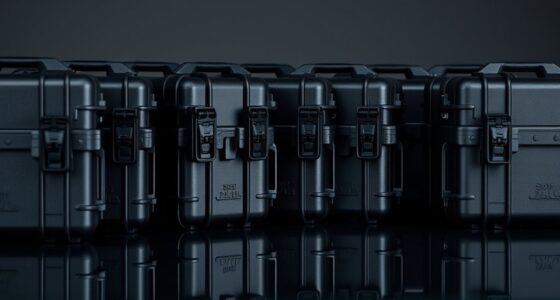

For facilities that need dependable radio coverage, the right repeater depends on the system you already use and the site it must serve. I rank the Retevis RT97L first for its weather protection, continuous-duty rating, and temperature controls; the CamelRadio R1 is my pick for linking DMR coverage across buildings over a LAN; and the Retevis RT97S base station is a more focused choice for GMRS users who want a standalone repeater platform.

Get privacy and security gear delivered free with Prime
- Fast, free delivery on millions of items
- Prime Video, Amazon Music and more included
- Member-only deals all year
The tradeoffs are practical: the R1 depends on a suitable network and compatible MOTO DMR handhelds, while the RT97S models use GMRS and differ mainly in whether you need radios included. The RT97L adds environmental protection but leaves key system details, including its power output and antenna configuration, unspecified. I treat these as commercial-oriented options, not interchangeable systems: check your frequency authorization, radios, antenna plan, and site conditions before choosing.
Key Takeaways
- Best for demanding outdoor sites: The RT97L combines an IP66-rated enclosure, 100% duty cycle, and automatic temperature controls, but its listing omits power output and antenna details.
- Best for LAN-linked DMR coverage: CamelRadio R1 connects DMR repeaters over a local network, provided latency stays below 30 ms and bandwidth exceeds 1 Mbps.
- Best standalone GMRS platform: The RT97S base station offers full duplex and a built-in duplexer, but you must supply an antenna and it is not weather resistant.
- Best smaller ready-to-deploy kit: The RT97S package with four RB48 Plus handhelds pairs the repeater with water- and dust-resistant radios.
- Best kit for a six-person team: The six-radio RT97S bundle adds rugged handhelds and listed battery life, though repeater-to-repeater expansion needs extra components.
| Retevis RT97L GMRS Repeater |  | Best for exposed sites and continuous operation | Frequency bands: GMRS, VHF, UHF | Duty cycle: 100% | Weather resistance: IP66 | VIEW ON AMAZON | See Our Full Breakdown |
| CamelRadio R1 DMR IP Radio Repeater |  | Best for linking DMR coverage across buildings | Frequency range: 400–470 MHz | Channels: 1 | Protocol: DMR | VIEW ON AMAZON | See Our Full Breakdown |
| Retevis RT97S GMRS Full-Duplex Repeater Base Station |  | Best standalone GMRS repeater platform | Frequency system: GMRS | Channels: 8 | Duplex: Full duplex with built-in duplexer | VIEW ON AMAZON | See Our Full Breakdown |
| Retevis RT97S GMRS Repeater with Four RB48 Plus IP67 Walkie-Talkies |  | Best four-radio starter system | Repeater model: RT97S | Radio quantity: 4 RB48 Plus handhelds | Repeater channels: 8 GMRS channels | VIEW ON AMAZON | See Our Full Breakdown |
| Retevis RT97S GMRS Repeater Kit with 6 RB48 Plus Walkie Talkies |  | Best for teams that need six rugged radios | Repeater model: RT97S | Radio quantity: 6 RB48 Plus handhelds | Repeater channels: 8 | VIEW ON AMAZON | See Our Full Breakdown |
More Details on Our Top Picks
Retevis RT97L GMRS Repeater
The RT97L is my leading choice when the installation may face rain, dust, cold, heat, and long operating periods. Its IP66-rated housing and stated 100% duty cycle set it apart from the RT97S options, whose listing does not claim weather resistance. Automatic heating below -15°C and power reduction above 60°C also give buyers site-specific protection features rather than leaving temperature management entirely to the installer.
That ruggedness comes with a power and planning tradeoff. High-power transmission draws 6 A DC, so the power supply and installation must suit the load. The listing gives a 15-kilometer range, but does not specify transmit output or antenna configuration; I would not use that distance alone to predict coverage. Compared with the CamelRadio R1, the RT97L is better suited to a weather-exposed GMRS deployment than LAN-based DMR linking. Compared with the RT97S base station, it supplies more environmental protection, but less clarity on the RF setup. Skip it if exact output and antenna specifications are required before purchase.
Pros:- IP66-rated protection against rain and dust
- 100% duty-cycle rating with full-duplex operation
- Automatic heating below -15°C and reduced power above 60°C
- High- and low-power modes support different operating needs
Cons:- High-power transmit current is listed as 6 A DC
- Power output and antenna configuration are not specified
- Does not include the handheld-radio bundles offered with two RT97S kits
Best for: GMRS users planning a fixed indoor or outdoor repeater site where weather protection, continuous duty, and temperature management matter.
Not ideal for: Buyers who need a fully specified power-output and antenna configuration, or who want a ready-made kit with handheld radios.
- Frequency bands:GMRS, VHF, UHF
- Duty cycle:100%
- Weather resistance:IP66
- Transmit current:6 A DC at high power
- Temperature controls:Heating below -15°C; switches to low power above 60°C
- Connectors:DB-9 and SL-16
- Dimensions:2.68 × 7.28 × 11.22 inches
- Warranty:2 years for radio body; 1 year for accessories
Our verdict“I rank the RT97L first for demanding sites because its listed enclosure and temperature features are unusually relevant to continuous commercial-style operation, subject to confirming the RF setup.”
CamelRadio R1 DMR IP Radio Repeater
The R1 solves a different problem from the GMRS units: it links DMR repeaters across a local area network, making it a distinctive option for facilities with multiple buildings, tunnels, or separated work areas. Its automatic negotiation without an external protocol controller may simplify the network side of a deployment, while the aluminum body and listed 200 mA idle current at 9 V speak to heat handling and low standby draw.
This network approach only works if the site meets its requirements. The listing calls for latency below 30 ms and more than 1 Mbps of available bandwidth, and specifies compatibility with MOTO DMR handheld radios. Those limits make it a poor fit for a buyer seeking a self-contained GMRS repeater or a radio system without a suitable LAN. Compared with the RT97S, the R1’s advantage is distributed DMR coverage over network infrastructure; the RT97S is simpler to frame as a GMRS base station and does not depend on LAN latency. The stated 4 km talking range should not replace a site survey.
Pros:- Links DMR repeaters across facilities over a LAN
- Automatic negotiation does not require an external protocol controller
- Aluminum body supports heat dissipation
- Listed idle current is 200 mA at 9 V
Cons:- Requires an existing network with specified latency and bandwidth
- Compatibility is listed for MOTO DMR handheld radios
- Single-channel configuration offers less channel flexibility than the eight-channel RT97S
Best for: Facilities already using compatible MOTO DMR handhelds and a local network that can meet the stated latency and bandwidth requirements.
Not ideal for: GMRS users, sites without a dependable LAN, or buyers seeking an all-in-one bundle of repeater and handheld radios.
- Frequency range:400–470 MHz
- Channels:1
- Protocol:DMR
- Network latency:Less than 30 ms
- Available network bandwidth:Greater than 1 Mbps
- Idle current:200 mA at 9 V
- Maximum talking range:4 km, as listed
- Temperature range:-20 to 60 °C
Our verdict“I recommend the R1 when a compatible DMR fleet and a qualified LAN are already in place; it is not a substitute for a GMRS repeater.”
Retevis RT97S GMRS Full-Duplex Repeater Base Station
For a buyer who wants a GMRS repeater without paying for bundled handhelds in the same package, the RT97S base station is the most direct choice here. It has eight default channels, a built-in duplexer for simultaneous transmitting and receiving through one antenna, and a DB-9 connector that supports a microphone connection and Raspberry Pi compatibility. Its ability to link with other RT97S repeaters gives it a path to wider coverage, although the listing says extra interconnection components are needed.
The central compromise is what it does not include. The antenna is not included, and the repeater is not water resistant, so buyers must plan for antenna selection and protected placement. Its duplexer also may cause some power loss. Compared with the RT97S four- and six-radio kits, this base station makes more sense if you already have compatible radios or want to choose the fleet separately. It is a better match than the RT97L when the buyer’s priority is a clearly identified GMRS platform and accessory ecosystem rather than listed weather protection or temperature controls.
Pros:- Built-in duplexer supports simultaneous transmission and reception on one antenna
- Eight default GMRS channels
- DB-9 supports microphone connection and Raspberry Pi compatibility
- Can link with other RT97S repeaters using additional components
Cons:- Antenna is not included
- Not water resistant
- Duplexer may cause some power loss
Best for: GMRS teams with radios already in hand that want a full-duplex base station and the option to plan antenna and accessories separately.
Not ideal for: Buyers needing a weather-resistant enclosure, an included antenna, or a ready-to-use handheld bundle.
- Frequency system:GMRS
- Channels:8
- Duplex:Full duplex with built-in duplexer
- Power:12 V DC
- Connector:DB-9 female
- Antenna:Not included
- Temperature range:-20 to 60 °C
- Warranty:2 years for radio body; 1 year for accessories
Our verdict“I favor this RT97S for buyers who want a standalone GMRS base station and already have a plan for radios, antenna, and protected installation.”
Retevis RT97S GMRS Repeater with Four RB48 Plus IP67 Walkie-Talkies
This package is the clearest choice for a smaller GMRS crew that needs both a repeater and handhelds in one purchase. It pairs the RT97S full-duplex repeater with four RB48 Plus radios, whose IP67 rating and listed resistance to drops up to 2 m suit work around water, dust, and rough handling. The repeater’s built-in duplexer supports simultaneous transmit and receive, while its DB-9 connector adds microphone and Raspberry Pi compatibility.
It is more immediately useful than the standalone RT97S if the team lacks radios, but less attractive if those handsets would sit unused. The included set has four radios, compared with six in the larger RT97S kit; that makes the larger bundle a stronger fit for a team that needs more handsets at once. Neither bundle removes the need to plan coverage carefully: the advertised maximum of 350,000 square feet or 30 floors may vary with the building and installation. This package also does not make inter-repeater expansion automatic—additional components are required to connect multiple repeaters.
Pros:- Includes an RT97S repeater and four RB48 Plus handhelds
- Handhelds are IP67-rated against dust and water exposure
- Handhelds are listed to withstand drops up to 2 m
- Full-duplex repeater includes a DB-9 connector
Cons:- Additional components are needed to interconnect multiple repeaters
- Advertised coverage is a maximum and depends on site conditions
- Four included radios may not cover a larger team
Best for: Small GMRS teams seeking a repeater and four rugged handhelds together for a facility or worksite.
Not ideal for: Organizations with an existing radio fleet, teams needing more than four handsets, or buyers who require guaranteed building coverage.
- Repeater model:RT97S
- Radio quantity:4 RB48 Plus handhelds
- Repeater channels:8 GMRS channels
- Repeater operation:Full duplex with built-in duplexer
- Handheld protection:IP67; immersion up to 1 m for 30 minutes
- Handheld drop resistance:Up to 2 m
- Repeater connector:DB-9 female
- Advertised coverage:Up to 350,000 sq. ft. or 30 floors
Our verdict“I choose this bundle over the standalone base station when four rugged handhelds are part of the requirement, but not when coverage or inter-repeater expansion is being treated as guaranteed.”
Retevis RT97S GMRS Repeater Kit with 6 RB48 Plus Walkie Talkies
The six-radio RT97S kit suits a team where handheld availability matters as much as the repeater itself. It combines an eight-channel full-duplex GMRS base station with six RB48 Plus radios, each listed with a 2000 mAh battery, IP67 water and dust protection, and drop resistance up to 2 m. The listed working time is up to 18 hours, so the bundle addresses both shared infrastructure and individual crew equipment in one package.
Compared with the four-radio bundle, the practical distinction is team size, not a different repeater platform. If your crew needs only four radios—or already owns compatible handhelds—the added units may not earn their place. The radios also take 4–5 hours to charge, which calls for a charging plan when shifts overlap or devices see heavy use. Like the smaller kit, it needs extra components to connect multiple repeaters. I rank it below the four-radio version because a larger bundle is less flexible for buyers who do not need all six radios, even though it is the stronger fit for a six-person crew.
Pros:- Includes an RT97S repeater and six RB48 Plus radios
- Handhelds have IP67 protection and up to 2 m drop resistance
- 2000 mAh batteries are listed for the handhelds
- Handheld working time is listed as up to 18 hours
Cons:- Handheld charging time is 4–5 hours
- Multiple-repeater connections need additional components
- The bundle may include more radios than a small team needs
Best for: GMRS work teams that need six rugged handhelds alongside a full-duplex repeater.
Not ideal for: Smaller teams, buyers who already own handhelds, or operations needing an explicitly weather-resistant repeater enclosure.
- Repeater model:RT97S
- Radio quantity:6 RB48 Plus handhelds
- Repeater channels:8
- Radio battery capacity:2000 mAh
- Handheld water resistance:IP67; immersion up to 1 m for 30 minutes
- Handheld drop resistance:Up to 2 m
- Working time:Up to 18 hours
- Charging time:4–5 hours
Our verdict“I recommend the six-radio bundle over the four-radio version when every handset will be assigned to a team member and the charging schedule is manageable.”

How We Picked
I ranked these five products around the needs implied by commercial-grade radio coverage: system fit, operating environment, installation requirements, and how much a buyer receives as a usable starting point. A repeater is only a good match when it works with the radios and frequencies an organization can use; a bundle with more handsets is not automatically a better infrastructure choice.
I gave the RT97L the top position because its stated IP66 protection, 100% duty cycle, and temperature controls address continuous operation and exposure more directly than the other listings. I placed the CamelRadio R1 next for its distinct ability to connect DMR repeater coverage over a LAN, while noting that this depends on network performance and compatible radios. The RT97S standalone unit follows as a focused GMRS base station. The two RT97S bundles come after it because they add useful handhelds, but they are less flexible for buyers who already own radios or need a different system.
I did not treat advertised coverage figures as guaranteed site performance. Building materials, terrain, antenna location, interference, configuration, and applicable radio rules can change what a deployment can achieve. Where a listing leaves out a major detail—such as antenna inclusion, output power, or interconnection hardware—I call that out rather than filling the gap with assumptions.
Factors to Consider When Choosing Radio Repeaters Commercial Grade
I would choose a repeater by working backward from the site and radio fleet, not from a claimed range figure. The most important split in this lineup is DMR over a LAN versus GMRS repeater systems; the other major split is whether you need the repeater alone or handhelds in the same package.
Start with radio system compatibility
The CamelRadio R1 is the lone DMR option here and is listed for use with MOTO DMR handheld radios. Its LAN connection lets repeaters link across a facility, but it also means network latency and bandwidth become part of the radio plan. The four Retevis choices are GMRS products. A GMRS repeater will not simply replace a DMR system, and an existing DMR fleet is not a reason to choose a GMRS bundle. Confirm that your radios, frequency plan, and intended operation are compatible before comparing secondary features.
Match the repeater to the site
For exposure to rain and dust, the RT97L has the clearest stated protection with its IP66-rated housing. The RT97S base station’s listing says it is not water resistant, so it needs a suitable protected installation. In a multi-building facility with network infrastructure, the R1 offers a different coverage strategy by joining DMR repeaters over a LAN. None of these descriptions can predict reception through a specific building; construction materials, antenna placement, interference, and local conditions all matter.
Decide whether a bundle saves planning work
The standalone RT97S is the sensible route when you already own compatible radios or want to source the handheld fleet independently. The four-radio kit is aimed at a smaller crew, while the six-radio package suits teams that will assign all six handsets. Their RB48 Plus radios are listed as IP67-rated and drop-resistant, but the bundles do not remove the need to plan charging, antenna placement, or coverage. I would avoid choosing a larger kit solely because it includes more radios.
Check antenna, power, and expansion details
The RT97S base station explicitly does not include an antenna; ask what antenna, feed line, and installation approach your site requires. The RT97L lists 6 A DC transmit current at high power but does not provide output power or antenna configuration, so clarify those points before treating the stated range as a design target. For RT97S multi-repeater links, the listing says extra components are required. For the R1, check that the LAN can provide less than 30 ms latency and greater than 1 Mbps of available bandwidth.
Treat range figures as planning inputs, not promises
The RT97L’s listed 15-kilometer range and the RT97S kit’s advertised coverage up to 350,000 square feet or 30 floors are not guarantees for a particular installation. Site geometry, antenna height, obstructions, radio settings, and interference can change practical reach. I would use these figures as prompts for questions, then validate the proposed setup with the seller or a qualified radio installer. A site survey is more useful than choosing solely by the largest stated coverage number.
Check rules and operating authorization
Frequency bands and permitted operating conditions depend on jurisdiction, equipment configuration, and how the system is used. Before purchasing or transmitting, confirm that the intended radios and repeater setup comply with the rules that apply to your location. Do not assume that a product’s frequency listing alone establishes permission to operate it. For a business-critical installation, have a qualified communications professional review the radio, antenna, and site plan.
Frequently Asked Questions
Which of these repeaters is the best fit for outdoor exposure?
The Retevis RT97L is the clearest fit on the information provided because it has an IP66-rated housing, a 100% duty-cycle rating, and temperature controls for cold and hot conditions. The RT97S base station is listed as not water resistant, and the RT97S kit descriptions do not specify an equivalent repeater weather rating. Confirm the antenna, mounting, power, and operating requirements before installing any unit outdoors.
Can I use the CamelRadio R1 with the Retevis GMRS radios?
The listings describe different systems: CamelRadio R1 is a DMR LAN repeater listed as compatible with MOTO DMR handhelds, while the Retevis RT97S products are GMRS repeaters and handheld bundles. I would not assume they interoperate. Match the repeater to the radio system already in use and verify compatibility with the manufacturer or a qualified radio professional before purchase.
Should I choose the standalone RT97S or one of its kits?
Choose the standalone RT97S if you already have compatible radios or want to select a fleet separately; remember that its antenna is not included. Choose the four-radio kit for a smaller crew starting without handhelds, or the six-radio kit if all six radios will be assigned and used. The repeater platform is the same family, so the main difference between the bundles is how many handhelds arrive with it.
Are the listed coverage distances and areas guaranteed?
No. The RT97L’s listed 15-kilometer range and the RT97S bundle’s advertised area are maximum claims, not guarantees for a specific building or site. Terrain, walls, antenna position, interference, equipment configuration, and installation can all affect practical coverage. I would plan around the site and have the proposed setup checked rather than relying on a headline range number alone.
What should I verify before installing a commercial-style repeater?
Confirm system and handheld compatibility, applicable radio operating rules, antenna requirements, power needs, installation environment, and any accessories required for linking repeaters. For the R1, verify LAN latency and available bandwidth; for the RT97L, ask about its unspecified output power and antenna configuration; for the RT97S base station, plan for an antenna and protected placement. A site-specific coverage assessment can help prevent buying a system that does not fit the facility.
Conclusion
For outdoor or demanding fixed installations, I would start with the Retevis RT97L, after confirming its power output and antenna details. For multi-building DMR coverage over a qualified network, the CamelRadio R1 is the distinctive pick, provided your radios are compatible. GMRS buyers who already own handhelds should look at the standalone RT97S; teams starting with four radios can choose its four-handheld kit, while six-person crews have a direct match in the six-radio bundle. In every case, I would confirm radio-system fit, site conditions, installation needs, and local operating rules before committing.
Columbus Day / Indigenous Peoples' Day Picks
long weekend sales
As an affiliate, we earn on qualifying purchases.