

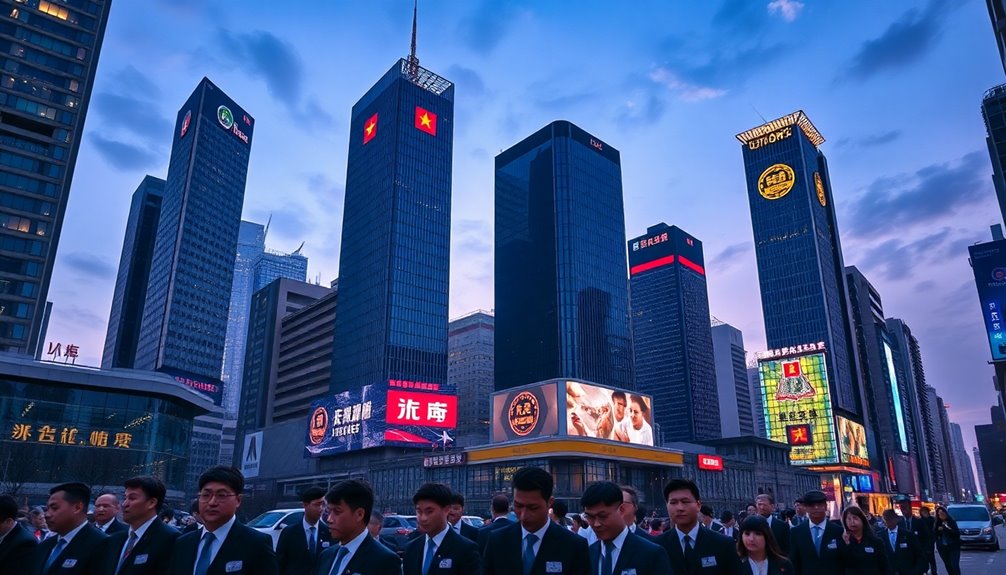
As China’s state-owned enterprises (SOEs) continue to shape the global economic landscape, you might wonder how these giants influence not only the domestic market but also international competition. With around 362,000 SOEs active as of 2022, they play a crucial role in China’s state capitalist model, steering the economy in alignment with national priorities. In 2023, 97 of the 142 Chinese companies on the Fortune Global 500 list were SOEs, underscoring their market presence and significance.
Despite their size, SOEs aren’t just about numbers. Their combined net profit grew by 7.4% to ¥4.63 trillion ($640 billion) in 2023, showcasing their economic impact. They account for half of the combined market capitalization of China’s top 100 listed firms, making them a powerful force in strategic sectors like energy and telecommunications. Additionally, the total operating income of SOEs rose to ¥85.73 trillion ($11.85 trillion), equating to 68% of China’s GDP.
SOEs are also key drivers of technological innovation and R&D, pushing China into the forefront of global technology. However, these enterprises don’t operate without challenges. Critics often highlight inefficiencies compared to private companies, and concerns about market distortions arise from government support and subsidies.
You might see how this reliance on state directives can lead to capital waste, raising questions about the long-term sustainability of SOEs. As they expand globally, especially in infrastructure projects, they encounter stiff competition from agile private companies worldwide.
In response to efficiency concerns, China has initiated mixed-ownership reforms, allowing private investors to take stakes in SOEs. This aims to improve operational efficiency while still aligning with national goals. The Zhuada Fangxiao policy focuses on strengthening larger SOEs while privatizing smaller ones, ensuring that strategic industries remain under state control.
The State-owned Assets Supervision and Administration Commission (SASAC) oversees non-financial SOEs, driving them toward global competitiveness. As SOEs dominate key industries, they’re pivotal in advancing China’s technological capabilities and leading innovation hubs.
The State Grid Corporation, for instance, plays a vital role in the energy sector, fully owned by SASAC. While their global expansion garners attention, you can’t overlook the underlying issues they face in competing with private firms, both domestically and internationally.

Energy Efficiency Services Sector: Workforce Analyses (Energy Science, Engineering and Technology)
As an affiliate, we earn on qualifying purchases.
As an affiliate, we earn on qualifying purchases.

Corning RST-000 Fiber Optic Ribbon Splitting Tool, Cleaning Brush & Nylon Case
As an affiliate, we earn on qualifying purchases.
As an affiliate, we earn on qualifying purchases.

Corporate Kit (Black) – Binder, Slipcase, Minutes & Bylaws, Stock Certificates, Index Tabs & Metal Corporate Seal
- Includes binder and slipcase: With spine window for labeling
- Pre-printed corporate documents: Minutes and bylaws included
- Stock certificates: 20 custom printed and numbered
As an affiliate, we earn on qualifying purchases.
As an affiliate, we earn on qualifying purchases.

Ultimate VMware NSX for Professionals: Leverage Virtualized Networking, Security, and Advanced Services of VMware NSX for Efficient Data Management … (Network Administrator — Enterprise Path)
As an affiliate, we earn on qualifying purchases.
As an affiliate, we earn on qualifying purchases.