
Social media monitoring can give you real-time insights into public opinion, brand sentiment, and influencer impact. It helps you gauge how people feel and spot issues quickly. However, it can’t reveal the full depth of emotions, motivations, or unspoken attitudes. Predicting future trends or understanding subtle feelings remains challenging. The data often reflects only active online voices, missing quieter opinions. Keep exploring to discover how you can make the most of these tools and avoid common pitfalls.

Get privacy and security gear delivered free — and shop member deals
- Fast, free delivery on millions of items
- Access to Prime Big Deal Days deals on October 6–7
- Prime Video, Amazon Music and more included
Key Takeaways
- Social media monitoring reveals real-time public opinion and brand sentiment but cannot fully capture deep or unspoken feelings.
- It identifies influential voices but cannot accurately predict future public opinion trends or motivations.
- Monitoring provides quick insights but may overlook broader or offline audience perspectives.
- It can oversimplify complex sentiments through content analysis and misses nuanced or subtle attitudes.
- Social media insights are valuable but should be supplemented with traditional research for comprehensive understanding.

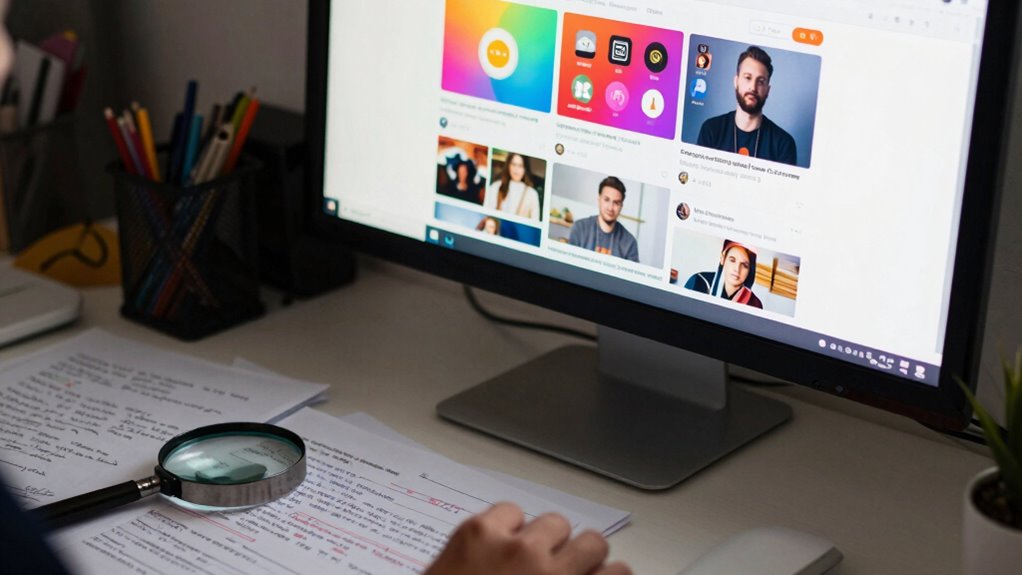
Have you ever wondered how businesses keep track of what’s being said about them online? Social media monitoring offers a powerful way to gauge public opinion, analyze brand sentiment, and identify influential voices. By scanning platforms like Twitter, Facebook, and Instagram, you can get a snapshot of how your brand is perceived. When you analyze brand sentiment, you’re fundamentally measuring whether the overall tone surrounding your brand is positive, negative, or neutral. This insight helps you understand customer opinions, spot potential issues early, and tailor your messaging accordingly. It’s a crucial tool for reputation management, giving you real-time feedback on how your brand is resonating with your audience.
Social media monitoring helps gauge public opinion and manage your brand’s reputation in real time.
However, social media monitoring isn’t a crystal ball. It cannot fully reveal the depth of public opinion or predict future trends with absolute certainty. While it can surface common themes and prevailing sentiments, it doesn’t capture every nuance, especially subtle feelings or unspoken attitudes. For example, a spike in negative comments might indicate dissatisfaction, but it doesn’t always explain why. You might see influencers talking about your brand, and through influencer analysis, you can identify key opinion leaders shaping perceptions. Yet, this doesn’t guarantee you’ll understand their motivations or the full context of their influence. Influencer analysis helps pinpoint who’s driving conversations and how their opinions might sway their followers, but it doesn’t tell you everything about the bigger picture.
Social media monitoring also has limitations in accurately representing your entire customer base. Not everyone is active online, and those who are may not reflect your broader audience. Additionally, algorithms and filters may miss certain conversations or skew data, leading to an incomplete view. It’s easy to focus on the loudest voices, but quiet dissent or unspoken concerns might go unnoticed. Moreover, social media conversations are often brief and superficial, making it difficult to gauge complex feelings or long-term attitudes solely from short posts and comments. The reliance on content analysis can sometimes oversimplify the depth of public sentiment. Incorporating a broader range of research methods, such as direct feedback or in-depth interviews, can provide a more comprehensive understanding of your audience. Recognizing the importance of contextual understanding is vital to avoid misinterpreting data and drawing inaccurate conclusions.
While social media monitoring provides valuable insights into brand sentiment and influencer analysis, it’s not an all-encompassing solution. It can’t replace traditional research methods like surveys or focus groups, nor can it predict every shift in public opinion. Instead, it’s a complementary tool that, when used wisely, helps you stay informed, respond quickly, and adapt your strategies. Recognizing its limits ensures you don’t over-rely on social media data alone and encourages a more holistic approach to understanding your audience’s true feelings.
social media monitoring software
As an affiliate, we earn on qualifying purchases.
As an affiliate, we earn on qualifying purchases.
Frequently Asked Questions
Can Social Media Monitoring Predict Future Consumer Behavior Accurately?
Social media monitoring, combined with predictive analytics, can offer valuable consumer insights and help forecast future behavior, but it’s not entirely accurate. You might identify trends and preferences, yet unpredictable factors like shifts in mood or external events can skew predictions. Relying solely on social media data limits accuracy, so use it as a part of a broader strategy to better understand and anticipate consumer actions, not as a crystal ball.
How Do Privacy Laws Impact Social Media Monitoring Practices?
You might think privacy laws limit your social media monitoring, but they mainly set boundaries to guarantee data compliance. Privacy restrictions protect users’ rights, so you must adapt your practices accordingly. By understanding these laws, you can responsibly gather insights without risking legal issues. Staying updated on privacy regulations helps you balance effective monitoring with respecting individuals’ privacy, ultimately building trust with your audience and maintaining ethical standards.
Can Social Media Monitoring Detect Fake or Bot Accounts?
Social media monitoring can help detect fake profiles and assist in bot detection, but it’s not foolproof. You actively analyze account behaviors, posting patterns, and engagement metrics to identify suspicious activity. However, clever bots mimic real users, making it challenging to catch every fake account. While monitoring tools improve your chances of spotting fake profiles, some sophisticated bots still slip through, requiring ongoing vigilance and advanced detection techniques.
What Are the Costs Associated With Comprehensive Social Media Monitoring?
Imagine investing in a high-tech security system; extensive social media monitoring involves similar costs. You face expenses for advanced tools, skilled analysts, and ongoing data privacy compliance. A detailed cost analysis reveals these can range from thousands to millions annually, depending on your scope. While the investment shields your brand, it’s crucial to balance costs with benefits, ensuring data privacy remains protected, without overspending on features you don’t need.
How Reliable Are Sentiment Analysis Tools in Understanding Public Opinion?
Sentiment analysis tools can be helpful, but their reliability varies because they often miss contextual nuances and emotional accuracy. You might find that they struggle to interpret sarcasm, humor, or cultural references, leading to inaccurate insights. While these tools give a quick overview of public opinion, you should be cautious and supplement them with human analysis for a more complete understanding of the true sentiments behind social media posts.
Conclusion
While social media monitoring offers valuable insights, it’s not the whole story. You can catch trends, gauge sentiment, and spot potential issues, but it’s not a crystal ball. Don’t put all your eggs in one basket, as some truths hide behind the scenes, away from screens. Use it as a tool, not a definitive answer, and remember, the truth often lies beneath the surface, waiting to be uncovered with a keen eye.
Fall Picks
fall essentials
As an affiliate, we earn on qualifying purchases.