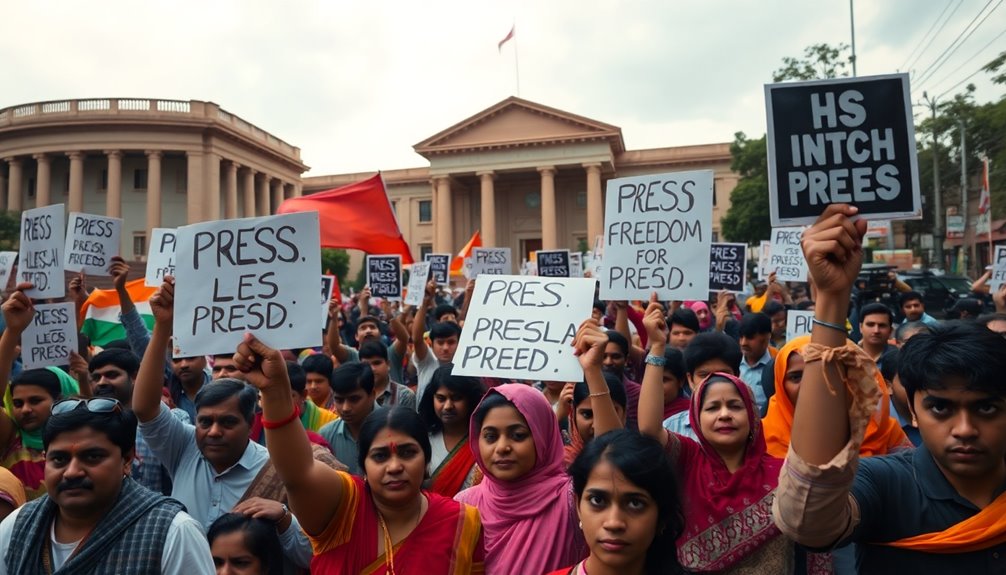


As India grapples with its complex relationship between press freedom and governmental control, journalists face increasing challenges that threaten their ability to report freely. Despite the constitutional protection under Article 19(1)(a), which guarantees freedom of speech and expression, numerous legal frameworks impose significant restrictions.

Get privacy and security gear delivered free with Prime
- Fast, free delivery on millions of items
- Prime Video, Amazon Music and more included
- Member-only deals all year
India's intricate balance of press freedom and government control imposes daunting challenges on journalists striving for independent reporting.
You may find it alarming that defamation laws and a lack of whistleblower protections create an environment where journalists are hesitant to expose corruption or wrongdoing. Additionally, recent amendments to laws like the Unlawful Activities (Prevention) Act (UAPA) have made it easier for the government to target those who dare to speak out.
The use of sedition laws, specifically Section 124A of the Indian Penal Code, is a tool often wielded against journalists critical of the government. When you hear about arrests and charges, consider that at least 15 journalists have faced UAPA charges since 2014, with 36 imprisoned. A total of 36 journalists have been imprisoned in India during this period.
Raids on outlets like NewsClick and the BBC demonstrate the lengths to which authorities will go to stifle dissent. Even economic pressures are evident, as the Income Tax Department has frozen bank accounts of targeted media outlets, squeezing their operational capabilities.
You might be disturbed to learn that allegations of spyware like Pegasus being used for surveillance on journalists only exacerbate the situation. Internet shutdowns, frequently imposed, hinder your ability to access and share vital information, leaving you in a state of uncertainty.
This environment creates a chilling effect, discouraging you and others from engaging in critical reporting. The fear of surveillance and potential legal repercussions leads to widespread self-censorship among journalists.
While the Supreme Court has made some strides, emphasizing the importance of press freedom and privacy, the judicial landscape remains fraught with challenges. The Court ordered a probe into the Pegasus spyware issue and has quashed some sedition charges, but the practice persists.
Legal battles are a constant for journalists seeking protection from arbitrary arrests. The lack of judicial oversight in the removal of online content raises further concerns about your safety and freedom of expression.
In regions like Jammu and Kashmir and Uttar Pradesh, the risks are even higher, with police interrogations and false charges against journalists. Minority group journalists often face heightened harassment, revealing a troubling trend that undermines the fabric of independent journalism.
As you reflect on these issues, it's clear that the legal battle for press freedom in India is intensifying, and it's a struggle that affects us all.
spyware detection software
As an affiliate, we earn on qualifying purchases.
As an affiliate, we earn on qualifying purchases.
Halloween Picks
halloween
As an affiliate, we earn on qualifying purchases.