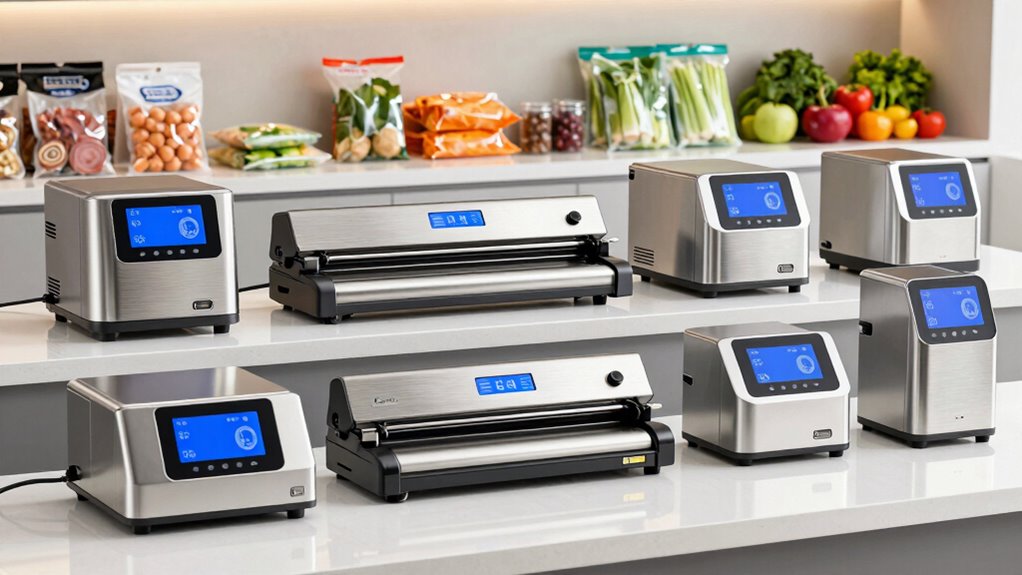

For a commercial vacuum sealer that can handle wet foods and repeated batches, I’d start with the VacMaster VP230, a chamber model suited to heavier-duty work. The Weston Pro-2300 stands out for wide external sealing, while the Potane Precision offers a more approachable feature set for home users. The main choice is between a chamber sealer, which can package liquids but takes more space, and an external sealer, which is easier to store but has limits with wet foods and bag types. Sealing width, batch pace, maintenance, and bag costs also separate these machines. Read on for how all 13 options compare and which one fits your workload.

Get privacy and security gear delivered free with Prime
- Fast, free delivery on millions of items
- Prime Video, Amazon Music and more included
- Member-only deals all year
Key Takeaways
- The VacMaster VP230 leads for demanding batches because its chamber design handles liquids and foods that can challenge external sealers, though its footprint and workflow suit a dedicated counter or prep area.
- External sealers divide by workload and sealing width: the Weston Pro-2300 and 16-inch MAGIC SEAL models favor larger packages, while compact feature-rich models emphasize home convenience.
- Chamber models change the packaging equation. They can seal liquids and use less specialized bag material, but their larger bodies require more counter space and setup.
- Built-in cutters, bag storage, and preset modes save small amounts of time repeatedly, making them more useful for frequent meal prep than for occasional sealing.
- High vacuum figures alone do not settle the ranking. Seal consistency, usable bag width, chamber capacity, pump design, and ease of cleaning matter more to a buyer’s day-to-day results.
| VacMaster VP230 Chamber Vacuum Sealer |  | Best for Liquid-Rich Foods | Pump: 1/2 HP oil pump | Seal bar: 12.25 inches | Maximum bag size: 12 × 15 inches | VIEW ON AMAZON | See Our Full Breakdown |
| Potane Precision Vacuum Sealer with Built-in Cutter and Bag Storage |  | Best for Repeated External Sealing | Motor: Brushless mechanical motor | Sealing element width: 3 mm | Included bag rolls: 11 × 16 feet and 8 × 16 feet | VIEW ON AMAZON | See Our Full Breakdown |
| FoodSaver V4400 2-in-1 Vacuum Sealer Machine with Automatic Bag Detection and Starter Kit |  | Best for Guided Everyday Use | Model: V4400 | Automatic bag detection: Yes | Automatic moisture detection: Yes | VIEW ON AMAZON | See Our Full Breakdown |
| MAGIC SEAL MS4005 16-Inch Commercial Vacuum Sealer |  | Best for Wide-Bag Versatility | Power: 250 W | Sealing bar: 16 inches (40 cm) | Seal width: 8 mm | VIEW ON AMAZON | See Our Full Breakdown |
| Weston Pro-2300 Vacuum Sealer Machine for Food Preservation & Sous Vide |  | Best for Large External Bags | Power: 1020 W | Motor: Fan-cooled commercial-grade | Pump: Double-piston | VIEW ON AMAZON | See Our Full Breakdown |
| 95kPa Vacuum Sealer Machine with AquaLock Technology – Dual-Pump Automatic Food Sealer, Double Heat Seal, Built-in Cutter, Bag Storage & Hose, 2 Bag Rolls, Stainless Steel |  | Best for All-Around Home Prep | Vacuum pressure: Up to 95 kPa | Motor: 130 W dual-pump | Seal design: Double heat seal with strips stated to be 30% wider | VIEW ON AMAZON | See Our Full Breakdown |
| CVS101 Dual-Chamber Vacuum Sealer with 6L Chamber, Dual Vacuum Zones, Extra-Wide Bag Clamp, 230W Dual-Core Dry Pumps – Commercial-Grade for Home Use |  | Best for Mixed Liquid and Batch Sealing | Chamber capacity: 6 L; approximately 300 × 260 × 80 mm | Vacuum power: Up to -100 kPa | Power consumption: 230 W | VIEW ON AMAZON | See Our Full Breakdown |
| 95 kPa 10-in-1 Commercial Vacuum Sealer with Double Heat Seal |  | Best for Fast, Repeated External Sealing | Brand and model: QKWXV SV629 | Suction force: 95 kPa | Motor power: 230 W | VIEW ON AMAZON | See Our Full Breakdown |
| Avid Armor USV20 Chamber Vacuum Sealer Machine |  | Best Compact Chamber Sealer | Model: USV20 | Chamber capacity: 4 L | Chamber dimensions: 12.25 in W × 8.5 in L × 3 in H | VIEW ON AMAZON | See Our Full Breakdown |
| MAGIC SEAL MS450 Commercial Vacuum Sealer, 16-Inch |  | Best for Long Bags and High-Volume Runs | Model: MS450 | Construction: 304 stainless steel | Power: 400 W | VIEW ON AMAZON | See Our Full Breakdown |
| 98 kPa Smart Vacuum Sealer with FreshTrack Label Printing & Food Manager App |  | Best for Food Inventory Tracking | Vacuum pressure: 98 kPa dual-pump suction | Sealing speed: Up to 50% faster than basic sealers | Heating strips: Widened dual heating strips | VIEW ON AMAZON | See Our Full Breakdown |
| 95 kPa Powerful Commercial Vacuum Sealer Machine – 2× Strength Double Seal |  | Best for Fast, Flexible Batch Sealing | Suction power: 95 kPa | Motor power: 130 W | Seal time: 8–18 seconds | VIEW ON AMAZON | See Our Full Breakdown |
| VEVOR Chamber Vacuum Sealer, 320W, 12.6-inch Sealing Length |  | Best for Bulk and Liquid-Rich Foods | Model: DZ-260C | Heater power: 320 W | Vacuum pump power: 180 W | VIEW ON AMAZON | See Our Full Breakdown |
More Details on Our Top Picks
VacMaster VP230 Chamber Vacuum Sealer
The VacMaster VP230 is the strongest fit here for commercial users who need to seal soups, marinades, or other wet foods. Its chamber design lets liquids stay in the bag during vacuuming, where an external sealer such as the Weston Pro-2300 is better suited to dry ingredients and large flat bags. The 1/2 HP oil pump and double seal protection are built for repeatable, secure sealing, while one-touch controls keep operation straightforward. Its 12.25-inch bar handles bags up to 12 by 15 inches, though that is narrower than the Weston’s 15-inch capacity. At 89 pounds, the VP230 is a substantial piece of equipment, so it makes more sense for a dedicated prep area than a kitchen where the sealer needs to be moved or stored after each use.
Pros:- Chamber vacuum sealing handles liquids and moist foods cleanly.
- 1/2 HP oil pump is suited to repeated commercial-style use.
- Double seal protection supports secure package closure.
- One-touch controls and a pressure indicator simplify operation.
Cons:- At 89 pounds, it is difficult to move or store between uses.
- Its 12.25-inch seal bar is narrower than the Weston Pro-2300’s 15-inch bar.
- The chamber format and footprint may be excessive for occasional household sealing.
Best for: Small food businesses and serious home cooks who regularly package liquids or liquid-rich foods.
Not ideal for: Casual users with limited counter or storage space, or operators who need to seal bags wider than 12 inches.
- Pump:1/2 HP oil pump
- Seal bar:12.25 inches
- Maximum bag size:12 × 15 inches
- Chamber dimensions:12.5 × 15 × 5 inches
- Overall dimensions:15.5 × 19 × 15.75 inches
- Weight:89 pounds
- Included supplies:60 assorted 3-mil chamber pouches, filler plates, maintenance kit, and user guide
Our verdict“Choose the VP230 if sealing liquids is a regular job and you have room for a heavy chamber machine.”
Potane Precision Vacuum Sealer with Built-in Cutter and Bag Storage
For a shop or busy household sealing many dry goods in succession, the Potane VS5736 offers an accessible external-sealer format with a motor designed for 100 or more consecutive cycles. That makes it better suited to repeated bag sealing than the FoodSaver V4400, whose appeal leans more toward automatic bag detection and everyday convenience. The brushless mechanical motor, one-hand C-type chamber, built-in cutter, and bag storage help keep a busy packing station moving without reaching for separate tools. It accepts rolls up to 20 feet long, but the supplied rolls are 11 and 8 inches wide, and other sizes need to be sourced separately. Unlike the VacMaster VP230, it is not a chamber sealer, so I would steer buyers handling liquids toward that chamber model instead.
Pros:- Brushless motor is specified for 100-plus consecutive sealing cycles.
- Built-in cutter and roll storage keep bag preparation close at hand.
- One-hand C-type design supports quick bag positioning.
- Five-year warranty is longer than the MAGIC SEAL MS4005’s one-year warranty.
Cons:- It is an external sealer, so it is less suitable than the VacMaster VP230 for liquid packaging.
- The machine may take more counter space than its compact label suggests.
- The included roll widths limit immediate bag-size choices.
Best for: Meal-prep operators and small businesses that repeatedly seal dry or lightly moist foods using roll bags.
Not ideal for: Buyers who need chamber sealing for liquids or who want a machine with a small storage footprint.
- Motor:Brushless mechanical motor
- Sealing element width:3 mm
- Included bag rolls:11 × 16 feet and 8 × 16 feet
- Maximum bag length:20 feet
- Modes:Automatic and manual
- Continuous use:100-plus cycles
- Warranty:5 years
Our verdict“Pick the Potane for frequent roll-bag sealing when chamber handling for liquids is not a requirement.”
FoodSaver V4400 2-in-1 Vacuum Sealer Machine with Automatic Bag Detection and Starter Kit
The FoodSaver V4400 is aimed at buyers who want an external sealer to guide routine food storage, rather than a machine built around commercial throughput. Automatic bag detection, moisture sensing, and LED indicators reduce the number of settings a new user has to manage. Its built-in roll storage and cutter also make it easier to prepare custom bags than the Potane VS5736 if the main goal is convenient home use. The dishwasher-safe drip tray is a practical touch for catching spills, but the V4400’s bulky housing still claims counter space. Its five-year limited warranty is useful, though neither that nor its starter kit changes the fact that it is not a chamber unit like the VacMaster VP230; buyers packaging liquids at commercial scale should look to the chamber format instead.
Pros:- Automatic bag and moisture detection reduce manual adjustments.
- Built-in roll storage and cutter allow custom-length bags.
- Dishwasher-safe removable drip tray simplifies cleanup.
- Starter kit includes rolls, vacuum bags, and zipper bags.
Cons:- Bulky housing requires a dedicated spot on the counter.
- Initial setup may take time for first-time users.
- External sealing is less suited to liquids than the VacMaster VP230 chamber system.
Best for: Home cooks who want guided vacuum sealing for leftovers, freezer portions, and occasional meal prep.
Not ideal for: Commercial operators handling frequent liquid packaging or needing a chamber sealer for high-volume work.
- Model:V4400
- Automatic bag detection:Yes
- Automatic moisture detection:Yes
- Included roll:11 inches × 10 feet
- Built-in cutter:Yes
- Drip tray:Removable and dishwasher-safe
- Warranty:5-year limited
Our verdict“Choose the V4400 for guided household food storage, but choose a chamber model for regular commercial liquid sealing.”
MAGIC SEAL MS4005 16-Inch Commercial Vacuum Sealer
The MAGIC SEAL MS4005 stands out for buyers who need one machine to handle both smooth and textured bags, including Mylar, across a wide 16-inch sealing bar. Its retractable nozzle and chamber modes give it a broader bag range than the Weston Pro-2300, which has a long bar but is described as an external sealer. The cooling system is rated for up to 450 consecutive seals, making the MS4005 a more natural fit for long packaging sessions than a household-focused machine such as the FoodSaver V4400. That flexibility comes with a large commercial-style form and sparse footprint information: dimensions and weight are not provided, making workstation planning harder. The one-year warranty is also shorter than the Potane’s five years, so buyers should weigh bag compatibility and width against the limited stated coverage.
Pros:- Nozzle and chamber modes support smooth and textured bags, including Mylar.
- 16-inch sealing bar accommodates wider packages than the VacMaster VP230.
- Cooling system is specified for up to 450 consecutive seals.
- Includes automatic and manual controls, cutter, accessory port, and starter supplies.
Cons:- Large commercial-style format may require dedicated counter space.
- Dimensions and weight are not provided, complicating space planning.
- One-year warranty is shorter than the Potane VS5736’s five-year warranty.
Best for: Small producers and packers who switch between smooth, textured, and Mylar bags and need a wide sealing area.
Not ideal for: Buyers with tight counter space or those who prioritize a longer stated warranty and clear footprint measurements.
- Power:250 W
- Sealing bar:16 inches (40 cm)
- Seal width:8 mm
- Sealing time:1–15 seconds
- Modes:Retractable nozzle and chamber
- Bag compatibility:Smooth and textured bags, including Mylar
- Consecutive seals:Up to 450
- Warranty:1 year
Our verdict“Choose the MS4005 when broad bag compatibility and a 16-inch sealing bar matter more than a compact footprint.”
Weston Pro-2300 Vacuum Sealer Machine for Food Preservation & Sous Vide
The Weston Pro-2300 is the external-sealer choice for operators who package wide cuts or large portions and value a 15-inch bag capacity. Its 1020-watt system, double-piston pump, and fan-cooled motor are specified for continuous use, giving it a more production-oriented profile than the FoodSaver V4400. One-touch automatic and manual modes keep the workflow simple, while LED indicators show sealing progress. The tradeoff is format: unlike the VacMaster VP230, the Weston is not described as a chamber sealer, so it is a less suitable choice for liquids. Its wide seal bar also does not match the MAGIC SEAL MS4005’s 16-inch span or its stated compatibility with smooth, textured, and Mylar bags. The Weston’s large countertop footprint calls for a dedicated station.
Pros:- Handles bags up to 15 inches wide for large portions.
- Fan-cooled commercial-grade motor is designed for continuous use.
- Double-piston pump is specified to reach 28 inches Hg vacuum.
- One-touch and manual operation with LED indicators supports straightforward sealing.
Cons:- Large countertop footprint may require a dedicated workstation.
- External-sealer format is less suited to liquid foods than the VacMaster VP230.
- Its 15-inch bar is shorter than the MAGIC SEAL MS4005’s 16-inch bar.
Best for: Butchers, hunters, and food-prep operators sealing large cuts or portions in wide external vacuum bags.
Not ideal for: Businesses that frequently package liquids or need chamber sealing and broader bag-type compatibility.
- Power:1020 W
- Motor:Fan-cooled commercial-grade
- Pump:Double-piston
- Vacuum strength:Up to 28 inches Hg
- Seal bar width:5 mm
- Maximum bag width:15 inches (38 cm)
- Operation:One-touch automatic and manual modes
Our verdict“Choose the Weston when wide external bags and repeated dry-food sealing are the priority.”
95kPa Vacuum Sealer Machine with AquaLock Technology – Dual-Pump Automatic Food Sealer, Double Heat Seal, Built-in Cutter, Bag Storage & Hose, 2 Bag Rolls, Stainless Steel
The Beelicious Pro suits home cooks who want commercial-style speed and flexible sealing without moving to a chamber machine. Its 130 W dual-pump motor reaches up to 95 kPa, while dry, moist, gentle, pulse, and marinate settings help adapt the seal to different foods. The wider double heat seal adds reassurance for stored portions, and the cutter, bag storage, and hose keep common accessories close at hand.
Compared with the QKWXV SV629, this model lists more specific food-control modes and a stainless-steel body, while the QKWXV has a higher stated motor wattage and cooling system. Like other external sealers, it may struggle with free liquids, where the Avid Armor USV20 chamber design is better suited. Multiple settings may slow down beginners, and missing dimensions make counter fit harder to judge.
Pros:- Dual-pump suction reaches up to 95 kPa for quick sealing.
- Multiple pressure and food modes offer control for different ingredients.
- Double, wider heat strips are designed to create a tighter seal.
- Built-in cutter, bag storage, accessory hose, and removable drip tray support an organized workflow.
Cons:- The range of modes may take time for first-time users to learn.
- No dimensions are provided, making it difficult to assess counter fit.
- As an external sealer, it is less suited to sealing liquids than chamber models.
Best for: Home cooks who batch-prep varied dry, moist, and delicate foods and want built-in bag organization.
Not ideal for: Beginners seeking a very simple one-button workflow, or cooks who regularly seal soups and other free liquids.
- Vacuum pressure:Up to 95 kPa
- Motor:130 W dual-pump
- Seal design:Double heat seal with strips stated to be 30% wider
- Modes:Dry, moist, normal, gentle, marinate, canister, and pulse
- Body:Stainless steel
- Included accessories:Built-in cutter, bag storage, accessory hose, 2 bag rolls, and spare sponge gasket
- Drip tray:Removable
Our verdict“Choose the Beelicious Pro if you want a versatile external sealer with integrated storage and several food-specific settings.”
CVS101 Dual-Chamber Vacuum Sealer with 6L Chamber, Dual Vacuum Zones, Extra-Wide Bag Clamp, 230W Dual-Core Dry Pumps – Commercial-Grade for Home Use
The CVS101 stands apart in this group by combining a 6 L chamber for liquids with a separate lower work area for external bag sealing. That dual-zone layout gives batch-prep cooks more flexibility than the Avid Armor USV20, whose chamber is smaller at 4 L, and the Beelicious Pro, which uses an external sealing format. Four oil-free dry pumps supply up to -100 kPa, while the 12-inch seal bar accommodates broader bags.
Its app can help log foods and sealing dates, though that feature adds complexity rather than improving the core seal. The larger chamber and external work area also call for more counter space than the Avid Armor. This makes the CVS101 a stronger fit for home kitchens handling frequent, varied batches or light commercial prep than for occasional, small-bag use.
Pros:- 6 L chamber supports sealing liquids and other foods that can be difficult in external sealers.
- Separate lower work area adds external bag-sealing flexibility.
- Four oil-free dry pumps provide up to -100 kPa vacuum power.
- 12-inch seal bar and extra-wide clamp accommodate larger bags.
Cons:- The dual-zone design takes more counter space than compact chamber models.
- App integration and customizable settings may add a learning curve.
- Its feature set may be more than occasional home users need.
Best for: Frequent batch-prep cooks and small food businesses that need to seal liquids in a chamber and larger bags externally.
Not ideal for: Small kitchens or occasional users who need a compact, uncomplicated sealer.
- Chamber capacity:6 L; approximately 300 × 260 × 80 mm
- Vacuum power:Up to -100 kPa
- Power consumption:230 W
- Pumps:4 oil-free dry pumps
- Seal bar:12 inches
- Work areas:Chamber plus independent lower area for out-of-chamber sealing
- Included bags:10 textured bags, 10 smooth bags, and 1 roll-packed vacuum bag
- App compatibility:Smart app for food identification and logging
Our verdict“Pick the CVS101 if your workflow regularly switches between chamber-sealing liquids and externally sealing larger bags.”
95 kPa 10-in-1 Commercial Vacuum Sealer with Double Heat Seal
The QKWXV SV629 is aimed at cooks who want a fast external sealer for repeated portions. Its 230 W motor and 95 kPa suction are stated to create seals in 8–18 seconds, while a cooling system and drip tray with water detection address two common annoyances during extended use: heat buildup and escaping liquid. The cutter and roll storage also reduce interruptions between bags.
Against the Beelicious Pro, the QKWXV lists higher motor power and more explicit cooling features, while Beelicious offers a stainless-steel body and a spare gasket. Neither replaces a chamber machine such as the Avid Armor USV20 for sealing free liquids. The SV629’s ABS body and bulky footprint may matter to buyers prioritizing metal construction or limited counter space, and its freshness claim should not replace careful food handling.
Pros:- 230 W motor and up to 95 kPa suction are specified for fast sealing.
- Cooling system supports repeated sealing sessions.
- Water-detection drip tray helps manage liquid drawn toward the machine.
- Built-in cutter and roll storage keep bag preparation close at hand.
Cons:- Its stated bulky, heavy design may be awkward on smaller counters.
- ABS construction may not suit buyers seeking a stainless-steel body.
- External sealing is less appropriate for free liquids than a chamber sealer.
Best for: Home meal-preppers who seal many solid or lightly moist portions in a session and want roll storage and cooling features.
Not ideal for: Buyers who need a compact machine, a stainless-steel body, or reliable chamber sealing for free liquids.
- Brand and model:QKWXV SV629
- Suction force:95 kPa
- Motor power:230 W
- Stated sealing time:8–18 seconds
- Heat seal:Dual strips, stated to be 30% wider, with four-layer heating wire
- Bag roll:5 m roll, 11 inches wide
- Included bags:15 vacuum bags: 5 small and 10 large
- Material and color:ABS; black and silver
- Operation:Automatic; single or double heat seal
Our verdict“Choose the QKWXV SV629 for quick, repeated external sealing when its footprint and ABS body fit your kitchen.”
Avid Armor USV20 Chamber Vacuum Sealer Machine
The USV20 is the chamber pick for cooks who want to seal soups, marinades, and other liquids without drawing them through an external sealer. Its 4 L stainless-steel chamber and adjustable vacuum and seal controls also make it easier to protect delicate foods than a basic automatic external machine. At 14 inches wide and 8.25 inches high, it is notably compact for a chamber model, though its 17.55-pound weight makes moving it less convenient.
Compared with the larger CVS101, the USV20 gives up chamber capacity and the second external work area in favor of a more manageable footprint. The MAGIC SEAL MS450 handles much longer bags and sustained external sealing, but it cannot match the USV20’s stated full-chamber approach to liquids. A 4 L chamber limits very large batches, and vacuum cycles take 15–60 seconds.
Pros:- Full-chamber pressure design supports mess-free sealing of liquids and marinades.
- Adjustable vacuum and seal controls help protect delicate foods.
- Compact chamber-sealer dimensions fit under many cabinets.
- User-replaceable parts support maintenance over time.
Cons:- The 4 L chamber limits batch size compared with the CVS101.
- At 17.55 pounds, it is heavy to move despite its compact dimensions.
- Vacuum time ranges from 15 to 60 seconds.
Best for: Home cooks who regularly seal soups, marinades, or sous-vide portions and want a relatively compact chamber machine.
Not ideal for: Caterers or batch processors who need a larger chamber, faster throughput, or a long seal bar for oversized bags.
- Model:USV20
- Chamber capacity:4 L
- Chamber dimensions:12.25 in W × 8.5 in L × 3 in H
- Product dimensions:14 in W × 12 in D × 8.25 in H
- Weight:17.55 lb
- Seal bar:11.5 inches
- Vacuum time:15–60 seconds
- Maximum pouch size:Up to 11 × 10 inches
- Material:Stainless steel
Our verdict“Choose the USV20 if sealing liquids matters more than chamber capacity or high-volume throughput.”
MAGIC SEAL MS450 Commercial Vacuum Sealer, 16-Inch
The MS450 is the strongest fit here for large external bags and long sealing runs. A 16-inch seal bar can handle bags wider than the 11.5-inch bar on the Avid Armor USV20, while dual pumps and 95 kPa suction serve wet and dry foods. The manufacturer specifies support for up to 450 continuous seals, with a cooling fan to help the machine keep working through batch jobs.
That production focus comes with a substantial 400 W power draw and a commercial-style form that may claim more counter space than the QKWXV SV629. Its stainless-steel construction and spare gasket are practical for ongoing use, but the MS450 is an external sealer: for soups or marinades, the Avid Armor’s chamber is the more suitable design. Choose this model when bag width and sustained sealing matter more than compact storage.
Pros:- 16-inch seal bar handles wider bags than the other listed models.
- Dual pumps and 95 kPa suction support wet and dry food sealing.
- Specified for up to 450 continuous seals, with a cooling fan.
- 304 stainless-steel construction and a spare foam gasket support ongoing use.
Cons:- Commercial-grade construction may take substantial counter space.
- Its 400 W power specification is higher than the other external sealers listed.
- External sealing is not as well suited to free liquids as the Avid Armor chamber design.
Best for: Small food businesses and serious batch-prep cooks sealing wide bags in long runs.
Not ideal for: Small kitchens, occasional users, or anyone who needs chamber sealing for free liquids.
- Model:MS450
- Construction:304 stainless steel
- Power:400 W
- Suction:95 kPa
- Pumps:Dual
- Seal bar:16 inches wide; 8 mm thick
- Continuous sealing:Up to 450 seals
- Included accessories:20 textured 8 × 12 inch bags, spare foam gasket, and printed guide
Our verdict“Pick the MS450 if your regular work calls for wide bags and extended external sealing sessions.”
98 kPa Smart Vacuum Sealer with FreshTrack Label Printing & Food Manager App
The VSP801 pairs 98 kPa dual-pump suction with FreshTrack label printing and the Beelicious app, making it the most inventory-focused option in this group. Labels and digital records can help families keep track of when stored food was sealed, while Extra Moist mode is suited to marinated meat and other wet ingredients. Compared with the 95 kPa Powerful Commercial Vacuum Sealer Machine, its standout difference is the connected food-tracking setup; the other model puts more emphasis on presets, double sealing, and built-in bag storage. The VSP801 also includes a cutter, hose storage, and drip tray for batch prep. Its app needs setup and occasional updates, and the printer adds another part to maintain. The larger countertop footprint may also be hard to justify if you only seal food occasionally.
Pros:- FreshTrack labels and the Beelicious app help organize sealed food
- 98 kPa dual-pump suction removes air quickly
- Extra Moist mode supports sealing high-moisture foods
- Easy-lift handle, bag cutter, hose storage, and drip tray support batch prep
Cons:- App setup and software updates add ongoing steps
- Larger footprint than a basic countertop sealer
- The label printer adds a component that may need maintenance
Best for: Families who batch-prep wet and dry foods and want labeled bags tied to a searchable digital inventory
Not ideal for: Buyers who want a simple, compact sealer without app setup or a label printer to maintain
- Vacuum pressure:98 kPa dual-pump suction
- Sealing speed:Up to 50% faster than basic sealers
- Heating strips:Widened dual heating strips
- Moisture handling:Ultra-sensitive moisture sensor with Extra Moist mode
- App integration:Beelicious food management app
- Label printing:FreshTrack label printer
- Safety certifications:ETL and FCC
Our verdict“Choose the VSP801 if app-linked food records and wet-food handling matter more to your household than a simpler setup.”
95 kPa Powerful Commercial Vacuum Sealer Machine – 2× Strength Double Seal
This model is a practical fit for kitchens that seal a mix of dry goods, moist ingredients, and liquid-rich portions. Its 95 kPa suction, 8–18 second sealing time, and integrated cooling are aimed at keeping a batch moving, while ten presets and Normal or Gentle vacuum strength give buyers more control over delicate foods. The double heat seal adds a second barrier that can be useful when bags hold liquids. Compared with the VSP801, it trades app-linked labeling for built-in bag storage, a cutter, and a countdown display. That makes it more focused on a self-contained counter workflow, though the number of settings may take practice. It is also larger than typical home models, so its batch-friendly features are a better match for regular use than occasional single-bag jobs.
Pros:- 95 kPa suction and 8–18 second seal time support quick batch work
- Ten presets and two vacuum-strength options accommodate different foods
- Double heat seal adds protection for liquid-rich bags
- Built-in bag storage, cutter, and countdown LCD keep the workflow organized
Cons:- Large countertop footprint can be difficult in a small kitchen
- Multiple modes and strength settings may take time to learn
Best for: Home cooks and small food operations that seal varied ingredients in batches and want presets, bag storage, and double seals in one machine
Not ideal for: First-time or occasional users who prefer a compact machine with fewer settings
- Suction power:95 kPa
- Motor power:130 W
- Seal time:8–18 seconds
- Preset modes:10, including Dry, Moist, and Extra Moist
- Vacuum strength:Normal and Gentle
- Heat seal:Single or double seal with 4-layer heating wires
- Bag storage capacity:Fits bags up to 11.8 inches wide
- Display and workflow:Countdown LCD, built-in cutter, and integrated cooling
Our verdict“Pick this machine for frequent, varied sealing when its presets, double seal, and integrated bag handling justify the counter space.”
VEVOR Chamber Vacuum Sealer, 320W, 12.6-inch Sealing Length
The VEVOR takes a different route from the countertop suction sealers in this group: its stainless-steel chamber is built to accommodate bulk cuts, whole loaves, and foods that are difficult to seal with external suction. With a 12.6-inch sealing length and up to 100 kPa suction, it suits users preserving larger portions or a steady supply of meat, seafood, coffee, and dry goods. Compared with the 95 kPa Powerful Commercial Vacuum Sealer Machine, this chamber design gives larger items more room, while that model offers ten presets and integrated bag storage in a more conventional sealer format. The VEVOR’s size is the main tradeoff: it can consume substantial counter or storage space, and its pump may be noisy. A smaller kitchen or occasional sealing routine may not make good use of its capacity.
Pros:- Deep chamber accommodates large items and bulk portions
- Up to 100 kPa suction and dual-lock seals support airtight preservation
- Stainless-steel chamber is built for repeated kitchen use
- Pressure gauge and LED display make operating status easy to read
Cons:- Bulky chamber design can be difficult to store or fit on a small counter
- Vacuum pump can generate noticeable noise during operation
Best for: Butchers, hunters, and serious home preservers who seal bulk cuts, whole loaves, or varied foods in chamber-compatible bags
Not ideal for: Small-kitchen users who seal only occasional portions and cannot spare space for a chamber unit
- Model:DZ-260C
- Heater power:320 W
- Vacuum pump power:180 W
- Sealing length:12.6 inches
- Suction power:Up to 100 kPa
- Voltage:110 V
- Chamber material:Stainless steel
- Controls:Built-in pressure gauge and LED display
Our verdict“Choose the VEVOR when chamber capacity for bulk or awkward foods matters more than compact size and quieter operation.”

How We Picked
I compared these 13 machines by the work they are designed to do: the type and volume of food they can package, their sealing area, vacuum and pump design, operating workflow, and the practical demands of cleaning and storage. I gave chamber models credit for handling liquids and irregular foods, while judging external models on accessible operation, wide seals, and convenience features. I also weighed whether a feature such as dual pumps, double sealing, bag storage, or app-based tracking changes the buyer’s routine in a meaningful way.
The order reflects fit across commercial-style use, not a claim that every model suits a restaurant line. The VacMaster VP230 ranks first for its chamber format and broader food-handling range; the Weston Pro-2300 and wide MAGIC SEAL units follow for external sealing capacity. Home-oriented models rank higher when their controls and storage features bring practical value, but lower when the available details do not establish the same capacity or wet-food flexibility. Buyers should verify current specifications, replacement parts, and compatible bag requirements before choosing.
Factors to Consider When Choosing Vacuum Sealer Commercial
Commercial in a product name can describe a robust home machine as easily as equipment intended for sustained service. I’d size the sealer around the work pattern first, then check bag compatibility, installation space, and maintenance needs. These broader choices can matter more than a headline vacuum figure.
Match Chamber Style to What You Package
Chamber sealers remove air from the chamber around the bag, so pressure inside and outside the bag equalizes during the cycle. That makes them a better fit for soups, marinades, and other wet foods than most external suction machines. External sealers draw air through the open bag edge, which is convenient for dry goods and portions but can pull liquid toward the seal. A common mistake is buying an external unit for frequent liquid packaging and then relying on extra steps to keep the sealing area dry. Chamber machines typically need more counter space and a stable work surface. Choose by the foods you seal routinely, not by the broadest possible use case you might try once.
Estimate Batch Pace Before Paying for Capacity
Think about how many bags you seal in one sitting and how often that session repeats. A household portioning meat for the freezer can tolerate pauses between cycles, while a prep operation benefits from a machine that supports a steady rhythm. Check whether the unit needs cooling time between seals and whether bag placement or manual adjustments slow the process. Chamber capacity and sealing-bar length affect which portions fit, but neither tells the whole story about throughput. An oversized machine can take valuable workspace without speeding up small batches. If your workload is growing, leave room for larger bags and repeat cycles rather than choosing on peak specs alone.
Check Bag Supply and Long-Term Compatibility
External machines often rely on textured or embossed bags that let air move toward the suction channel. Chamber models can often use smooth bags, which may broaden supply choices, though buyers should confirm the manufacturer’s requirements. Bag rolls with a built-in cutter can reduce trimming and odd-sized leftovers, but they do not automatically lower ongoing supply needs. Before purchase, confirm that the widths you use fit the sealing bar and that your preferred bag material is compatible. Also check whether replacement gaskets, foam inserts, and other wear parts are available. A machine that is easy to supply and maintain can be a better long-term fit than one with more controls.
Treat Seal Width and Seal Design as Different Questions
A wide sealing bar lets you close larger bags or place multiple bags across a bar when the machine’s design allows it. A double seal adds another barrier along the bag opening, which can help when packaging bulky or moisture-prone contents. Neither feature makes poor bag placement or a contaminated seal area harmless. Measure your usual bags and portions, then compare them with the usable sealing width rather than the machine’s overall dimensions. For powders and liquids, plan a clean, dry margin at the bag opening even when using a chamber model. Buyers sometimes pay for a wide bar they rarely use while overlooking the ability to clean and inspect the seal area.
Plan for Space, Cleaning, and Service
Commercial-style equipment may be heavy and awkward to move, so measure the counter and the route to its storage spot before ordering. Leave room to open the lid fully, place bags, and reach controls without shifting other equipment. After packaging meat, fish, or sauced food, wipe-down access and removable parts can shape how likely the machine is to get cleaned promptly. Ask how the pump should be maintained and whether the manufacturer documents service steps and replacement parts. A chamber model can deliver broader food handling, but its larger body makes permanent placement more practical. If you need to put the sealer away after each use, a compact external model may see more use.
Prioritize Useful Controls Over Feature Counts
Pulse controls and adjustable vacuum settings can help protect soft foods that would crush under a full cycle. Automatic bag detection, presets, and hose ports can simplify repeat tasks, but each control adds little if your packaging routine is already straightforward. App-based food logs or label printing may help a shared freezer or organized prep operation, while adding setup and dependence on a connected workflow. Look for clear cycle feedback and controls you can operate with clean hands. Do not assume a listed mode covers every food type; check what the settings actually change. Pay more for features tied to a repeated task, not for a long list that sounds capable but does not fit your routine.
Frequently Asked Questions
Can an external vacuum sealer package soup or marinated food reliably?
It can work with careful preparation, but suction may pull liquid toward the bag opening and interfere with a clean seal. Chilling or partially freezing the food first can reduce that risk, and a pulse setting may give more control. For frequent liquid packaging, a chamber machine is generally a more suitable format. Leave a generous dry area at the top of the bag and inspect the seal before storage. The right choice depends on whether wet foods are occasional or routine in your workflow.
Do chamber vacuum sealers require special bags?
Many chamber sealers work with smooth bags because air is removed from the chamber rather than drawn through textured channels in the bag. External suction machines commonly need embossed bags to provide an air path. Requirements vary, so check the manual for the exact machine before stocking supplies. Bag dimensions also need to fit the chamber and sealing bar. Broader bag availability can be a useful ownership advantage, but it does not remove the need to confirm compatibility.
Is a high kPa rating enough to choose a commercial vacuum sealer?
No single vacuum figure describes how well a machine fits your work. Pump design, cycle consistency, bag width, seal quality, and how the unit handles repeated sessions all affect results. The 95 kPa and 98 kPa external models in this roundup still differ in controls and added functions, while chamber machines use a different packaging approach altogether. Treat pressure claims as one specification to verify, not as a direct ranking across unlike machine types. If possible, compare the full operating details and service support.
When is a 16-inch sealing bar worth the extra space?
A long bar is useful when you regularly seal broad bags or need room for larger portions. It can also offer more placement flexibility, depending on the machine’s design and seal cycle. If your usual bags are narrow, the extra width may consume counter space without changing your routine. Measure the bags you already use and leave clearance for the lid and bag handling. For mixed-size batches, a wide bar may offer practical headroom; for small portions, a more compact unit can be easier to live with.
What should I verify before using a home-oriented sealer for commercial-style work?
Check the manufacturer’s guidance for duty cycle, cooling intervals, and expected use, since the word commercial in a listing does not establish suitability for continuous service. Review replacement-part access, warranty coverage, and cleaning instructions as well. Consider whether the machine can seal the bag sizes your operation uses without frequent pauses or awkward handling. For food businesses, follow applicable food-safety procedures and keep packaging records independently of any app features. A machine suited to heavy home meal prep may not meet the pace of a production kitchen.
Conclusion
For the broadest mix of commercial-style food packaging, my best overall choice is the VacMaster VP230, especially when liquids and frequent batches are part of the routine. The best value for home users is the Potane Precision, which focuses on practical convenience without the larger chamber format. For a best premium external option, I’d compare the Weston Pro-2300 with the 16-inch MAGIC SEAL models based on the bag width and sealing workflow you need. The best option for beginners is the FoodSaver V4400, whose automatic bag detection and included starter kit make basic food storage more approachable. For specific needs, choose a chamber model such as the Avid Armor USV20 or VEVOR when wet-food flexibility matters, and consider a Smart Vacuum Sealer with FreshTrack if tracking and label printing support your routine. Match the machine to your batch size, food types, and available workspace before settling on a pick.